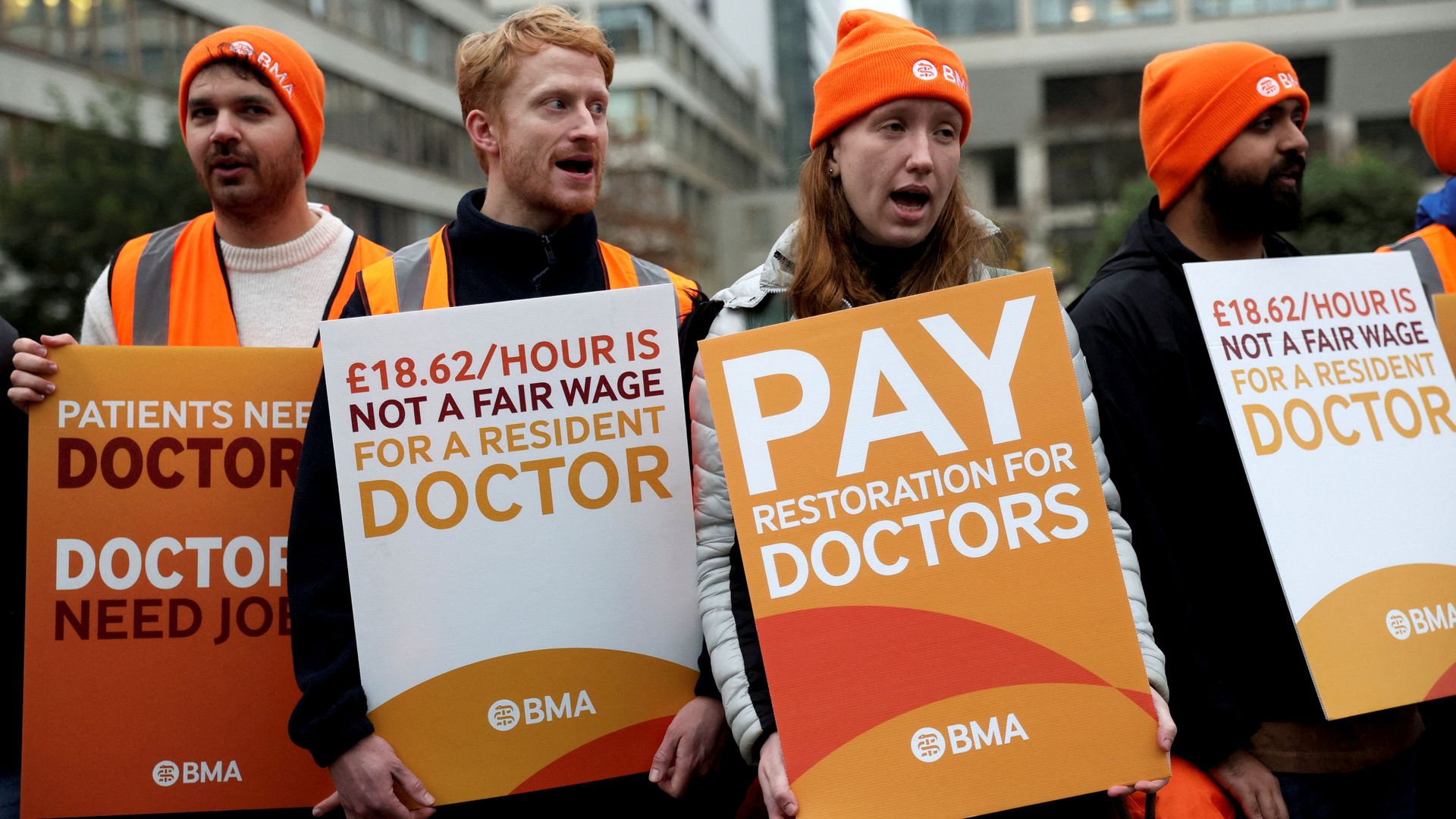
The current cycle of NHS industrial action is not a transient labor dispute but the inevitable output of an over-leveraged monopsony employer meeting a diminishing return on human capital. To understand why junior doctors—now termed resident doctors—are striking, one must look past the emotive headlines and analyze the three structural deficits driving the friction: the cumulative erosion of real-terms value, the failure of the Review Body on Doctors' and Dentists' Remuneration (DDRB) as an independent arbiter, and the escalating opportunity cost of medical practice in the United Kingdom.
The Mechanics of Real-Terms Degradation
The primary driver of the dispute is "pay restoration," a term that distinguishes itself from a standard "pay rise." While a rise implies an increase in purchasing power, restoration addresses a decade-long slide in the relative value of medical labor. Between 2008 and 2023, the real-terms pay for resident doctors fell by approximately 26%. This is not an accident of inflation but the result of specific fiscal policy choices.
The cost function of medical training in the UK operates on a high-debt, high-specialization model. As tuition fees increased and student loan interest rates were pegged to RPI plus a premium, the starting "break-even" point for a doctor shifted later into their career. When base pay is frozen or capped at 1% or 2% while inflation runs at 10%, the internal rate of return (IRR) on a medical degree enters a terminal decline.
This creates a Retention Leakage, where the cost of training a doctor—estimated at roughly £230,000 to £300,000 including clinical placements—is lost to the state when that individual migrates to the private sector or foreign healthcare systems (Australia, Canada, Ireland) where the pay-to-cost-of-living ratio is superior.
The Breakdown of the DDRB Mechanism
Industrial peace in the NHS historically relied on the DDRB. This body was designed to act as a pressure valve, recommending pay awards that balanced government affordability with the need to recruit and retain staff. However, the mechanism has suffered from Institutional Capture.
- Restricted Remits: The government frequently issues "remit letters" to the DDRB that set pre-determined affordability ceilings. This renders the "independent" analysis secondary to Treasury targets.
- Delayed Implementation: Recommendations are often published and implemented months into the financial year, forcing retrospective payments and undermining the psychological impact of the award.
- Loss of Trust: When the government ignores recommendations or implements them selectively (e.g., excluding certain grades), the workforce views the negotiation process as a theater rather than a functional labor market tool.
The failure of the DDRB forced the British Medical Association (BMA) to shift from a consultative posture to a confrontational one. The strike is the only remaining lever to re-establish the market value of labor in a system where the government is the sole significant buyer (monopsony).
The Workforce Substitution Trap
The Department of Health and Social Care (DHSC) has attempted to mitigate physician shortages through the introduction of Medical Associate Professions (MAPs), such as Physician Associates (PAs). From a management perspective, this is an attempt at Task Shifting—moving high-cost labor tasks to lower-cost, shorter-trained staff.
While this looks efficient on a spreadsheet, it creates two distinct negative feedback loops:
- Supervisory Load: Doctors are required to sign off on prescriptions and scans for MAPs, increasing their legal liability without a corresponding increase in pay or time.
- Training Dilution: In a finite clinical environment, every procedure or consultation performed by an associate is one fewer opportunity for a resident doctor to gain the competency required for consultancy.
This substitution creates a "bottleneck of expertise." By suppressing doctor pay while expanding associate roles, the system incentivizes the very people it needs to lead the service to exit the training pathway.
The Cumulative Cost of Strike Action
Measuring the impact of strikes solely by "cancelled appointments" is a superficial metric. The true cost is a composite of three variables:
- Direct Financial Outlay: The NHS spends significantly more on "locum cover" during strike days than it would cost to settle the pay dispute. Senior consultants are often paid premium rates to cover resident shifts, creating a perverse fiscal outcome where the government pays more for a reduced service.
- Elective Backlog Expansion: The NHS Long Term Plan relies on hitting elective recovery targets. Each strike day resets the clock on these targets, compounding the waiting list and increasing the eventual cost of clearing it through private sector outsourcing.
- Morale Decay: The "disengagement coefficient" grows with every failed negotiation. Doctors who feel undervalued perform the minimum required (quiet quitting) or actively seek exit routes, further increasing the burden on those remaining.
Strategic Divergence: The BMA vs. The Treasury
The stalemate exists because the two parties are using different accounting logic. The BMA is focused on Labor Value, arguing that a doctor's time is a commodity that has been undervalued for fifteen years. The Treasury is focused on Macroeconomic Precedent, fearing that meeting a 35% pay restoration demand will trigger similar demands across the entire public sector, fueling a wage-price spiral.
However, this "contagion" argument ignores the specificity of the medical labor market. Unlike many public sector roles, doctors have high international mobility and a high barrier to entry. Treating medical pay as a generic public sector cost failing to recognize it as a strategic infrastructure investment.
The Critical Path to Resolution
A sustainable resolution requires a move away from "one-off" percentage offers and toward a structural multi-year framework.
- Indexation: Linking future pay to a fixed metric (such as RPI or average earnings growth) to prevent further real-terms erosion.
- Reform of the DDRB: Granting the body true independence, similar to the Judiciary or the Low Pay Commission, where recommendations are binding unless overturned by a vote in Parliament.
- Retention Credits: Implementing a "stay-and-earn" model where student loan interest is subsidized or principal is forgiven in exchange for years of NHS service. This addresses the net-wealth deficit of junior doctors without purely relying on base salary increases.
The government’s current strategy of attrition—waiting for doctors to run out of strike funds or for public opinion to turn—is structurally flawed. It assumes the workforce is static. It is not. Every month the dispute continues, the "drain" of talent to the private sector and overseas accelerates. The cost of settling the dispute is high, but the cost of maintaining a collapsing monopsony is higher.
The final strategic move for the DHSC is to decouple "Pay Restoration" from "Pay Rise." By acknowledging the unique inflationary hit doctors took during the 2010s austerity period, the government can frame a settlement as a "correction" rather than a "concession," allowing for a face-saving exit that stabilizes the workforce. Failure to do so will result in a permanent shift toward a "Gig Economy" healthcare model, where the NHS relies on hyper-expensive locum agencies to fill the gaps left by a vanished permanent workforce.