The Artemis II mission represents the transition from theoretical deep-space capability to operational human lunar transit, moving beyond the low Earth orbit (LEO) constraints that have defined crewed spaceflight since 1972. While public discourse focuses on the emotional weight of "returning" to the Moon, the engineering reality is a high-stakes validation of the Orion Multi-Purpose Crew Vehicle (MPCV) and the Space Launch System (SLS) under extreme thermal and radiative stress. This mission is not a repeat of Apollo; it is a stress test of a modern, digital-first architecture designed for multi-decadal sustainability.
The success of Artemis II hinges on three critical systemic pillars: environmental life support stability, high-velocity atmospheric reentry thermodynamics, and the psychological endurance of a four-person crew in a pressurized volume of approximately 9 cubic meters.
The Architecture of Lunar Velocity and Trajectory Logic
Unlike the Apollo missions, which utilized a direct Lunar Orbit Insertion (LOI), Artemis II employs a High Earth Orbit (HEO) profile. This serves as a deliberate safety buffer. After an initial launch into LEO, the SLS interim cryogenic propulsion stage (ICPS) will raise the high point of the orbit—the apogee—to approximately 74,000 kilometers.
This 24-hour elliptical orbit allows the crew to verify that the Environmental Control and Life Support System (ECLSS) is functioning perfectly before the final Trans-Lunar Injection (TLI) burn. If a CO2 scrubber fails or a leak is detected during these first 24 hours, the crew can return to Earth far more easily than if they were already on a trajectory toward the Moon.
The physics of this trajectory creates a unique "free-return" loop. The spacecraft will use the Moon's gravity to whip around the far side—reaching a distance of roughly 10,300 kilometers beyond the lunar surface—and naturally head back toward Earth. This trajectory is a passive safety mechanism. Once the TLI burn is executed, the laws of orbital mechanics dictate the return path, minimizing the fuel required for course corrections.
Quantifying the Radiation and Thermal Constraints
Spacecraft operating beyond the protection of the Van Allen belts face a hostile radiative environment. Artemis II will be the first time modern microelectronics and human biology are exposed to deep-space galactic cosmic rays (GCRs) and potential solar particle events (SPEs) for an extended duration since the early 1970s.
The Shielding Paradox
Orion uses a combination of mass shielding and localized protection. The spacecraft's hydrogen-rich materials, such as the water supplies and plastic shielding, are more effective at stopping high-energy particles than heavy metals, which can actually produce secondary radiation (spallation) when struck by cosmic rays.
- The Radiation Shelter: In the event of a solar flare, the crew is trained to create a temporary shelter in the center of the cabin using stowage bags and water containers.
- Electronic Hardening: The onboard flight computers must manage "single-event upsets"—bit flips caused by ionizing radiation—without crashing the system. Redundancy here is triple-layered, with voting logic to ensure that if one computer provides an outlier data point, it is ignored by the other two.
Reentry Thermodynamics
The most significant technical hurdle is the return. Orion will hit the Earth's atmosphere at speeds exceeding 40,000 kilometers per hour. This is 30% faster than a return from the International Space Station (ISS).
The thermal protection system (TPS), composed of an Avcoat ablative heat shield, must withstand temperatures of nearly 2,760°C. The energy dissipation required is exponential, not linear, relative to velocity. The mission validates whether the updated heat shield design, which saw some unexpected charring during the uncrewed Artemis I flight, has been sufficiently refined to protect a human crew.
The ECLSS Bottleneck: Life Support in Deep Space
The ISS relies on constant resupply and massive, power-hungry systems to recycle air and water. Artemis II must be self-contained. The ECLSS on Orion is a masterpiece of miniaturization, but it introduces specific failure modes that do not exist in LEO.
- Nitrogen/Oxygen Mix: Maintaining a sea-level atmospheric pressure (101.3 kPa) is essential for cognitive function, but any leak in a small volume results in a rapid pressure drop.
- CO2 Scrubbing: The Amine Swing-bed system removes carbon dioxide and humidity. Unlike chemical canisters used in early missions, this system regenerates by venting to the vacuum of space. The mechanical cycling of these valves represents a single point of failure; if the valves seize, the cabin air becomes toxic within hours.
- Water Management: On a 10-day mission, weight is the enemy. Every liter of water must be accounted for. Unlike the ISS, there is no massive urine processing assembly. The crew relies on stored water and the metabolic water produced by the fuel cells, creating a delicate mass-balance equation.
Human Factors and Volumetric Constraints
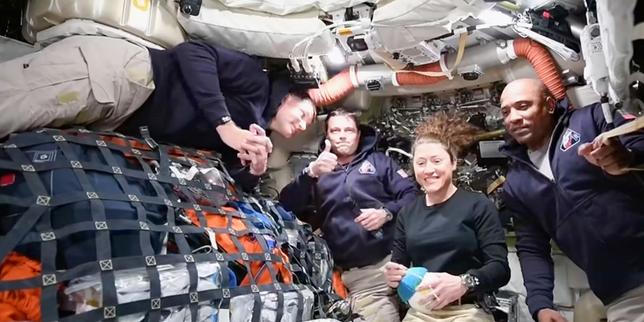
The psychological reality of Artemis II is defined by "The Overview Effect" met with extreme physical confinement. While the Apollo Command Module offered about 6 cubic meters of space for three people, Orion provides roughly 9 cubic meters for four.
The internal layout is optimized for "zoning." Even in a tiny capsule, the crew must distinguish between work, sleep, and hygiene areas to maintain mental health. The presence of the first woman and the first person of color on a lunar mission adds a layer of global visibility, but the operational focus remains on the "man-machine interface." The crew must operate glass cockpit displays while wearing pressurized suits during high-G maneuvers, a task that requires muscle memory and significant haptic feedback integration.
The Economic and Strategic Utility of Artemis II
From a consultancy perspective, Artemis II is the "Minimum Viable Product" (MVP) for deep-space human presence. It validates the supply chain and the launch cadence. The SLS, despite its high per-launch cost (estimated at $2 billion), remains the only operational vehicle capable of sending the Orion, its crew, and necessary supplies to the Moon in a single shot.
This mission settles several strategic questions:
- Lunar Gateway Feasibility: If Orion cannot maintain stable life support for 10 days, the planned orbiting station (Gateway) becomes an untenable asset.
- Commercial Integration: The success of the NASA-led Artemis II mission sets the safety standards for future commercial landers, such as the SpaceX Starship HLS. NASA is effectively de-risking the environment for the private sector.
The mission's true value is not the "firsts" it achieves in terms of identity, but the "firsts" it achieves in deep-space systems integration. We are moving from the era of "flags and footprints" to the era of "infrastructure and industry."
Strategic Recommendation for Mission Evolution
The transition from Artemis II to Artemis III (the actual landing) requires an immediate pivot in data acquisition. The sensors on the Artemis II crew suits and the interior cabin must prioritize high-fidelity radiation mapping over the lunar far side. This data will be the most valuable commodity for the next decade of spaceflight.
NASA should utilize the high-bandwidth optical communications (laser-based) tested on this flight to stream real-time telemetry not just to Mission Control, but to a distributed network of international research institutions. By democratizing the raw environmental data, NASA can accelerate the development of shielding technologies by third-party contractors, shortening the development cycle for the Mars-class transit vehicles that will follow.
The mission should be viewed as a 10-day stress test of a closed-loop system. The primary objective is not the Moon itself, but the verification of the "Heat Shield-ECLSS-Avionics" triad. Failure in any single node of this triad terminates the program’s momentum. Therefore, the operational directive must be a "conservative-aggressive" posture: aggressive in testing the limits of the communications array, but conservative in the trajectory correction burns. The margin for error in deep space is zero; the margin for learning is infinite.