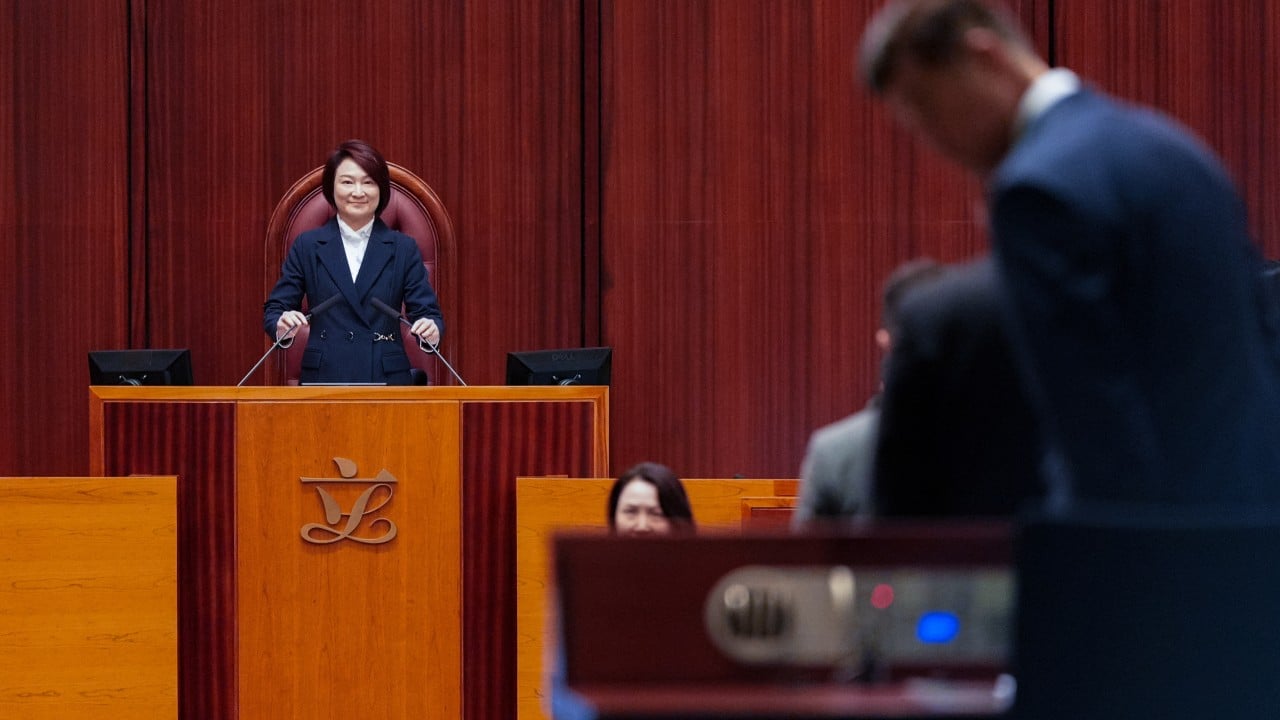
The transition of the Hong Kong Legislative Council (LegCo) from a site of procedural friction to a mechanism for rapid policy execution requires more than political alignment; it demands a fundamental re-engineering of oversight architecture. While traditional parliamentary models emphasize the "check and balance" function through adversarial debate, the emerging governance model in Hong Kong prioritizes "executive-led" synchronization. This shift mirrors the Mainland Chinese system of supervisory logic, where oversight is not a barrier to implementation but a diagnostic tool to ensure departmental compliance with central strategic objectives.
The Architecture of Synchronized Governance
The efficiency of a legislative body is inversely proportional to the friction between policy conception and statutory enactment. In the previous era of LegCo, the "friction coefficient" was high due to filibustering and the weaponization of quorum calls. The current restructuring aims to lower this coefficient by adopting a "Supervisory-Feedback Loop."
In this model, the legislature functions as a high-fidelity sensor for the executive branch. Rather than simply voting on pre-packaged bills, the committee stage is reimagined as a technical audit. This reflects the "Mainland-style" oversight where the National People’s Congress (NPC) and its Standing Committee utilize specific investigative powers to identify bottlenecks in local administration. To achieve this in Hong Kong, LegCo must move toward a Three-Pillar Oversight Framework:
- KPI-Based Scrutiny: Transitioning from qualitative debate to quantitative assessment. Each government bureau’s funding should be tethered to measurable milestones defined during the budget cycle.
- Specialized Technical Subcommittees: Mirroring the NPC’s specialized committees, these bodies focus on domain-specific expertise (e.g., semiconductor supply chains, land reclamation physics) rather than political posturing.
- Direct Accountability Links: Establishing a formal mechanism where legislative queries trigger mandatory administrative internal audits, ensuring that legislative oversight has "teeth" within the civil service hierarchy.
Quantifying the Legislative Throughput
To understand the impact of this oversight shift, one must analyze the "Legislative Lead Time"—the duration between a policy’s first reading and its final gazettal. Under an adversarial model, lead times are unpredictable, often stretching across multiple legislative sessions. Under a synchronized model, the objective is to standardize these durations through "Concurrent Processing."
Instead of sequential review, where the public, then the legislature, then the executive react to one another, Concurrent Processing allows for:
- Pre-consultation Alignment: Key legislative stakeholders are briefed during the drafting phase to resolve technical conflicts before the bill reaches the floor.
- Resource Allocation Audits: Ensuring that the manpower required for a new regulation exists before the regulation is passed, preventing "hollow legislation."
The cost of a dysfunctional legislature is not just wasted time; it is the "Opportunity Cost of Inertia." For every month a housing policy is delayed by procedural hurdles, the economic drag on the territory scales non-linearly. By adopting a supervisory system that identifies these delays in real-time, the government shifts from reactive damage control to proactive system optimization.
The Logic of the Mainland Oversight Model
The Mainland’s approach to oversight is frequently misunderstood as mere rubber-stamping. In reality, it functions as a "Continuous Improvement" (Kaizen) system for the state. The NPC’s oversight involves "Enforcement Inspections," where legislators travel to specific regions to verify if laws are being implemented as intended.
If LegCo adopts a similar "Field Audit" approach, members would move beyond the legislative chamber to verify the progress of the Northern Metropolis or the integration of the Greater Bay Area (GBA). This creates a direct feedback path:
- Observation: A legislative subcommittee identifies a lag in cross-border data flow regulations.
- Inquiry: Formal questions are posed to the Innovation, Technology and Industry Bureau.
- Correction: The Bureau is required to submit a remediation plan with a 90-day expiry.
This cycle removes the "black box" of administrative implementation. It ensures that the executive branch remains accountable not just for the intent of the law, but for the outcome of the law.
Technological Integration in Modern Oversight
The complexity of modern governance—encompassing digital currencies, AI ethics, and carbon neutrality—exceeds the cognitive load capacity of traditional legislative debate. To bridge this gap, LegCo must integrate "Regulatory Technology" (RegTech) into its oversight toolkit.
A centralized "GBA Policy Dashboard" would allow legislators to track real-time metrics on economic integration, infrastructure spending, and social welfare distribution. This data-driven approach eliminates the "Asymmetry of Information" that typically exists between the executive branch (which holds the data) and the legislature (which asks for it). When both parties operate from a "Single Source of Truth," the debate shifts from the validity of the facts to the strategy of the implementation.
The Human Capital Constraint
A structural shift toward Mainland-style oversight requires a concomitant shift in the "Competency Profile" of the legislators. The role evolves from a "Political Representative" to a "Governance Auditor." This necessitates:
- Domain Mastery: Legislators must possess or have immediate access to deep technical knowledge in fields like urban planning, finance, or law.
- Systemic Thinking: The ability to understand how a change in one regulation (e.g., environmental standards) impacts another (e.g., construction costs in the public housing sector).
- Operational Literacy: Understanding the internal workings of the civil service to identify where "Bureaucratic Silt" is slowing down policy delivery.
The bottleneck to this transition is the "Legacy Mindset." If legislators continue to view their role as purely reactive, the new oversight mechanisms will remain underutilized. The system requires "Proactive Surveillance" of policy trends to anticipate issues before they manifest as public crises.
Risks and Mitigation in Unitary Oversight
Every system has failure modes. The primary risk in a highly synchronized legislative-executive model is the "Echo Chamber Effect," where the lack of dissenting friction leads to the unchecked propagation of errors. To mitigate this, the oversight system must include "Red Teaming" protocols.
Internal "Challenge Cells" within the LegCo committees should be tasked with finding the flaws in proposed executive plans. This is not for the purpose of political obstruction, but for "Stress Testing" the policy. If a bill cannot survive a rigorous internal audit, it will not survive the complexities of the global market or social reality.
Furthermore, the "Mainlandization" of oversight must be calibrated to Hong Kong’s Common Law framework. The synthesis of these two systems—the NPC’s supervisory vigor and Hong Kong’s judicial precision—creates a unique "Hybrid Governance" model. This model is more resilient than a pure parliamentary system because it combines the speed of an executive-led state with the transparency of a rule-of-law society.
Strategic Execution Plan
The transformation of LegCo into a high-performance oversight body requires a phased implementation:
- Immediate Realignment: Establish a "Joint Committee on Strategic Milestones" to map all current legislative agendas against the 14th Five-Year Plan and the Chief Executive’s Policy Address.
- Structural Reform: Amend the Rules of Procedure to prioritize "Audit-Style Hearings" over general debate, focusing on the deployment of resources and the achievement of specific KPIs.
- Data Transparency: Launch a public-facing performance portal that tracks the progress of every bill and the subsequent administrative implementation, creating a "Visibility Loop" that holds both legislators and bureaucrats accountable.
The final strategic move is the institutionalization of the "Post-Legislative Review." Six months after any major bill is passed, the relevant committee must reconvene to assess whether the promised benefits have materialized. If the data shows a shortfall, the oversight system triggers a mandatory policy recalibration. This ensures that the legislative process is not a terminal event, but a continuous cycle of optimization that guarantees Hong Kong’s competitive edge in the regional economy.