The convergence of the Julian and Gregorian calendars during a high-intensity kinetic conflict transforms the religious geography of Jerusalem from a global pilgrimage hub into a restricted security zone. This transition is not merely a reduction in foot traffic; it represents a fundamental breakdown in the socio-economic and diplomatic architecture that sustains the Old City. When war disrupts the Easter cycle in Jerusalem, the impact radiates through three distinct vectors: the suspension of the "Status Quo" logistical agreements, the collapse of the sectarian economic ecosystem, and the erosion of soft-power diplomatic channels maintained by the patriarchates.
The Triad of Disruption Logic
The viability of Easter celebrations in Jerusalem depends on a precarious equilibrium between the Israeli security apparatus, the various Christian denominations (Greek Orthodox, Armenian, Latin), and the Palestinian merchant class. The current conflict has introduced a series of stressors that have fractured this equilibrium.
1. Kinetic Friction and the Logistics of Faith
During periods of stability, the "Holy Fire" ceremony and the Palm Sunday processions function through a complex series of pre-negotiated permits and crowd-control measures. War shifts the operational priority of the state from facilitation to containment. This shift manifests in:
- Permit Atrophy: The systematic denial of entry permits for Palestinian Christians from the West Bank and Gaza. This removes the demographic "core" of the local congregation, leaving ceremonies populated only by the clergy and a handful of foreign residents.
- Security Enclosure Expansion: The physical perimeter around the Holy Sepulchre expands, creating a "grey zone" where even residents of the Christian Quarter find their movement restricted. This is a function of heightened threat assessments that prioritize the prevention of civil unrest over the freedom of religious assembly.
- The Checkpoint Bottleneck: Access points like the Jaffa Gate and Damascus Gate transition from transit hubs to screening filters, introducing a high-latency variable into the timing of ancient liturgical rites.
2. Economic Evaporation and the Fixed-Cost Trap
The Old City’s Christian Quarter operates on a high-intensity seasonal revenue model. Easter represents the peak of the fiscal year, providing the liquidity necessary to sustain operations during the low-occupancy summer and winter months. The current conflict has triggered an "Economic Vacuum State" characterized by:
- The Absence of High-Yield Pilgrimage: Unlike casual tourists, religious pilgrims often travel in large groups with pre-paid, high-margin itineraries. The mass cancellation of these groups has resulted in a 90% to 95% revenue drop for hospitality providers within the walls.
- Supply Chain Inversion: Merchants who stocked specific religious artifacts, specialized foodstuffs, and liturgical supplies months in advance are now burdened with inventory that has zero local utility and a shelf-life that may not survive until the next cycle.
- Labor Displacement: The workforce supporting the Easter economy is largely comprised of residents from East Jerusalem and the surrounding peripheries. Without the influx of foreign capital, these workers face immediate insolvency, further destabilizing the local social fabric.
3. Diplomatic Attrition and Soft Power Decay
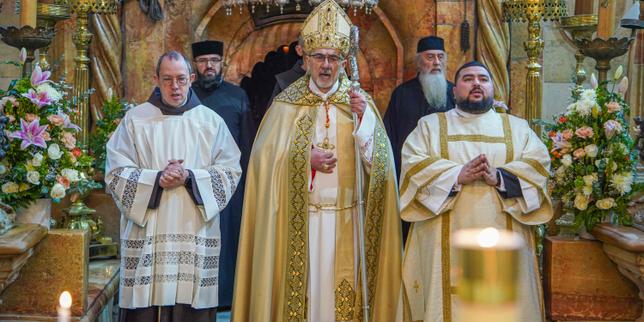
Jerusalem’s patriarchates serve as quasi-diplomatic entities, representing millions of adherents globally. The disruption of Easter reduces their ability to project influence. When the Greek Orthodox Patriarch or the Latin Patriarch cannot host international dignitaries or lead full processions, it signals a weakening of their institutional "presence" in the city. This creates a power vacuum that state actors often attempt to fill with increased administrative oversight.
The Mechanism of Security Overreach
The escalation of security measures during wartime is often framed as a necessity, yet it functions as a permanent shift in the administrative "Status Quo"—the 19th-century agreement governing the shared use of holy sites. Security protocols introduced under the guise of temporary safety frequently become the new baseline for future years.
The Barrier Elasticity Theory suggests that once a security perimeter is established and maintained for a duration (such as a multi-month war), the psychological and bureaucratic cost of retracting that barrier increases. For the Christian communities of Jerusalem, this means that the "war-time" restrictions of today are the likely "pre-conditions" for the celebrations of 2027 and beyond. The physical barriers are not just steel and concrete; they are the tangible expression of a policy that prioritizes demographic control over religious pluralism.
Sectoral Vulnerability Assessment
The impact of the war on Easter is not uniform across all sectors of the Jerusalem economy. A stratified analysis reveals who bears the brunt of the volatility.
- Hospitality (Acute Failure): Guesthouses and hotels located within the Old City (such as the Casa Nova or the Knight’s Palace) have fixed overheads but zero occupancy. Unlike modern hotels in West Jerusalem, these institutions often lack the diversified revenue streams needed to weather a prolonged downturn.
- Small-Scale Retail (Slow Erosion): The olive wood carvers and icon painters of the Christian Quarter rely on physical presence. While some have attempted to pivot to e-commerce, the lack of a standardized shipping infrastructure from the Old City makes this transition inefficient.
- The Clerical Class (Institutional Isolation): The leadership of the churches finds itself increasingly isolated. Their traditional role as mediators between the local population and the state is neutralized when the state enters a total security footing.
Strategic Realignment of the Jerusalem Pilgrimage Model
To survive the current and future periods of kinetic instability, the stakeholders within the Jerusalem Easter ecosystem must transition from a "Passive-Seasonal" model to a "Resilient-Structural" model. The reliance on mass-market pilgrimage is a systemic vulnerability that can no longer be ignored.
The first move is the decoupling of religious identity from physical presence. The patriarchates must leverage digital liturgical broadcasting not as a temporary fix, but as a permanent secondary revenue and engagement stream. This allows the global diaspora to maintain a financial and emotional connection to the Holy Sepulchre regardless of the security situation on the ground.
The second move involves the "Localisation of the Supply Chain." The Christian Quarter must reduce its dependence on imported religious goods and instead focus on a hyper-local economy that can be sustained by the resident population and domestic visitors during times of international travel bans.
The final strategic play is the internationalization of the "Status Quo" legal defense. The heads of churches must move beyond local petitions and engage in high-level diplomatic pressure at the UN and EU levels to ensure that "security measures" are subjected to independent audits. Without external oversight, the unique character of the Jerusalem Easter will continue to be eroded by the creeping annexation of sacred space into the security apparatus of the state. The future of the Easter celebration depends on the ability of these ancient institutions to modernize their diplomatic and economic defenses while maintaining the archaic rituals that provide their legitimacy.