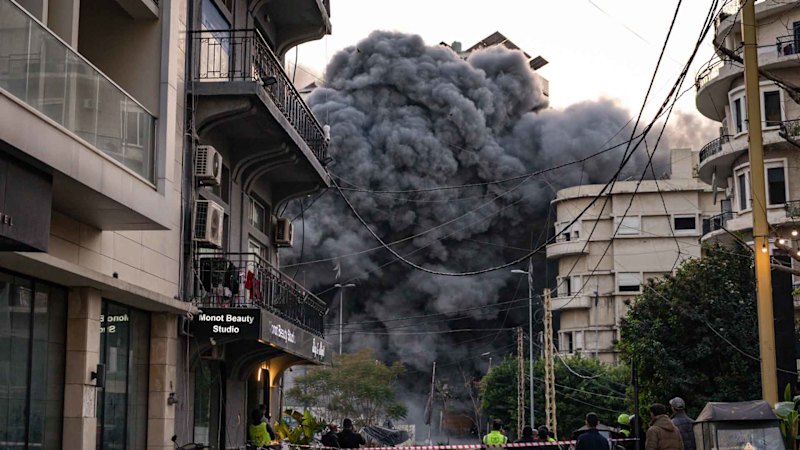
The Lebanese healthcare system currently operates in a state of terminal friction where the velocity of incoming trauma exceeds the systemic capacity for resource replenishment. This is not merely a crisis of "grim work" conditions; it is a mathematical certainty of failure when a nation’s primary tertiary care infrastructure is forced to absorb the externalities of high-kinetic conflict while tethered to a hyper-inflated, dollarized supply chain. The burden of this systemic imbalance falls exclusively on the clinical workforce, who must now navigate a tri-fold deficit: depleted human capital, fractured logistics, and the psychological erosion of the "caregiver-victim" duality.
The Triad of Systemic Exhaustion
The operational viability of any hospital during a mass-casualty event depends on the stability of three specific pillars. In Lebanon, all three have been compromised simultaneously, creating a feedback loop of diminishing returns.
1. The Human Capital Deficit
The migration of skilled medical professionals—often termed the "brain drain"—has transitioned from a steady leak to a structural hemorrhage. This creates a Dependency Ratio Imbalance. As senior consultants and specialized trauma nurses depart, the remaining staff are forced to manage higher acuity patients with fewer mid-level supports.
- Skill Compression: General practitioners are performing roles previously reserved for specialists.
- Cognitive Load: The decision-making cycle time for triage is compressed, increasing the statistical probability of diagnostic error.
- Duration Fatigue: Shift lengths have decoupled from biological recovery needs, leading to a state of chronic sympathetic nervous system activation among staff.
2. The Resource Liquidity Gap
Lebanese hospitals operate on a "Just-In-Time" inventory model that was designed for a stable Mediterranean economy, not a wartime siege.
- Currency Decoupling: While hospital revenues are often tied to devalued local credit or delayed government reimbursements, medical consumables (anesthetics, orthopedic implants, sterile gauze) are priced in hard currency.
- Stockpiling Failure: The inability to maintain a 90-day buffer of essential surgical supplies means that a single week of high-intensity conflict can deplete a facility's entire operational reserve.
- Power Autonomy Costs: The failure of the national grid forces hospitals to rely on private diesel generators. The cost of fuel effectively acts as a "tax" on every life saved, diverting funds from staff salaries to mechanical maintenance.
3. The Geographic Concentration Risk
The centralization of advanced trauma centers in Beirut and a few major hubs creates a logistical bottleneck. When conflict zones are remote or transportation infrastructure is targeted, the "Golden Hour"—the critical window for trauma intervention—is effectively eliminated. This forces decentralized, under-equipped rural clinics to attempt complex stabilizations for which they lack the requisite hardware.
The Mechanics of Moral Injury
Standard "burnout" frameworks are insufficient to describe the current state of Lebanese hospital workers. What is occurring is Moral Injury: the psychological distress resulting from actions, or the lack thereof, which transgress deeply held moral beliefs and expectations.
In a functional system, a doctor's primary constraint is the limit of medical science. In the current Lebanese context, the constraint is the inventory. When a clinician must choose which patient receives the last vial of an anesthetic or the last functional ventilator based on supply rather than survivability, the psychological contract of the profession breaks.
This is compounded by the Socio-Economic Inversion. Hospital workers, many of whom have seen their life savings evaporated by the banking crisis, are treating patients while wondering if they can afford the transport to their next shift. The caregiver is often as economically precarious as the patient they are treating, removing the professional "buffer" that typically protects medical staff from vicarious trauma.
Logistical Cascades and Trauma Throughput
To quantify the strain on Lebanese hospitals, one must look at the Trauma Throughput Equation. The efficiency of a hospital is not measured by its bed count, but by its "clearance rate"—how fast it can move a patient from the ER to Surgery to ICU to a Step-down unit.
The current bottleneck exists in the Post-Acute Phase.
- Surgical Backlog: Non-trauma surgeries (oncology, cardiac, elective) are indefinitely postponed to keep theaters open for blast injuries. This creates a "hidden mortality rate" where patients with chronic conditions die from preventable complications because the system has been monocultured for trauma.
- Discharge Stasis: Patients who are medically fit for discharge often have no homes to return to or no local pharmacies capable of providing follow-up medication. This leads to "bed blocking," where acute care beds are occupied by recovering patients, preventing the intake of new, critical arrivals.
- Sterilization Latency: The sheer volume of patients reduces the time available for deep-cleaning surgical suites. This increases the risk of nosocomial (hospital-acquired) infections, specifically multi-drug resistant organisms, which thrive in overcrowded, resource-strained environments.
The Economic Architecture of Medical Survival
The survival of these institutions currently rests on a precarious mix of international aid and aggressive internal cost-cutting. However, aid is often "earmarked," meaning a hospital might have an abundance of one specific antibiotic provided by an NGO but zero fuel to run the lights in the operating room.
The Internal Subsidy Model
Many Lebanese hospitals have survived by "subsidizing" the poor through the high fees charged to the dwindling number of wealthy or insured patients. As the middle class disappears, this internal redistribution model collapses. The result is a tiered system where "grim work" is a euphemism for the daily negotiation of who lives based on the availability of external funding.
Operational Redundancy and the "Shadow" Workforce
One overlooked aspect of the Lebanese response is the emergence of an informal medical layer. This includes medical students, retired nurses, and volunteers who fill the gaps left by the professional exodus. While this provides raw labor, it introduces a Standardization Risk.
Medical protocols are only as effective as their consistent application. In a high-stress environment with a fluctuating, semi-professionalized workforce, the risk of "protocol drift" is high. This is where local "workarounds" become the standard, often at the expense of long-term patient outcomes or staff safety (e.g., reusing single-use PPE or extending the life of chemical reagents beyond their expiration).
Strategic Requirements for Systemic Preservation
The path forward for Lebanese healthcare is not found in "resilience"—a term that has been exhausted to the point of irrelevance—but in Radical Decentralization and Supply Chain Autonomy.
Immediate Tactical Pivot: The "Cell" Model
Hospitals must transition from large, centralized departments to autonomous surgical "cells." Each cell must be equipped with its own dedicated power backup and 72-hour supply kit. This mitigates the risk of a single utility failure or administrative bottleneck paralyzing the entire facility.
Strategic Inventory Sovereignty
The dependence on international shipping for basic medical consumables is a strategic liability. There must be an investment in "low-tech" local production of saline, medical-grade oxygen, and basic wound care supplies. The goal is to reduce the "Import-to-Intervention" ratio.
The Retention Paradigm Shift
To stop the flight of medical personnel, the compensation model must be decoupled from the Lebanese Pound entirely. This requires international donors to pivot from sending "kits" to providing direct, hard-currency salary supplements. Without the stabilization of the human element, the most advanced field hospital is merely a collection of expensive tents.
The Lebanese healthcare worker is currently the only bridge between a degraded state infrastructure and a total public health catastrophe. This bridge is showing signs of structural fatigue. If the international community and local governing bodies continue to treat this as a temporary "emergency" rather than a permanent structural shift in medical delivery, the collapse will move from the peripheral to the core. The objective is no longer to return to the pre-crisis "norm," but to engineer a high-efficiency, low-resource trauma network that can survive in a state of permanent volatility.


