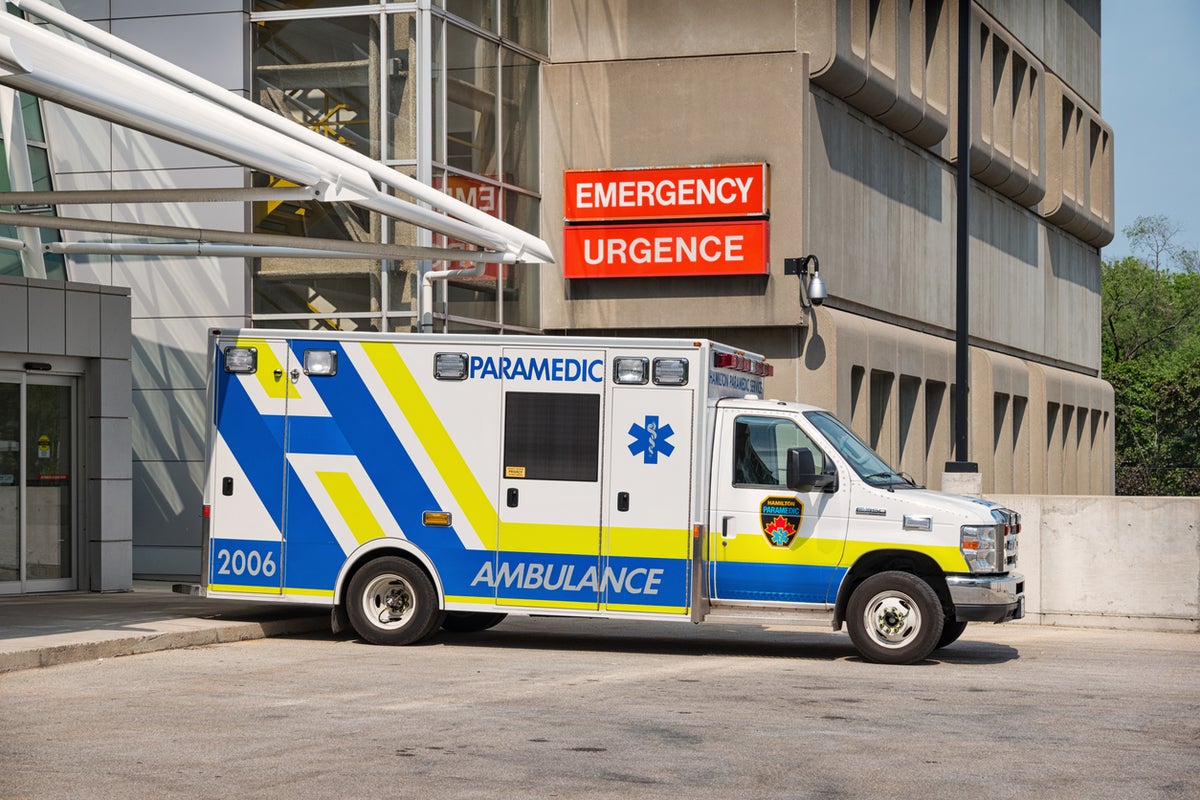
The Canadian emergency department has transitioned from a point of acute care to a warehouse for systemic failure. When patients wait 20 hours for a physician assessment or expire in waiting room chairs, the failure is not a localized lapse in clinical judgment; it is a mathematical certainty born of three intersecting bottlenecks: acute bed block, labor attrition, and the dissolution of the primary care safety net. To treat these "wait times" as a standalone metric is to ignore the underlying cost function of a healthcare system that has prioritized administrative stability over throughput efficiency.
The Triad of Systemic Stagnation
The crisis is defined by a feedback loop where inputs (patient arrivals) exceed the system’s processing capacity, but more critically, where the "exit" of the system is obstructed. This creates a state of internal pressure that manifests as the headlines we see today.
1. The Exit Blockade
The primary driver of ER overcrowding is not "too many patients" in the waiting room, but "no beds" on the wards. When an emergency physician determines a patient requires admission, that patient remains in an ER stretcher until an inpatient bed becomes available. This is known as Access Block.
- Resource Displacement: Every admitted patient "boarding" in the ER occupies a physical space and a nursing ratio that should be dedicated to the next incoming acute case.
- The Downward Spiral: As more ER stretchers are occupied by admitted patients, the department’s functional capacity drops. A 30-bed ER with 25 "boarders" is effectively a 5-bed ER.
- ALC (Alternate Level of Care) Saturation: Inpatient beds are frequently occupied by elderly or complex patients who no longer require acute care but cannot be discharged because long-term care or home-care supports are unavailable. This effectively turns acute care hospitals into expensive, high-acuity nursing homes.
2. The Primary Care Deficit
The ER is the only part of the Canadian healthcare system that cannot say "no." As family physician shortages grow, the ER absorbs the "overflow" of non-acute maintenance.
- Screening vs. Treatment: Patients with chronic conditions (diabetes, hypertension) utilize ER resources for routine management because they lack a primary provider. While these cases are often low-acuity, they consume the triage and registration bandwidth, slowing the "front door" of the system.
- Loss of Preventative Buffers: Without primary care, manageable conditions escalate into acute crises. A missed prescription for a diuretic in a primary care setting becomes a high-stakes congestive heart failure presentation in the ER three weeks later.
3. The Nursing Labor Chasm
The staffing shortage is not merely a headcount issue; it is a loss of institutional memory and specialized skill.
- The Experience Drain: Senior nurses, faced with moral injury and unsafe patient-to-staff ratios, are exiting for private agency work or early retirement.
- The Juniorization Paradox: Hospitals are backfilling roles with new graduates or agency staff who lack the "triage intuition" required to manage high-volume surges. This increases the time spent on each patient encounter, further slowing the throughput.
Quantifying the Human Cost of Latency
The correlation between wait times and mortality is non-linear. Data suggests that once an ER exceeds 100% capacity, the risk of adverse events increases by 30% or more. This is not due to a lack of effort by clinicians, but the physical impossibility of monitoring a patient in a hallway or a waiting room chair with the same rigor as one in a monitored bay.
The Mechanics of "Waiting Room Deaths"
When a patient dies in a waiting room, it is a failure of Triage Sensitivity. Triage is designed to sort, not to treat. In a functional system, a patient is triaged and moved to a treatment area within 30 minutes. In the current 20-hour wait model, the "triage status" of a patient is a snapshot of their health at 8:00 PM, which may no longer be accurate at 3:00 AM.
- Dynamic Decomposition: Patients with sepsis or internal hemorrhaging can appear stable (Level 3 on the Canadian Triage and Acuity Scale) but can decompose rapidly. Without continuous monitoring—which is impossible in a packed waiting room—these patients slip through the cracks of the initial assessment.
- The Noise Floor: When 100 people are in a waiting room, the "signal" of a deteriorating patient is lost in the "noise" of general distress.
Operational Efficiency vs. Safety Margins
Canadian hospitals have historically been managed toward 95% to 100% bed occupancy to "maximize efficiency." In any other high-stakes industry (aviation, nuclear power), operating at 100% capacity is considered a failure state because it leaves zero margin for surges. The "lean" management of hospital beds has removed the buffer required to handle seasonal flu, COVID-19 ripples, or simple day-to-day variance.
The Economics of the Hallway
Hallway medicine is an informal expansion of hospital capacity without a corresponding increase in budget or staff. It is a "shadow" healthcare system that carries hidden costs.
- Increased Length of Stay (LOS): Patients treated in hallways or ER stretchers stay in the hospital longer because their initial care is suboptimal, and they are prone to hospital-acquired infections or delirium.
- Medication Errors: Distracted environments and lack of proper equipment (suction, oxygen, monitors) in hallways significantly increase the probability of pharmacological mistakes.
- Litigation and Indemnity: The cost of settling claims related to "failure to monitor" or "delayed diagnosis" is an invisible tax on the provincial healthcare budgets.
Deconstructing the "Solution" Narrative
Provinces often respond to these crises with "one-time" funding injections or promises of more medical school seats. These are delayed-impact solutions for an immediate-impact crisis.
Why More Doctors Won't Fix the ER Next Week
The "pipeline" for a new physician is 10 years. Increasing medical school enrollment today yields results in 2036. The current crisis requires an immediate shift in Physical Throughput and Workflow Optimization.
The Credentialing Bottleneck
Canada has thousands of internationally trained physicians and nurses currently working in non-medical fields due to a rigid, protectionist credentialing system. Streamlining the integration of these professionals is the only lever available to increase labor supply within a 12-to-18-month window.
Necessary Strategic Re-Engineering
To move beyond the state of emergency, the healthcare model must shift from a "hospital-centric" view to a "flow-centric" view.
- The Discharge Command Center: Hospitals must adopt the logistics models used by global shipping firms. Discharge planning should begin the moment a patient is admitted. If a patient is cleared for discharge at 9:00 AM, but the paperwork isn't processed until 4:00 PM, that bed is "dead air" for seven hours.
- Mandatory Bed Targets: Provinces should mandate that ER boarders must be moved to inpatient hallways if no beds are available. This "distributes the risk" across the entire hospital rather than concentrating 100% of the danger and workload on the ER staff. Wards are often better equipped to manage a "hallway patient" than an overstretched ER.
- Paramedic Offload Standards: Ambulances are currently used as "mobile ER overflow," with paramedics waiting hours to transfer a patient. This removes emergency response capacity from the streets. Hard time limits on ambulance offloads (e.g., 30 minutes) force hospital administrations to prioritize patient flow.
- The High-Acuity Community Model: Expanding the scope of "Urgent Care Centres" to handle Level 3 and Level 4 cases with on-site imaging and labs can divert up to 40% of the current ER volume. These centers must be open 24/7 to be a viable alternative to the hospital.
The current trajectory suggests that the "State of Emergency" is not a temporary phase but the new baseline. Without a fundamental restructuring of how patients move through the building—specifically the removal of long-term care patients from acute beds—the 20-hour wait will soon be viewed as an optimistic metric.
The strategic imperative is clear: Decouple social care from acute care to restore the ER to its original purpose. Hospitals must stop functioning as catch-all safety nets for every societal failure and return to being high-speed intervention centers. This requires the political will to admit that "free" healthcare is worthless if it is inaccessible at the moment of peak need.