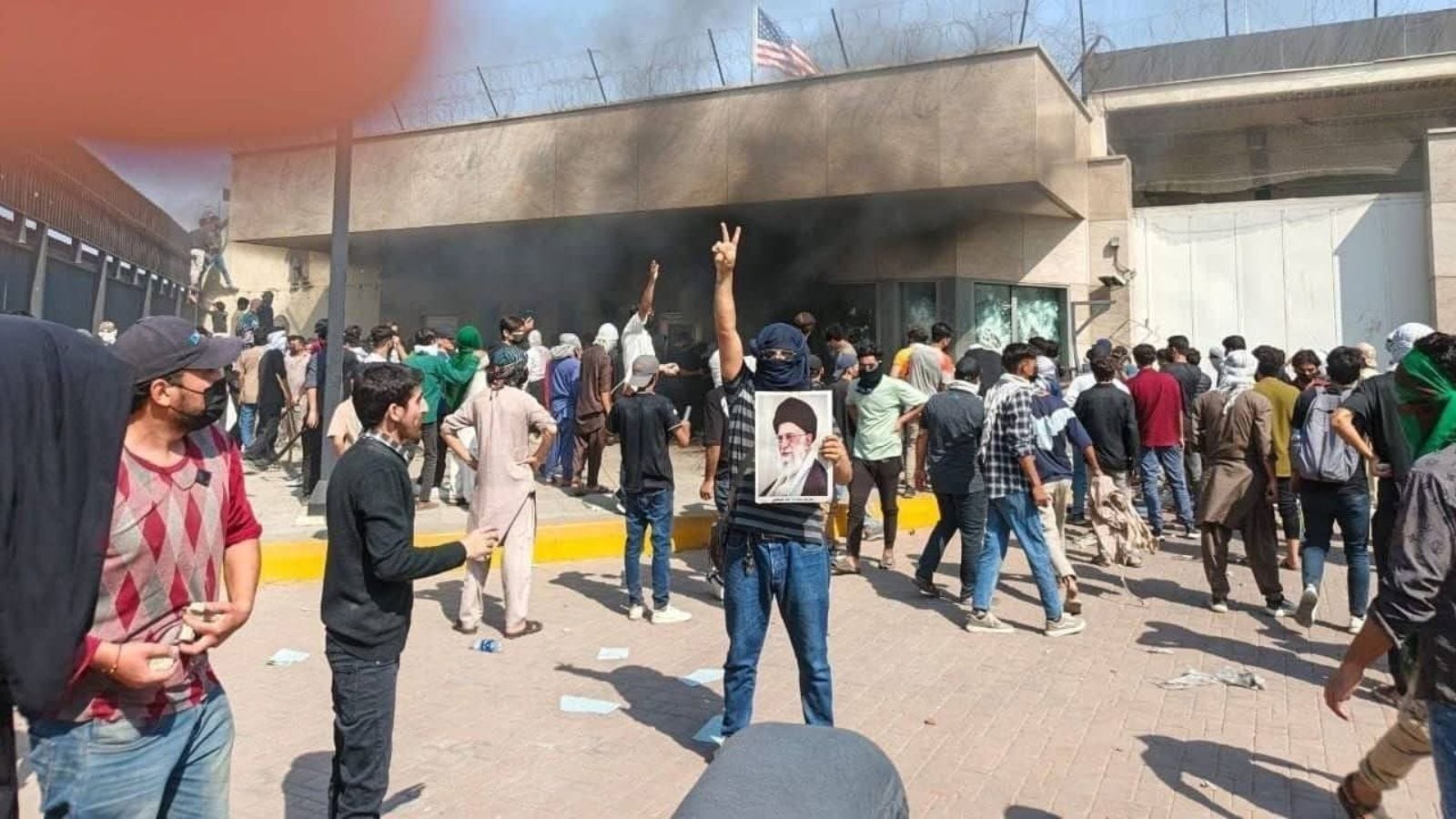
The fatal breach of the United States Consulate in Karachi on March 1, 2026, represents a failure of the tiered security layers designed to insulate diplomatic missions from regional kinetic shifts. While initial reports focus on the casualty count—nine confirmed dead—the strategic significance lies in the collapse of the "buffer zone" logic that typically governs urban diplomatic security in high-risk environments. This event serves as a definitive case study in how localized civil unrest can be weaponized into a high-impact asymmetric assault when triggered by regional escalations, in this case, the recent strikes on Iranian territory.
The Triad of Deterrence Failure
To understand why the Karachi consulate fell while others remained secure, one must analyze the three failure points in the deterrence chain: intelligence signaling, perimeter integrity, and the host-nation enforcement contract.
Intelligence Lag and Signal Noise: Security protocols rely on "threat indicators" that move from latent to active. In the hours following the reports of strikes on Iran, the speed of digital mobilization outpaced the deployment of provincial paramilitary reinforcements. The transition from a protest to a "storming" event occurred within a 22-minute window, a timeframe that defies standard riot control response cycles.
The Urban Porosity Factor: Karachi’s dense layout creates a high "porosity" index. Unlike purpose-built diplomatic enclaves (e.g., Islamabad’s Red Zone), the Karachi consulate exists in a high-traffic urban fabric. This proximity reduces the "stand-off distance"—the physical space required to identify and neutralize a threat before it reaches the primary barrier.
Host-Nation Political Friction: Diplomatic security is a shared liability. When the host nation’s internal political climate is sensitive to the cause of the protesters (anti-interventionism or religious solidarity), the "rules of engagement" for local police become blurred. This creates a hesitation gap that organized elements within a mob can exploit to breach the first line of defense.
Deconstructing the Mob: Chaos vs. Kinetic Intent
Observers frequently mischaracterize such events as "spontaneous outbursts." A structural analysis of the breach patterns suggests a hybrid composition. The crowd functioned through two distinct layers:
The Atmospheric Layer
This group provides the visual and physical mass. Their primary function is to overwhelm the sensory capacity of security forces and provide "human shielding" for more tactical actors. They operate on emotional triggers and collective behavior, making them unpredictable but generally non-lethal on their own.
The Kinetic Core
Within the mob, smaller, decentralized cells utilized the cover of the crowd to execute technical breaches. Reports of "storming" usually involve the use of improvised breaching tools or coordinated pressure on specific structural weak points, such as gates or pedestrian chokepoints. The death toll of nine indicates a high-lethality environment that suggests small arms fire or explosive fragmentation, tools not typically carried by average protestors.
The Geopolitical Feedback Loop
The Karachi incident is a direct consequence of the "Contagion of Proxy Violence." When a kinetic action occurs in one theater (Iran), the repercussion is felt in the secondary theater (Pakistan) through a mechanism of ideological resonance.
- The Proximity Variable: Pakistan shares a 900-kilometer border with Iran. Cultural and religious ties ensure that any perceived violation of Iranian sovereignty acts as a domestic irritant in Pakistani urban centers.
- The US-Pakistan Security Paradox: The US relies on Pakistan for regional counter-terrorism, yet the presence of US diplomatic infrastructure serves as a lightning rod for anti-Western sentiment fueled by US-Middle East policy. This creates a permanent state of high-readiness fatigue for security details.
Quantitative Impact on Diplomatic Continuity
The breach forces a re-evaluation of the "Hardened Facility" doctrine. If a consulate with modern reinforcements can be overrun, the cost-benefit analysis of maintaining physical footprints in volatile urban centers shifts toward "Remote Diplomacy" or "Fortress Enclaves."
Operational Degradation
The immediate result is the suspension of visa services and American Citizen Services (ACS), which triggers a secondary economic impact. Karachi is Pakistan’s financial hub; the closure of a major Western consulate signals to international investors that the local security apparatus is incapable of protecting sovereign assets. This leads to an "Insecurity Premium"—an increase in the cost of doing business due to heightened insurance and private security requirements.
The Escalation Ladder
This event moves the regional tension from a state-to-state conflict (US-Iran) to a state-to-civilian conflict. When a mob kills personnel at a diplomatic mission, the response is rarely just local. It necessitates a "Force Protection" surge, which can include the deployment of Marine Security Guard (MSG) reinforcements or specialized FAST (Fleet Antiterrorism Security Team) units. This presence, while necessary, often serves to further agitate the local populace, creating a self-sustaining cycle of friction.
Strategic Vulnerabilities in Perimeter Engineering
Modern consulates are built to resist "The Big Three": Vehicle-Borne Improvised Explosive Devices (VBIEDs), forced entry, and ballistic attack. However, the Karachi breach highlights a fourth vulnerability: Sustained Mass Pressure.
Standard anti-ram barriers and ballistic glass are rated for specific durations and intensities. They are not necessarily designed to withstand the persistent, multi-hour physical pressure of thousands of individuals. When the "outer skin" of a facility is compromised, the "inner sanctum" (the Safe Haven) becomes the only remaining defense. The nine fatalities likely occurred during the transition between these two zones, where security personnel are most exposed while attempting to hold the line.
Tactical Realignment for Diplomatic Assets
The failure in Karachi dictates a shift in how diplomatic missions must operate in the 2026 geopolitical climate. The reliance on host-nation "cordons" is no longer a viable primary defense strategy during high-latency periods of regional conflict.
Dynamic Egress and Evacuation: Standard operating procedures must move away from "shelter-in-place" as a default. If the standoff distance is compromised, the facility becomes a trap. Pre-emptive evacuation triggered by digital sentiment analysis—monitoring the velocity of protest mobilization on social platforms—must become a standard trigger.
Non-Lethal Denial Systems: There is a gap between "verbal warnings" and "lethal force." The deployment of Active Denial Systems (ADS) or advanced sensory deterrents could provide the necessary time-buffer for reinforcements to arrive without creating the "martyrdom" events that turn a riot into a prolonged siege.
Strategic Decoupling: Large-scale diplomatic footprints in non-capital cities must be audited for their "defensibility-to-value" ratio. In a digital age, the necessity of a massive physical presence in an urban center like Karachi is outweighed by the liability it creates during periods of regional kinetic flux.
The immediate move for regional security directors is the implementation of a "Regional Trigger Protocol." This protocol dictates that any kinetic strike within a 1,000-mile radius involving a US adversary automatically elevates all Tier-2 missions to a "Reduced Footprint" status within one hour of the event, bypassing the delay of local intelligence assessments. Waiting for the mob to form is a terminal error; the defense must begin the moment the first missile is launched across the border.


