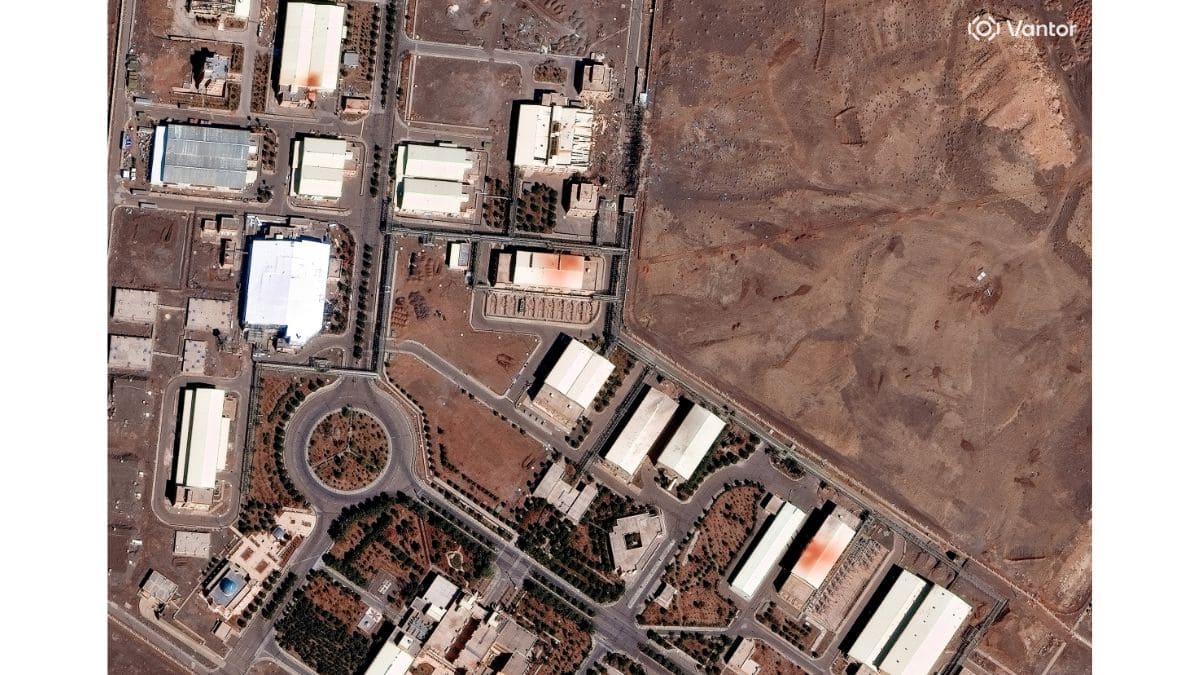
The integrity of Iran's uranium enrichment program depends less on the volume of its gas centrifuges and more on the hardened infrastructure required to assemble them. Recent satellite imagery of the Natanz Pilot Fuel Enrichment Plant (PFEP) reveals a sophisticated intersection of structural failure and thermal scarring. This is not merely "damage"—it is a targeted disruption of the enrichment supply chain. To understand the strategic implications, one must analyze the kinetic signatures against the requirements of advanced centrifuge manufacturing.
The Architecture of Enrichment Constraints
Nuclear enrichment is a game of mechanical tolerances. Centrifuges like the IR-4 and IR-6 operate at rotational speeds exceeding 60,000 RPM. Any facility designed to assemble these machines requires specialized environmental controls: "clean room" conditions, vibration isolation, and precise thermal regulation.
The visible destruction at the Natanz site focuses on the Centrifuge Assembly Center. By mapping the debris field and roof displacement, we can categorize the impact into three distinct failure vectors:
- Thermal Pulse Overload: Scorching patterns indicate a high-temperature event that likely compromised the structural tempering of the building’s steel frame. Even if the walls remain standing, the internal climate control systems—essential for carbon-fiber rotor balancing—are rendered non-functional.
- Structural Discontinuity: The displacement of the roof suggests an internal overpressure event. In a facility designed for sub-millimeter precision, a shift of even a few centimeters in the floor slab or mounting brackets makes the assembly of high-speed rotors impossible.
- Logistical Decapitation: The assembly center acts as the "narrow neck" of the Natanz complex. While the underground enrichment halls (FEP) house the cascades, the surface-level assembly plant creates the replacement parts. Destroying the assembly capability creates a "depletion timer" for the underground cascades; as centrifuges naturally fail due to mechanical stress, there is no inventory to replace them.
Quantification of Delay: The Recovery Function
Rebuilding a specialized nuclear assembly plant is not a standard construction project. The recovery time is dictated by the Complexity of Specialized Tooling (CST). To resume operations, the facility must re-acquire and recalibrate:
- High-precision CNC machines for maraging steel or carbon fiber.
- Horizontal and vertical balancing stands.
- Vacuum testing chambers.
The procurement of these items is heavily restricted under international sanctions and the JCPOA "Procurement Channel." Therefore, the damage at Natanz forces Iran into a binary choice: divert resources to clandestine procurement networks, which increases the risk of intelligence exposure, or attempt to domesticate the manufacturing of high-precision tools, which introduces a 12-to-24-month lag in centrifuge deployment.
Kinetic Analysis of the Debris Field
Standard aerial photography provides the "what," but a structural analysis provides the "how." The pattern of the roof collapse at the Natanz assembly annex shows an outward-inward pressure differential.
- Evidence of Internal Origin: The debris is distributed in a manner consistent with an internal blast rather than an external kinetic strike (such as a missile or drone). This suggests a breach of the facility’s internal security perimeter or the sabotage of industrial control systems (ICS).
- The Power Grid Vulnerability: Large-scale enrichment facilities require massive, stabilized power loads. If the explosion targeted the frequency inverters or the power distribution hub within the assembly center, the "damage" extends far beyond the physical building. High-frequency inverters are dual-use technologies that are notoriously difficult to replace under sanction regimes.
Strategic Bottlenecks in the IR-6 Transition
Iran’s stated goal is the transition from the aging IR-1 fleet to the more efficient IR-6 models. The IR-6 is roughly ten times more productive than the IR-1, but it is exponentially more difficult to manufacture.
The IR-1 uses aluminum rotors; the IR-6 uses carbon fiber. Carbon fiber requires specific resin-curing ovens and filament-winding machines. These machines are sensitive to dust and temperature fluctuations. By compromising the structural envelope of the Natanz assembly center, the adversary has effectively paused the IR-6 transition.
This creates a Technological Regression: Iran may be forced to rely on the less efficient IR-1s, which occupy more floor space and are more prone to "crashing" (mechanical failure). This increases the overhead of the enrichment program while slowing the rate of accumulation of highly enriched uranium (HEU).
The Intelligence-Kinetic Feedback Loop
The precision of the damage suggests a high-fidelity intelligence capability. To strike a specific assembly hall without destroying the entire campus requires knowledge of the Internal Workflow Logic. The attackers identified the exact room where the most critical, non-redundant equipment was housed.
This creates a psychological "Security Tax." Iran must now dedicate a significant percentage of its scientific and military budget to counter-intelligence and hardening, rather than enrichment R&D. Every hour spent moving equipment to deeper underground bunkers is an hour lost to technical optimization.
Comparative Hardening: Surface vs. Subterranean
The Natanz complex features two primary enrichment zones: the surface-level PFEP and the underground FEP.
- The PFEP (Surface): Designed for R&D and rapid iteration. It is vulnerable to kinetic strikes but allows for faster scientific advancement.
- The FEP (Underground): Hardened against most conventional munitions but rigid in its configuration.
The strike on the surface facility is a tactical masterstroke because it leaves the underground "production" intact while destroying the "innovation" engine. It allows the international community to avoid the escalation of a total facility destruction while effectively freezing Iran’s enrichment technology at its current, manageable level.
Forecasting the Industrial Response
The immediate Iranian move will likely be the "dispersal strategy." Instead of a single, centralized assembly center at Natanz, they will attempt to move assembly operations to smaller, decentralized workshops across the country.
However, decentralization introduces its own set of failures:
- Quality Control Variance: Maintaining identical clean-room standards across five sites is significantly harder than at one.
- Transportation Risk: Moving sensitive centrifuge rotors over public infrastructure introduces mechanical shocks that can cause micro-fractures in the carbon fiber.
- Information Leakage: More sites mean more personnel with access to sensitive data, increasing the surface area for future intelligence operations.
The move to rebuild the assembly center deep underground is the only viable long-term strategy for Iran, but this requires significant excavation time—likely 18 to 30 months—during which the "depletion timer" on their existing cascades continues to tick.
The strategic play is now to monitor the Excavation Rates at the southern edge of the Natanz site. Any increase in heavy machinery or spoil piles indicates the start of a "Fortress Assembly" strategy. Counter-strategy must focus on the disruption of specialized construction materials, specifically high-strength concrete and blast-rated doors, to ensure that the "reconstruction phase" becomes as costly and time-consuming as the initial loss.


