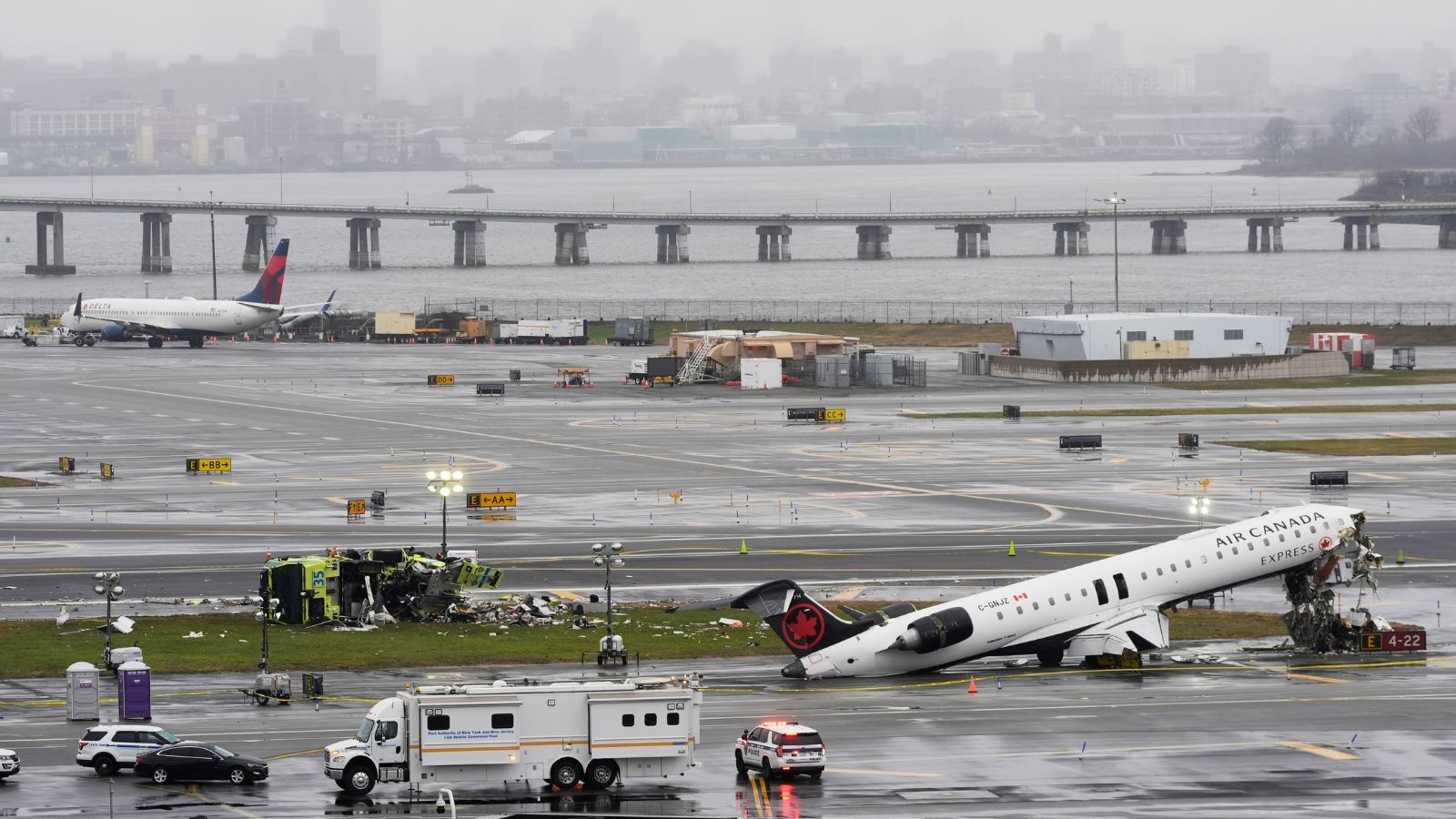
The safety of high-density urban airports rests on a razor-thin margin between mechanical redundancy and human reaction time. When an Air Canada Embraer 190 encountered a critical flight deck indication during its departure sequence at New York’s LaGuardia Airport, the event transitioned from a routine takeoff to a high-stakes kinetic management problem. Understanding this incident requires moving past sensationalized narratives of "crashes" or "victims" and instead analyzing the specific physics of a rejected takeoff (RTO), the physiological constraints of emergency egress, and the logistical friction of one of the world’s most congested pieces of airspace.
The Physics of the Go/No-Go Decision
In commercial aviation, the takeoff roll is governed by a specific velocity known as $V_1$. This is the "decision speed." If a failure occurs before $V_1$, the pilot is trained to abort the takeoff using maximum braking and spoilers. If the failure occurs even one knot after $V_1$, the aircraft must take off, as the remaining runway length is mathematically insufficient to dissipate the aircraft's kinetic energy.
The Air Canada incident at LaGuardia centers on the timing of this decision. At high speeds, the energy $E$ that the braking system must absorb is defined by:
$$E = \frac{1}{2}mv^2$$
Where $m$ is the mass of the aircraft and $v$ is the velocity. Because velocity is squared, an abort at 130 knots involves significantly more thermal stress on the carbon brake disks than an abort at 100 knots. When the flight crew detected a smoke indication in the cockpit, they triggered a high-speed RTO. The mechanical consequence of this is immediate: the brake assemblies can reach temperatures exceeding 800°C. This heat often triggers the "fuse plugs" in the tires, which deliberately deflate the tires to prevent an explosive blowout that could rupture fuel lines in the wings.
The Smoke and Fire Feedback Loop
The reported "fire" in many witness accounts is frequently a misunderstanding of chemical and mechanical reactions. In a high-speed abort, two distinct phenomena occur that the public perceives as a crash:
- Hydraulic Fluid and Friction: If a brake line seeps under extreme pressure or if tire rubber atomizes due to friction, a thick, acrid smoke is produced.
- The Thermal Soak: Once the aircraft stops, the lack of airflow causes the heat from the brake stators to radiate outward. If this heat reaches the outer tire carcass, it can produce visible flames, even if the internal aircraft systems remain intact.
The crew’s decision to evacuate via emergency slides is dictated by the "Primary Threat Assessment." If smoke is detected in the cabin or cockpit, the source is secondary to the immediate threat of asphyxiation or flashover. The Embraer 190 is designed to facilitate a full evacuation in under 90 seconds with half of the exits blocked. However, the presence of external smoke near the wings—where the engines and fuel tanks are located—forces a tactical choice: which slides to deploy to avoid venting passengers directly into a perceived fire zone.
Human Factors and Kinetic Egress
The "victims" in an RTO situation are rarely the result of a collision, as the aircraft typically remains on the paved surface of the runway. Instead, injuries are a byproduct of the evacuation process itself. The transition from a pressurized metal tube to a nylon slide involves a vertical drop of several meters.
Statistical data from the NTSB indicates that the majority of injuries in non-impact evacuations are orthopedic:
- Ankle and Knee Fractures: Caused by improper landing posture at the base of the slide.
- Friction Burns: Resulting from skin contact with the slide material during high-velocity descent.
- Secondary Trauma: Caused by passengers attempting to retrieve carry-on luggage, which creates bottlenecks and can puncture the inflatable slides.
The Air Canada event underscores a persistent failure in passenger education. Despite safety briefings, the instinct to "save" personal property often overrides the necessity of clear egress paths. A single bag snagging on a slide rail can render an entire exit inoperable, increasing the "dwell time" inside a smoke-filled cabin.
Airspace Cascades and Economic Friction
LaGuardia (LGA) operates under a slot-constrained system, meaning every minute of runway closure generates an exponential delay across the National Airspace System (NAS). When an Air Canada jet is disabled on Runway 4/22, the impact is three-fold:
- The Sterile Runway Zone: Federal regulations require a complete halt of operations until the aircraft is towed and the runway is inspected for Foreign Object Debris (FOD), such as tire fragments or metal shards from the brake assemblies.
- The Diversion Matrix: Airborne aircraft low on fuel must divert to Newark (EWR) or John F. Kennedy (JFK), which are often already at 90% capacity. This creates a "holding stack" that ripples back to departure gates in Chicago, Atlanta, and Toronto.
- Ground Equipment Saturation: Emergency ARFF (Aircraft Rescue and Firefighting) units must stay with the disabled aircraft until the brakes have cooled to a safe "tow temperature." This takes the airport's primary emergency response offline for the rest of the field, technically requiring a temporary suspension of other heavy aircraft operations.
Systemic Reliability of the Embraer 190 Platform
The Embraer 190 utilized by Air Canada is an "E-Jet," featuring a fly-by-wire system that provides the crew with high-fidelity data regarding engine performance and environmental hazards. In this specific incident, the "smoke in cockpit" checklist was the primary driver of the outcome.
A critical distinction must be made between a "fire" and a "smoke indication." Modern aircraft use photoelectric smoke detectors and ionized sensors. These are hypersensitive and can be triggered by:
- Recirculation fan motor failures.
- Dust in the air conditioning packs (common during seasonal transitions).
- Cleaning fluid residue on a heater element.
To the crew, the cause is irrelevant in the moment. The protocol is binary: if the alert is sustained, the aircraft is evacuated. The fact that all passengers exited with only minor injuries is not a matter of "luck" but an validation of the "Swiss Cheese Model" of accident prevention. Each layer—the RTO training, the fuse plug design, and the slide deployment—functioned to catch the failure before it became a catastrophe.
The investigation by the Transportation Safety Board (TSB) and the NTSB will focus on the "Internal Environmental History" of the airframe. They will examine maintenance logs to see if the aircraft had a history of "nuisance" alerts or if a specific component, such as a power distribution unit, showed signs of thermal distress in prior flights.
The strategic takeaway for the aviation industry is the continued refinement of the "High-Speed Reject" criteria. While the pilots in the Air Canada incident followed standard operating procedures (SOPs), the industry is currently evaluating whether certain non-critical alerts should be inhibited during the high-speed phase of takeoff to prevent the inherent risks of a 130-knot emergency stop. Every RTO is a gamble with kinetic energy; the goal is to ensure the gamble is only taken when the risk of staying in the air exceeds the risk of a high-energy stop on the ground.
The operational priority now shifts to the recovery of the airframe and the analysis of the brake cooling data. This data will be integrated into flight simulators worldwide, ensuring that the next crew facing a smoke alert at LaGuardia has a refined data set to inform their go/no-go decision.
Operators must prioritize the replacement of older detection sensors with multi-spectrum infrared units to reduce the frequency of "unverified smoke" evacuations. This reduces the primary source of passenger injury—the evacuation itself—without compromising the conservative safety margins that define modern commercial flight.