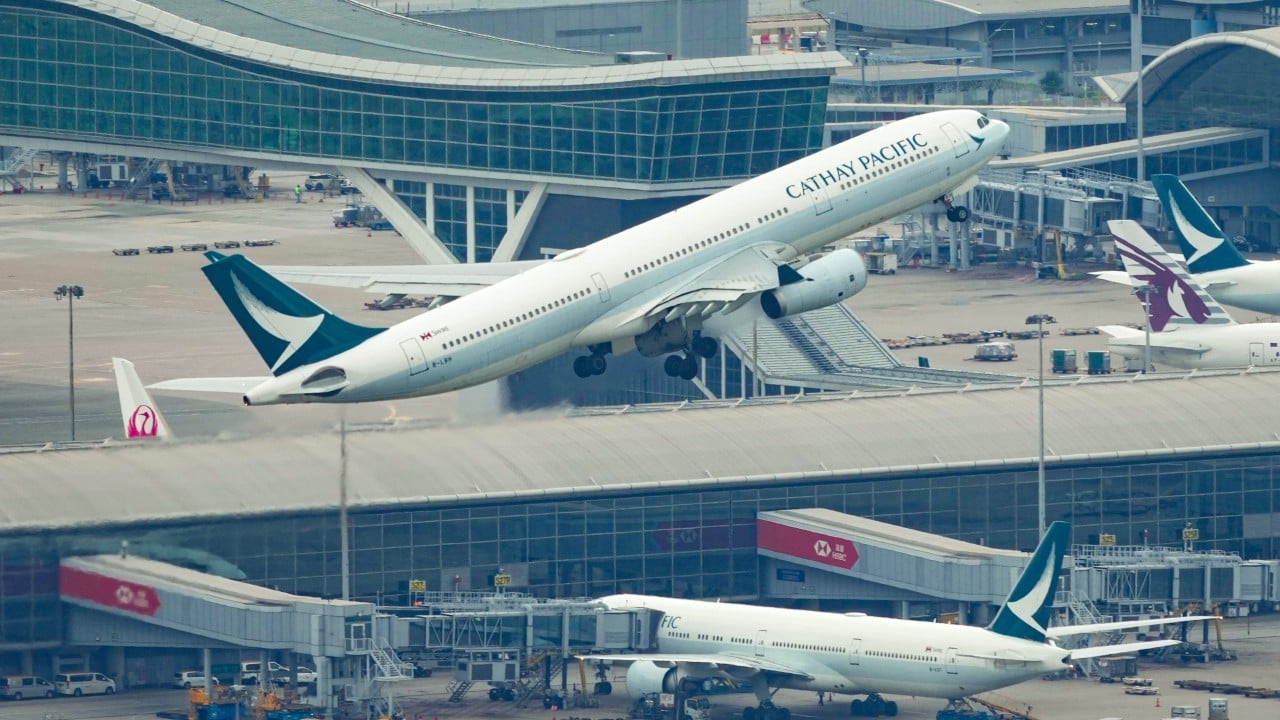
The viability of Hong Kong as a global aviation nexus depends on its ability to arbitrage geographic risk and infrastructure capacity. As kinetic conflict in the Middle East disrupts the traditional "Superconnector" model favored by Gulf carriers, a structural vacuum has emerged in the Long-Haul East-West corridor. Hong Kong is currently executing a tactical pivot to capture this diverted flow by synchronizing its Three-Runway System (3RS) expansion with targeted diplomatic-commercial incentives for Middle Eastern carriers. This is not merely a recovery of pre-pandemic volume; it is a calculated reconfiguration of the transshipment cost function.
The Triad of Hub Competitiveness
To understand why Hong Kong is aggressively courted by and courting Middle Eastern partners, one must analyze the three variables that dictate hub dominance: Temporal Efficiency, Geopolitical Neutrality, and Slot Elasticity.
Temporal Efficiency: For passengers traveling between the ASEAN region and Europe or the East Coast of the United States, the deviation via the Persian Gulf (Dubai, Doha, Abu Dhabi) is often minimal. However, when Northern polar routes or direct East-West corridors are constricted by airspace closures—such as the ongoing restrictions over Russia and Ukraine—the "Great Circle" math changes. Hong Kong offers a southerly alternative that bypasses the immediate volatility of Levantine airspace while maintaining access to the high-growth markets of the Greater Bay Area.
Geopolitical Neutrality: Aviation hubs are sensitive to sovereign risk. Regional instability in the Middle East creates a "risk premium" for insurers and a "psychological tax" for passengers. By positioning itself as a stable, technically advanced alternative, Hong Kong absorbs the demand that seeks to avoid potential airspace closures or sudden escalations in the Red Sea and surrounding territories.
Slot Elasticity: The completion of the Three-Runway System at Hong Kong International Airport (HKIA) provides a rare commodity in global aviation: unallocated capacity. While Heathrow, Schiphol, and even some Gulf hubs face physical or regulatory caps, HKIA can now offer the "transfer windows" necessary to build a bank of connecting flights that optimize aircraft utilization for long-haul operators.
The Mechanics of Capacity Absorption
The expansion of direct flights between Hong Kong and Riyadh, alongside increased frequencies to Dubai and Istanbul, serves a dual purpose. It satisfies the immediate requirement for diversified supply chains and facilitates the "Belt and Road" capital flows that are increasingly independent of Western financial rails.
The logic follows a specific sequence of operational scaling:
Phase I: The Anchor Carrier Strategy
By incentivizing flag carriers like Riyadh Air or Qatar Airways to utilize HKIA as a primary Asia-Pacific "scoke" (spoke-and-hub), Hong Kong secures high-margin business traveler volume. These carriers do not just bring passengers; they bring belly-hold cargo capacity. In a high-interest-rate environment, the speed of inventory turnover is critical. Direct flights reduce the "Value-at-Risk" for time-sensitive electronics and pharmaceutical exports moving from the Pearl River Delta to EMEA markets.
Phase II: Intermodal Synergy and the 45-Minute Circle
The strategic advantage of HKIA is no longer confined to the tarmac. The integration of the Hong Kong-Zhuhai-Macao Bridge and the "Fly-Via-Hong Kong" sea-to-air transfer service effectively expands the airport’s catchment area to a population of 86 million. This creates a massive, captive demand base that Gulf carriers can tap into without needing to secure multiple bilateral landing rights in secondary Chinese cities. They land in Hong Kong; the "Hinterland Logic" does the rest.
The Cost Function of Airspace Volatility
Aviation economics is a game of fuel burn and overflight fees. When Middle Eastern airspace becomes a "No-Fly Zone" or requires significant detours, the Cost per Available Seat Kilometer (CASK) for carriers like Emirates or Etihad spikes.
If a flight from London to Sydney must avoid the Gulf, the fuel penalty can exceed 10-15%. Hong Kong serves as a strategic "Fuel Hedge." By offering a robust, high-capacity transfer point that sits outside the immediate theater of conflict, HKIA allows airlines to maintain schedule reliability. The reliability of a hub is often more valuable to a network planner than the nominal airport charges. A missed connection due to an airspace detour costs an airline thousands in re-accommodation and lost customer lifetime value.
Structural Bottlenecks and Mitigation
Despite the aggressive expansion, three primary constraints threaten the efficacy of this strategy:
- Labor Scarcity in Ground Handling: The technical capacity of a third runway is negated if the "Turnaround Time" (TAT) is extended by a lack of baggage handlers and gate agents. The current reliance on imported labor programs is a temporary fix for a demographic deficit.
- The SAF (Sustainable Aviation Fuel) Gap: European and North American regulators are increasingly mandating SAF blends. If Hong Kong cannot provide a competitive SAF bunkering infrastructure, it will lose the "Green Premium" traffic that defines the corporate travel segment.
- Bilateral Air Service Agreements (BASAs): Increasing flight frequencies is not just a commercial decision; it is a diplomatic one. Protectionist impulses from domestic carriers in either region can stall the rollout of the very flights intended to boost capacity.
The Pivot to the "Global South" Corridor
The strategic reorientation toward the Middle East is a hedge against the softening of Trans-Pacific demand. As trade tensions between the US and China fluctuate, the "North-South" and "East-West" axes (connecting Asia to Africa and the Middle East) represent the highest growth potential for the next decade.
The data suggests that the Middle East is no longer just a destination for Hong Kong; it is a gateway to the emerging markets of the African continent. By securing the Middle Eastern leg of the journey, Hong Kong effectively becomes the primary gateway for Chinese investment into Africa.
The Logistics of the "Silk Road in the Sky"
- Redundancy: Creating multiple daily frequencies ensures that cargo forwarders can guarantee "Next Day" delivery, a prerequisite for the e-commerce giants (Alibaba, Temu, Shein) operating out of the GBA.
- Cold Chain Integration: Middle Eastern carriers often operate some of the youngest, most technologically advanced fleets. Their ability to handle temperature-sensitive goods aligns with Hong Kong’s investment in specialized cold-chain terminals.
- Capital Alignment: The rise of Islamic Finance and the listing of Saudi ETFs in Hong Kong signals a deeper institutional tie. Aviation is the physical manifestation of this financial integration.
Strategic Forecast: The Shift from Transit to Node
The traditional "Transfer Hub" model is dying. In its place, we are seeing the rise of the "Integrated Economic Node." Success will not be measured by "Passenger Throughput" alone, but by "Value Added per Square Meter of Airside Space."
The strategic play for the next 36 months is the aggressive conversion of transit passengers into short-stay business visitors. The development of "Airport City" (SkyCity) is the mechanism for this. By providing high-end retail, professional services, and entertainment within the airport perimeter, Hong Kong internalizes the economic activity that previously leaked out to the city center or to competing hubs like Singapore.
The final move in this geopolitical chess game is the harmonization of the 3RS with the digital yuan and other cross-border payment systems. This will lower the "frictional cost" of travel and trade for Middle Eastern partners, creating a frictionless corridor that operates independently of Western-centric payment gateways. The infrastructure is built; the capacity is online. The only remaining variable is the speed of diplomatic execution.
Airlines should prioritize securing long-term slot allocations in the HKIA 3RS now, before the inevitable "Capacity Crunch" returns as the Middle Eastern volatility stabilizes into a new, bifurcated global reality. The window to arbitrage this geographic shift is narrow, but the rewards for the first movers—both airlines and logistics firms—will be structural and long-lasting.