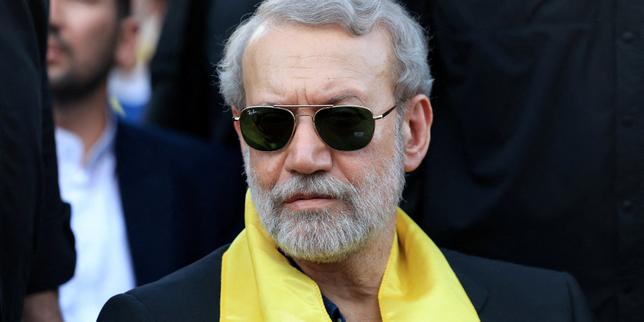
The assassination of Ali Larijani—a foundational figure of the Islamic Republic’s conservative-pragmatic wing—represents a terminal point for the "systemic flexibility" that once characterized Iranian statecraft. To analyze this event beyond the immediate shock of the kinetic strike, one must evaluate it as a structural failure of the regime's internal balancing mechanism. The elimination of a figure who served as the primary bridge between the clerical establishment, the military-industrial complex (IRGC), and international diplomatic channels forces the Iranian state into a feedback loop of radicalization. This is not merely a personnel loss; it is the destruction of a cooling system in a nuclear-political reactor.
The resulting power vacuum accelerates a shift toward a monolithic security-state, stripping the regime of the "double-speak" capacity it utilized to navigate Western sanctions and regional escalations for decades.
The Triad of Institutional Collapse
Larijani functioned as the apex of three critical institutional functions. His removal triggers a simultaneous degradation across these vectors:
- Diplomatic Buffer Capacity: Larijani was the architect of the "Look East" policy while maintaining backchannel credibility with European interlocutors. Without this middle-tier negotiator, the regime loses its ability to conduct "plausible de-escalation."
- Technocratic Mediation: As a former Speaker of the Parliament and head of the IRIB, Larijani managed the friction between the ideological purity of the IRGC and the operational requirements of the state bureaucracy.
- Succession Stability: In the context of the Supreme Leader’s eventual succession, Larijani represented the "traditionalist" alternative to the more radicalized elements of the Paydari Front. His removal simplifies the succession path for hardliners but increases the risk of systemic collapse by narrowing the regime’s social and political base.
The "cost function" of this assassination for the Iranian state is an immediate increase in the discount rate applied to any future diplomatic overtures. If the pragmatic center is physically eliminated, the remaining actors have a rational incentive to adopt maximalist positions to ensure their own survival within the tightening security circle.
The Radicalization Feedback Loop
Radicalization in the Iranian context is often misidentified as purely ideological. In a structured analysis, it is an operational response to perceived existential vulnerability. When a state’s elite are targeted with impunity, the internal logic shifts from "governance and influence" to "survival and deterrence."
The Cost of Entry for Pragmatism
For a political actor in Tehran to advocate for moderation, they must demonstrate that moderation yields tangible security or economic benefits. The assassination of a high-level moderate-conservative proves the opposite: that internal status provides no protection against external kinetic action. This creates a "Brain Drain" of strategic thought. Middle-tier officials who previously aligned with Larijani’s pragmatic school now face a binary choice: defect from the political sphere or adopt the rhetoric of the ultra-nationalists to avoid being labeled as "weak" or "compromised."
Escalation as a Defense Mechanism
The regime’s "Fuite en avant" (Forward Escape) is a mathematical necessity when defensive depth is compromised. Without Larijani’s diplomatic finesse to manage the "Gray Zone" between peace and war, the IRGC is likely to prioritize:
- Vertical Escalation: Increasing the technical parameters of the nuclear program (enrichment levels/metal production) to force a change in the adversary's risk calculus.
- Horizontal Expansion: Activating regional proxies with less restraint, as the diplomatic "brakes" previously applied by the Foreign Ministry and Larijani’s circle have been severed.
The Geometry of Power: IRGC vs. The Traditionalists
The internal hierarchy of the Islamic Republic has historically functioned as a dual-track system. One track is the ideological-military (IRGC), and the other is the clerical-traditionalist (The Larijani/Rafsanjani lineage). The assassination effectively completes the "purification" (yek-dast sazi) of the state, but at a massive cost to institutional resilience.
A state that lacks internal dissent or diverse perspectives becomes brittle. This brittleness is visible in two specific areas:
The Intelligence Gap
The fact that a figure of Larijani’s stature could be targeted suggests a profound penetration of the Iranian security apparatus. In a healthy state system, such a breach would lead to a transparent overhaul of security protocols. In a radicalizing, paranoid system, it leads to internal purges. These purges further degrade the quality of intelligence and analysis reaching the Supreme Leader, as subordinates prioritize loyalty over accuracy.
The Economic Chokepoint
Larijani was a key proponent of the 25-year strategic pact with China. While the IRGC supports the China alignment, they lack the administrative experience to manage the complex trade and investment requirements that Larijani’s technocrats oversaw. The result is an economy that becomes even more reliant on smuggling and shadow banking, further empowering the IRGC’s economic wings and creating a closed-loop system that is immune to Western sanctions but also incapable of growth.
Strategic Implications for Regional Actors
The removal of the "Pragmatic Pivot" changes the game theory for regional neighbors and Western powers. Previously, the Iranian regime could be modeled as a rational actor with multiple competing interest groups. Post-Larijani, the model must shift toward a "Unitary Security Actor."
- Diminishing Returns on Sanctions: Sanctions work by creating friction between different elite groups (e.g., making the merchants angry at the generals). If the merchant-pragmatist class is politically or physically eliminated, the friction disappears. The state becomes a "fortress economy" where the elite actually profit from the lack of competition.
- The Miscalculation Trap: Without seasoned negotiators like Larijani to interpret signals from Washington or Jerusalem, the risk of a "kinetic miscalculation" skyrockets. Subtle diplomatic signals are likely to be ignored or misinterpreted as threats by a leadership core that is now dominated by individuals with a purely military background.
The Iranian state’s "response function" to external pressure has lost its nuance. We are entering a phase where the only two gears are "Total Stasis" or "Total Escalation."
The End of the Reformist-Pragmatic Mirage
For years, Western policy relied on the hope that "moderates" could eventually steer the Iranian ship toward a grand bargain. The Larijani assassination is the final nail in the coffin of this strategy. It signals that the Iranian system is no longer interested in—or perhaps no longer capable of—maintaining a space for pragmatism.
The remaining power structure is a "Monolith of Necessity." Every actor currently within the inner circle knows that any sign of "softness" is a career-ending, or life-ending, mistake. This creates a competitive radicalism where officials vie to propose the most aggressive responses to external stimuli.
The strategic play for external observers is no longer to look for "the next Larijani." There isn't one. The play is to prepare for an Iran that functions as a purely ideological military state, where the traditional clerical oversight is subservient to the IRGC’s tactical requirements. Diplomatic engagement will no longer be about "grand bargains," but about "conflict management" between two parties that no longer speak the same language of power.
The most immediate risk is not a planned war, but an accidental one triggered by a regime that has lost its ability to perceive the "middle ground." When the architects of pragmatism are gone, the only remaining tool is the hammer.
The international community must now recalculate the "Price of Containment." If the internal mechanisms for moderation are dead, the cost of keeping Iran "in its box" will increase exponentially, requiring a permanent and much more aggressive posture that the current global order may not be prepared to sustain. The focus must shift from incentivizing internal change to hardened, externalized deterrence, as the internal levers of Iranian politics have been effectively welded shut.