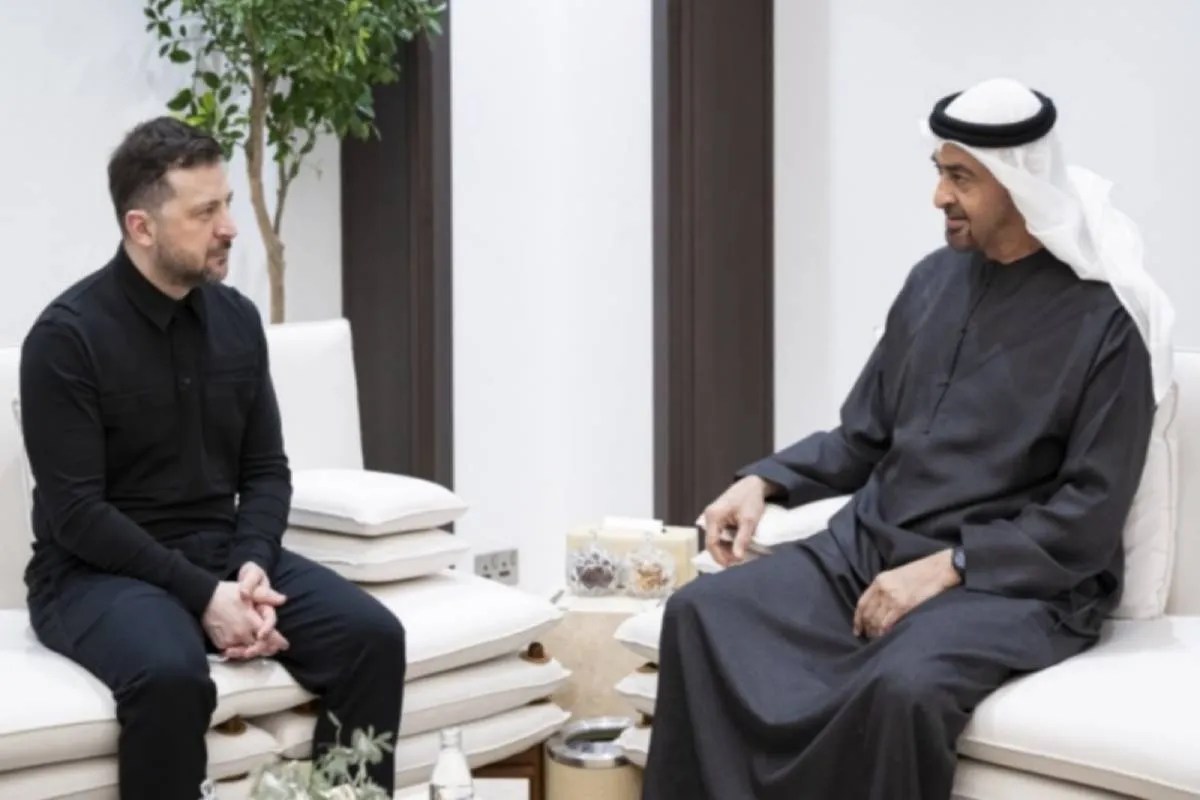
The Ukrainian defense strategy is undergoing a fundamental structural shift from total dependence on NATO-standard logistics to a diversified, multi-polar procurement model. By engaging the United Arab Emirates (UAE) and Qatar, President Volodymyr Zelensky is not merely seeking immediate hardware; he is architecting a "Buffer of Neutrality" that exploits the unique geopolitical positioning of the Gulf Cooperation Council (GCC). This pivot addresses a critical bottleneck: the exhaustion of Soviet-era stockpiles and the political volatility of Western legislative cycles.
The Tri-Node Logic of Gulf Integration
Ukraine’s engagement with Abu Dhabi and Doha operates across three distinct strategic nodes. These nodes function as a hedge against the diminishing returns of traditional diplomacy. For a different look, consider: this related article.
1. The Intermediary Logistics Node
The UAE serves as a global hub for dual-use technology and third-party defense transfers. Unlike direct NATO transfers, which are often paralyzed by domestic political debates or "escalation management" fears, the UAE offers a commercialized pathway for procurement. This includes unmanned aerial systems (UAS), electronic warfare (EW) components, and armored mobility platforms that may be manufactured under license or sourced via complex global supply chains.
2. The Financial Liquidity Node
Qatar’s sovereign wealth and investment capabilities provide a potential capital injection for the Ukrainian defense industrial base (DIB). The goal is to transition from a "grant-based" defense model to a "joint-venture" model. By securing Qatari investment for domestic Ukrainian production facilities—likely located in underground or decentralized sites—Ukraine secures a long-term production capacity that is insulated from the whims of foreign aid budgets. Related coverage on this trend has been published by Al Jazeera.
3. The Diplomatic Counterweight Node
Russia has historically leveraged its relationship with OPEC+ and the GCC to bypass Western sanctions and maintain regional influence. Ukraine’s presence in these capitals forces a "zero-sum" diplomatic calculus upon Moscow. If Ukraine can secure defense agreements with the UAE, it effectively neutralizes Russia’s ability to claim a monopoly on security partnerships in the Middle East.
The Security Wall Mechanism
The concept of a "security wall" against Iranian and Russian cooperation is not a physical fortification but a disruption of the "Shahed-Sourcing" pipeline. Iran and Russia have developed a high-velocity feedback loop for loitering munitions. To dismantle this, Ukraine requires two specific technological interventions that the Gulf states are uniquely positioned to facilitate.
Component Interdiction and Substitution
A significant portion of the technology found in Iranian-designed drones consists of Western-manufactured microelectronics and engines that pass through global trade hubs. By deepening intelligence and customs cooperation with the UAE, Ukraine seeks to tighten the "noose of end-user certificates." If the UAE enforces stricter scrutiny on components transiting through its ports, the cost function for Iranian drone production increases exponentially due to the need for more circuitous smuggling routes.
Counter-UAS (C-UAS) Proliferation
The UAE has invested heavily in C-UAS technologies, specifically laser-directed energy weapons and high-frequency jamming arrays, to protect its own infrastructure from Houthi-led drone strikes. Ukraine is targeting the acquisition of these proven, desert-tested systems. These assets are vital because they provide a cost-effective intercept solution compared to the $2 million Patriot missiles used to down $30,000 drones.
The Cost Function of Neutrality
Engaging the Gulf states is not without significant strategic friction. The primary limitation is the "Neutrality Premium." Both the UAE and Qatar have maintained a delicate balance with Moscow, particularly regarding energy pricing and regional stability.
- Political Risk: Any defense deal with Ukraine is calculated against the risk of Russian retaliation in the form of intelligence sharing with Iran or disruptions in the Syrian theater where Gulf interests are active.
- Technology Transfer Restrictions: Much of the high-end hardware in the Gulf is of U.S. or French origin. These states cannot transfer "controlled items" to Ukraine without Third Party Transfer (TPT) authorization from the original manufacturer. Consequently, the deals currently on the table likely focus on indigenous Gulf platforms (like the EDGE Group’s munitions) rather than re-exported Western tech.
Systematic Integration of Gulf Defense Assets
To maximize the utility of this new partnership, the Ukrainian Ministry of Defense is focusing on three technical categories:
- Tactical Mobility: The UAE's Streit Group and Nimr provide armored vehicles that are optimized for high-intensity conflict. These platforms fill the gap between heavy Main Battle Tanks and unarmored civilian vehicles.
- Precision Munitions: Qatar has explored investments in long-range strike capabilities. Ukraine’s interest lies in co-producing rocket artillery that utilizes Qatari capital and Ukrainian ballistic expertise.
- Maritime Security: Both Gulf nations have significant expertise in littoral combat and port security. As Ukraine continues to challenge the Russian Black Sea Fleet, the transfer of Unmanned Surface Vessels (USVs) and coastal surveillance sensors becomes a priority.
Structural Bottlenecks in the Ukraine-GCC Axis
The primary obstacle to a seamless "Security Wall" is the lack of a pre-existing logistical framework. Unlike the Rammstein Group, which utilizes established NATO infrastructure, the Gulf-Ukraine pipeline must be built from the ground up.
The first bottleneck is interoperability. Gulf military hardware often uses different communications protocols and maintenance cycles than the mix of Soviet and NATO gear currently in Ukraine. This necessitates a separate training and spare-parts tail, potentially straining an already overburdened Ukrainian logistics corps.
The second bottleneck is sovereign pressure. Russia remains a key member of OPEC+. If Moscow perceives the UAE’s defense cooperation with Ukraine as a shift toward a "pro-Kyiv" stance, it may use its leverage within the oil markets to destabilize the very economic surplus that allows the UAE to fund these defense ventures.
Strategic Recommendation
The pivot to the UAE and Qatar is a pragmatic recognition that the "Unipolar Defense" model—relying solely on the United States—is high-risk. Ukraine must treat the Gulf states as an "Industrial Rear."
The strategic move is not to ask for donated tanks, but to offer the Gulf states a "Live Testing Lab." By providing the UAE and Qatar with real-time data on how their indigenous weapons perform against Russian EW and kinetic threats, Ukraine offers a value proposition that no other nation can: the hardening of Gulf technology against top-tier adversarial systems. This creates a symbiotic cycle of development where the GCC gets battle-proven tech and Ukraine gets a non-Western stream of high-tech attrition assets.
Ukraine should prioritize the establishment of a "Joint Defense Investment Fund" in Doha. This fund should bypass the slow-moving bureaucratic hurdles of Western military aid by operating on a commercial, venture-capital basis, focused on the rapid prototyping of electronic warfare systems. This move shifts the relationship from one of "assistance" to one of "asymmetric investment," securing Ukraine’s defense needs through the 2030s regardless of Western political shifts.