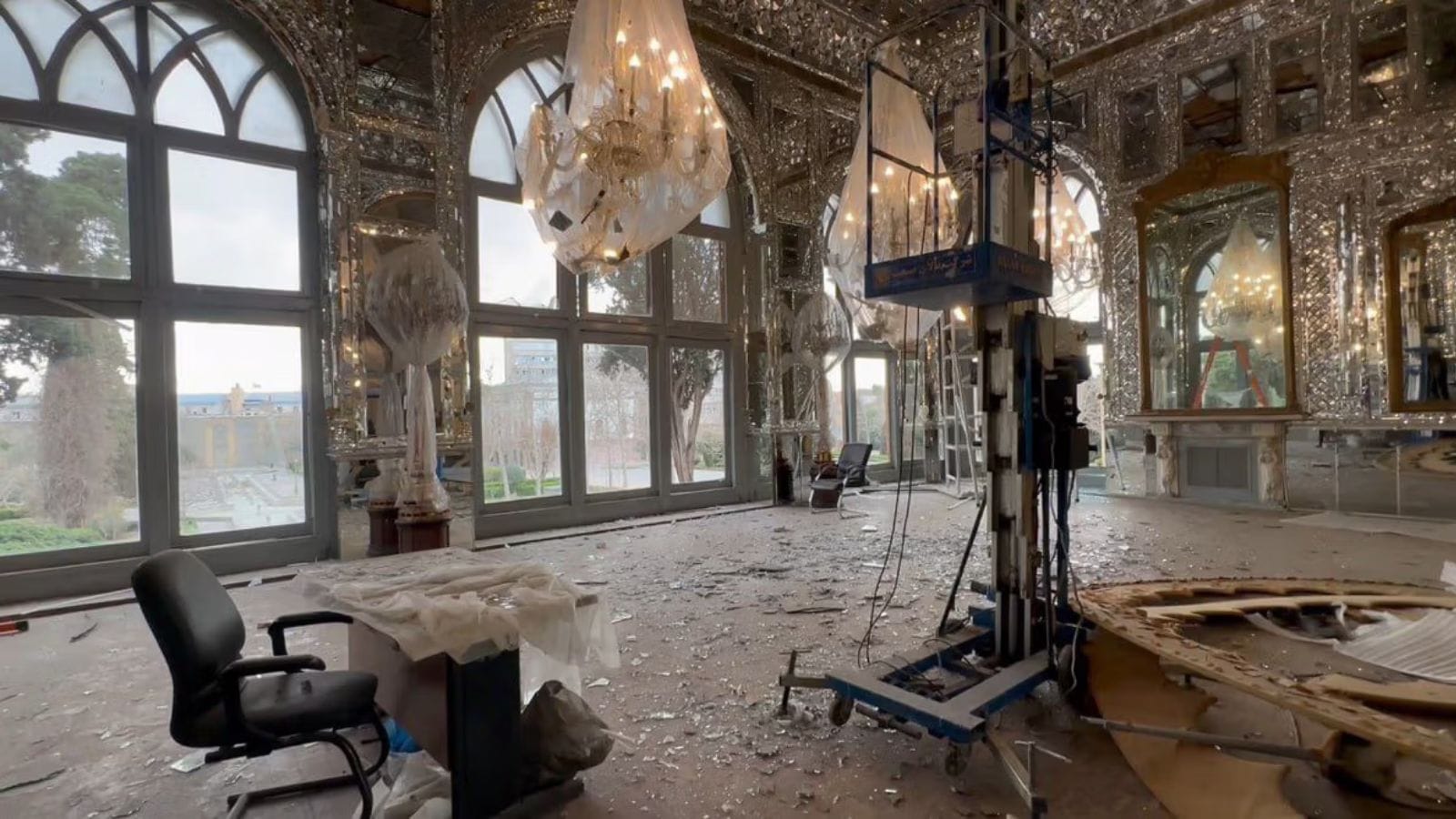
The damage sustained by the Golestan Palace during recent kinetic activity in Tehran represents more than a localized loss of Mughal-era Persian architecture; it identifies a systemic collapse in the "Protection-by-Design" protocols intended to insulate UNESCO World Heritage sites from modern urban warfare. When high-precision munitions intersect with 19th-century tilework and mirrored halls, the resulting destruction is rarely a byproduct of simple proximity. Instead, it is the result of a specific failure in three distinct operational layers: the spatial buffer zones defined by international treaties, the structural resilience of vernacular materials against overpressure, and the geopolitical enforcement of the 1954 Hague Convention.
The Architecture of Vulnerability: Material and Structural Thresholds
To quantify the impact on the Golestan Palace, one must analyze the physical resistance of its primary components. The palace complex, a masterpiece of the Qajar era that fused Persian craftsmanship with Western architectural influences, is characterized by its fragility.
The Overpressure Variable
Traditional masonry and intricate tilework (kashi-kari) possess high compressive strength but near-zero tensile strength. When an aerial detonation occurs, the resulting blast wave creates a rapid fluctuation in atmospheric pressure. For the "Shams-ol-Emareh" (Edifice of the Sun), even a non-direct hit induces vibrational frequencies that exceed the mortar’s bonding capacity.
- Fragmentation: Modern munitions are designed for maximum kinetic distribution. The palace’s expansive use of exterior ceramics makes it a high-probability target for "scouring," where high-velocity debris strips the aesthetic facade even if the core structure remains standing.
- Acoustic Resonance: The Hall of Mirrors (Talar-e Aineh) operates as a geometric trap for sound waves. A pressure spike outside the structure is magnified as it enters the enclosed space, shattering thousands of hand-cut mirror fragments through simple resonance, a process that is effectively irreversible given the bespoke nature of the original installation.
The Failure of Spatial Neutrality
UNESCO designations rely on the "Buffer Zone" concept—a defined geographic perimeter where military activity is theoretically prohibited to prevent collateral damage. In the case of the Golestan Palace, located in the heart of Tehran’s historical core, this buffer zone has become a strategic liability.
The proximity of the palace to central government administrative centers creates a "Proximity Trap." When military targets are nested within an urban fabric that contains high-value cultural assets, the protective status of the monument is diluted by the operational necessity of the strike. This identifies a fundamental flaw in the 1954 Hague Convention for the Protection of Cultural Property in the Event of Armed Conflict: the "Military Necessity" clause. This loophole allows a party to waive the immunity of a site if it is being used for military purposes or if the tactical advantage of a strike outweighs the cultural loss.
The Economic and Socio-Political Cost Function
The damage to the Golestan Palace is not a static loss; it is a compounding economic drain on the state. The cost of restoration is governed by three primary variables:
- Material Scarcity: The specific clays and pigments used in Qajar-era tiling are no longer in mass production. Sourcing authentic replacements requires small-batch artisanal recreation, which inflates the per-square-meter cost by a factor of ten compared to modern materials.
- Intellectual Capital: Restoration requires "living heritage"—craftspeople who possess the tacit knowledge of traditional techniques. Every year of delay in restoration risks the permanent loss of these skills as the aging demographic of master artisans retires.
- Tourism Yield: As a UNESCO site, the Golestan Palace is a primary driver of Tehran’s cultural tourism revenue. Physical degradation directly correlates to a decrease in "Site Desirability Index," leading to a projected 15-22% drop in high-value international visitors once travel resumes.
Institutional Response and the "Paper Shield" Effect
The urgent warning issued by UNESCO functions as a diplomatic signal but lacks a mechanical enforcement vector. The international community currently utilizes a "Naming and Shaming" strategy, which is ineffective against actors who prioritize immediate tactical objectives over long-term cultural standing.
The primary bottleneck in protecting the Golestan Palace lies in the lack of an "Active Defense" protocol for heritage sites. While "Blue Shield" markings are intended to deter strikes, they provide no physical protection against the automated logic of GPS-guided or AI-driven munitions that may misidentify a target or suffer from circular error probability (CEP) drift.
The Data Gap in Heritage Documentation
A significant failure in the preservation strategy for the Golestan Palace was the incomplete digitization of its structural components.
- BIM (Building Information Modeling): Without a high-fidelity 3D map of the palace before the strike, restoration efforts will rely on photographs and memory, introducing "Historical Drift"—where the restored site is a contemporary interpretation rather than a factual reconstruction.
- Seismic Sensors: The absence of real-time vibration monitoring during the strike means that internal structural micro-cracks may go undetected, leading to a catastrophic collapse during the next minor seismic event in the Tehran basin.
Strategic Reclassification of Cultural Assets
To prevent the total erasure of Mughal-influenced Persian history, the management of sites like the Golestan Palace must shift from a "Museum Model" to a "Resiliency Model." This requires the immediate implementation of three tactical shifts:
- Hardened Storage: All movable artifacts, including the legendary Takht-e Marmar (Marble Throne), must be relocated to subterranean, vibration-isolated vaults. Leaving high-value assets in situ during periods of heightened geopolitical tension is an analytical failure.
- Digital Swinning: Creating a "Digital Twin" of the site via LiDAR scanning is the only way to ensure that the mathematical proportions of the Qajar architecture can be replicated with millimeter precision following structural failure.
- Neutral Zone Renegotiation: The international community must move toward a "Hard Buffer" system where certain high-value heritage zones are digitally geofenced within munition guidance systems, rendering them "No-Strike" zones at the software level.
The current state of the Golestan Palace is a warning that the "Universal Value" of heritage is a fragile construct when faced with the cold calculus of modern warfare. The preservation of history is no longer a task for historians alone; it is a problem of engineering, data science, and hard-line diplomatic engineering.
The immediate move for the Iranian Ministry of Cultural Heritage and international observers is not a plea for peace, but the rapid deployment of a standardized "Heritage Impact Assessment" (HIA) to map the micro-structural damage before environmental exposure degrades the exposed masonry further. Every hour the interior mirrors and tiles remain exposed to urban pollutants through broken windows, the cost of restoration increases by an estimated 1.5%. Stabilization of the site’s climate control and structural shoring must take precedence over political rhetoric to prevent a "Slow-Motion Collapse" of the remaining edifice.