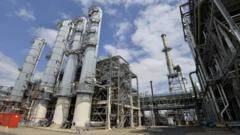
The reopening of a dedicated carbon dioxide (CO2) production facility under a national "war contingency" framework represents a fundamental shift from market-based procurement to state-backed resource security. In high-output industrial economies, CO2 is not merely a byproduct; it is a critical utility. When supply chains for this gas fail, the resulting paralysis spans the food preservation, nuclear power, and medical sectors. The decision to restart dormant infrastructure—specifically within the United Kingdom's recent energy maneuvers—exposes the fragility of "just-in-time" chemical sourcing and the necessity of a localized strategic reserve.
The Tri-Sector Dependency Model
To understand why a single plant closure can trigger a national emergency, one must map the three primary pillars of CO2 consumption. These sectors do not have readily available substitutes, creating a hard floor for demand that market pricing cannot easily suppress without causing systemic collapse.
1. The Cold Chain and Food Security
CO2 is the primary medium for both the stunning of livestock and the creation of "dry ice" (solid-state CO2) used for temperature-controlled logistics. The gas is also used in Modified Atmosphere Packaging (MAP). By displacing oxygen with CO2 in plastic packaging, producers inhibit the growth of aerobic bacteria, extending the shelf life of fresh produce by up to 200%. Without this chemical intervention, the rate of food spoilage increases linearly, leading to immediate inventory loss and a subsequent spike in consumer-level inflation.
2. Advanced Gas-Cooled Reactor (AGR) Stability
The United Kingdom's specific reliance on CO2 for its nuclear power fleet is a structural outlier compared to most global energy grids. AGRs use pressurized CO2 as a primary coolant to transfer heat from the reactor core to the steam generators. If the supply of high-purity CO2 is interrupted, the reactors must be powered down for safety, removing gigawatts of baseload power from the grid. This creates a direct link between industrial chemical production and national energy security.
3. Medical and Beverage Logistical Integrity
Beyond the food chain, CO2 is utilized for minimally invasive surgeries (to inflate the abdomen) and as a crucial component in some medical gas mixtures. In the beverage industry, carbonation is a non-negotiable input for soft drinks and beer. While the beverage sector can sustain temporary shortages through production cuts, the medical sector's demand is inelastic.
The Cost Function of Synthetic CO2 Recovery
The primary bottleneck in CO2 production is its traditional status as a byproduct of ammonia synthesis for fertilizer. This relationship creates a dangerous "co-dependency loop" where the availability of CO2 is governed by the global price of natural gas ($CH_4$).
The chemical equation for the Steam Methane Reforming (SMR) process is:
$$CH_4 + 2H_2O \rightarrow CO_2 + 4H_2$$
In this reaction, the primary goal is $H_2$ for ammonia production. When the price of natural gas rises above a certain threshold, ammonia production becomes unprofitable, leading to plant shutdowns. Because the CO2 is merely a captured byproduct, its supply vanishes the moment the fertilizer production ceases. Reopening a plant specifically for CO2—as seen in the "war contingency" model—inverts this economics. The CO2 becomes the primary product, and the energy costs are subsidized to maintain the chemical flow.
The Mechanics of Industrial Resilience
A "war contingency" or strategic restart requires the government to absorb the price delta between the market rate of CO2 and its elevated production cost in a high-energy-price environment. This is essentially a national insurance premium. The mechanism involves:
- Variable-Cost Subsidies: Directly covering the difference in natural gas inputs to keep the SMR process active.
- Minimum Offtake Agreements: Ensuring the plant operator has a guaranteed buyer even if global fertilizer prices drop and make domestic production temporarily uncompetitive.
- Logistical Command: Using state authority to prioritize CO2 delivery to high-impact sectors like nuclear cooling and food processing over non-essential industrial uses.
Strategic Constraints and Technical Barriers
A plant cannot simply be "switched on" like a light. Industrial chemical facilities face significant degradation during periods of dormancy. Reopening a facility under an emergency plan requires a rapid assessment of:
- Catalyst Integrity: The catalysts used in the SMR process are highly sensitive to temperature fluctuations and contamination. If a plant has been cold for months, these expensive materials often require replacement or complex regeneration.
- Corrosion and Fouling: CO2, when combined with water vapor, forms carbonic acid ($H_2CO_3$), which is corrosive to standard carbon steel. Dormant plants often suffer from localized thinning of pressure vessels and piping that must be non-destructively tested (NDT) before reactivation.
- Purity Calibration: Food and medical grade CO2 requires a purity level of 99.9% or higher. Small concentrations of sulfur or benzene, common in raw syngas, must be scrubbed with extreme precision. The restart phase involves a "flare-off" period where off-spec gas is vented until the scrubbers reach thermal and chemical equilibrium.
The Decoupling of Ammonia and CO2
The current crisis highlights a strategic error in relying on a byproduct-dependent supply chain. To achieve long-term resilience, industrial policy must shift toward dedicated carbon capture (CC) technologies that are independent of fertilizer production.
Direct Air Capture (DAC) and Point-Source Capture (PSC) at cement or steel plants represent the next stage of this evolution. These methods decouple CO2 production from the volatile global natural gas and fertilizer markets. While the current cost of PSC is higher than byproduct recovery from ammonia plants, the "security premium" of having a reliable, non-volatile source of CO2 for nuclear reactors and food chains justifies the capital expenditure (CAPEX).
The Strategic Operational Blueprint
To mitigate future supply shocks, the following actions are required to transform a temporary contingency into a permanent security framework:
- Diversification of Sourcing: Mandating that critical sectors (nuclear, medical) source at least 30% of their CO2 from non-ammonia related capture technologies.
- Strategic Liquefaction Reserves: Building high-capacity, cryogenic storage tanks that can hold a 90-day national supply of liquid CO2, similar to strategic petroleum reserves.
- Modular SMR Deployment: Investing in smaller, modular ammonia/CO2 plants that can be throttled up or down based on local demand rather than relying on massive, centralized industrial complexes that are "all or nothing" operations.
The move to reopen a shuttered plant under emergency conditions is a tactical success but a strategic warning. It confirms that in the modern industrial economy, chemical sovereignty is as critical as energy or food sovereignty. The goal is no longer just finding the cheapest CO2 on the global market; it is ensuring that the molecule is available exactly when the cooling system or the cold chain demands it.
Would you like me to map the specific cost-per-tonne delta between ammonia-byproduct CO2 and Direct Air Capture to assist in long-term CAPEX planning?