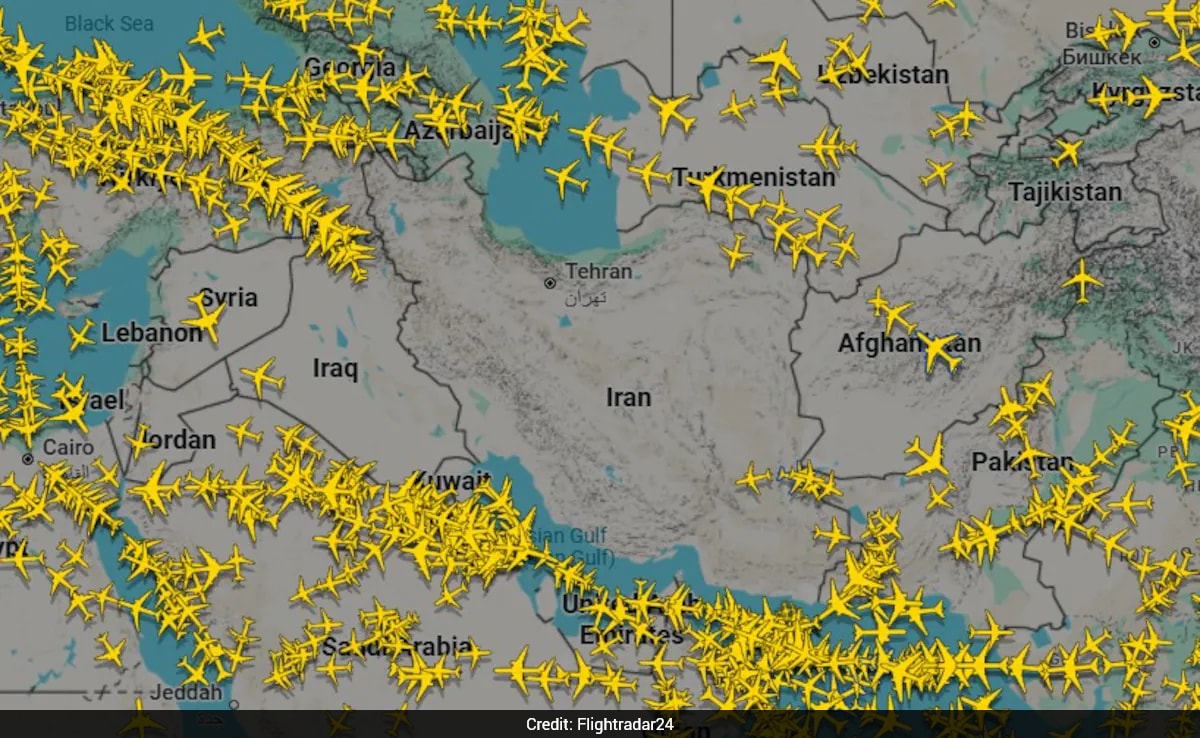
The closure of Iranian airspace following Israeli kinetic action is not merely a localized security measure; it is a systemic shock to the global aviation logistics network that forces a total recalculation of operational risk and fuel-burn efficiency. When a primary transit corridor—specifically the Tehran Flight Information Region (FIR)—goes dark, the resulting rerouting triggers a cascade of second-order effects that degrade the profitability of long-haul carriers and stress the infrastructure of neighboring sovereign territories.
The immediate suspension of flights at Imam Khomeini International Airport and the issuance of NOTAMs (Notice to Air Missions) serve as the primary mechanism for state-level risk mitigation. This decision-making process is governed by a specific cost-benefit calculus: the political and safety cost of a potential civilian hull loss versus the economic hemorrhage of lost transit fees and domestic connectivity.
The Tri-Node Risk Architecture
Aviation security in high-conflict zones functions through three distinct layers of risk assessment. The Iranian closure represents a failure of the first two, forcing the activation of the third.
- Kinetic De-escalation Probability: The likelihood that active hostilities will cease within a 24-hour window. When Israel initiates a strike, the Iranian response window remains open, creating a state of "unpredictable kinetic potential" that makes civilian flight paths untenable.
- Electronic Warfare and Signal Interference: Modern strikes are rarely purely kinetic. The deployment of GPS spoofing and Meaconing (the interception and rebroadcast of navigation signals) creates a "dark zone" where automated flight systems cannot be trusted. For a carrier, the risk of a "controlled flight into terrain" (CFIT) due to jammed signals outweighs the logic of maintaining the route.
- The Overflight Revenue Vacuum: Iran generates significant hard currency through overflight fees. Shutting down the FIR is a self-inflicted economic wound, signaling that the perceived threat to internal regime stability or military assets has bypassed the threshold of economic endurance.
The Efficiency Penalty: Mapping the Reroute Calculus
When the Tehran FIR closes, traffic is diverted primarily into the Iraqi and Saudi Arabian corridors. This is not a simple detour; it is a fundamental shift in the Global Great Circle Logic. The Great Circle route is the shortest distance between two points on a sphere, and for routes connecting Western Europe to Southeast Asia, the Iranian plateau is the geographical fulcrum.
The Fuel-Time Congestion Loop
The diversion of flights into the "Baku-Ankara" or "Riyadh-Dubai" corridors creates three specific operational bottlenecks:
- Fuel Payload Penalty: For every 10 minutes of additional flight time, a Boeing 777-300ER consumes approximately 800-1,000 kg of additional Jet A-1 fuel. On a 12-hour haul, a 45-minute reroute requires the aircraft to take off heavier, which in turn increases the burn rate per hour—a phenomenon known as the "fuel-to-carry-fuel" penalty.
- Crew Duty Limitations: International civil aviation regulations mandate strict "Flight Duty Period" (FDP) limits. A closure in Iran can push a flight from a standard 13-hour duty day into a 14-plus hour emergency scenario. This often necessitates unplanned technical stops in cities like Istanbul or Doha solely for crew swaps, doubling the landing and ground handling costs.
- Air Traffic Control (ATC) Saturation: The sudden influx of 40–70 widebody aircraft into Turkish or Iraqi airspace creates a "stacking" effect. To maintain separation, ATC must increase longitudinal spacing, effectively slowing down the entire global flow of traffic and causing arrival delays that ripple into the next day's flight rotations.
Tactical Response and the "Dark Sky" Protocol
The moment the first explosions are reported or the NOTAM is issued, airline Operations Control Centers (OCCs) pivot to a pre-defined tactical playbook. This isn't a manual process; it is a data-driven redirection.
The Dispatcher's Hierarchy of Needs
The flight dispatcher must prioritize variables in a specific sequence to prevent a total fleet grounding:
- The Point of No Return (PNR): For aircraft already in the air, the dispatcher calculates the PNR. If the aircraft has not yet crossed into the Iranian FIR, it must be diverted to a "bolt-hole" airport (e.g., Baku, Tashkent, or Dubai). If it has passed the PNR, the aircraft must continue, often under high-altitude "silent" procedures or immediate emergency descent to exit the zone.
- Insurance Breach Thresholds: Most commercial hull insurance policies contain "War Risk" clauses. Flying into a shuttered FIR or a zone with an active NOTAM regarding missile activity voids the policy instantly. The carrier is then operating a $250 million asset with zero financial protection, a risk no board of directors will authorize.
- The Cargo Perishability Matrix: In the belly of these rerouted planes sits high-value, time-sensitive freight (semiconductors, pharmaceuticals). A 5-hour delay caused by Iranian airspace closure can result in the total loss of cargo value for specific temperature-controlled biotics.
Geopolitical Leverage via Infrastructure Control
The closure of airspace is often used as a tool of "Non-Kinetic Signaling." By shutting down its skies, Iran forces the international community—specifically Western economies and Asian manufacturing hubs—to feel the friction of the conflict. It is a reminder that the Iranian geography is a choke point not just for maritime oil (Strait of Hormuz) but for the digital and physical "Cloud" of global aviation.
The "Strategic Depth" of Iranian territory allows it to use its sky as a shield. By clearing civilian traffic, the military can operate Air Defense Systems (such as the S-300 or Khordad-15) without the risk of a "Type I Error"—the accidental downing of a civilian airliner, as seen with Ukraine International Airlines Flight 752. This clearance is a prerequisite for a "Free-Fire Zone," signaling to Israel that Iran is prepared for a sustained engagement where any transponder in the sky is categorized as hostile.
Structural Bottlenecks in Neighboring Corridors
As traffic migrates, the pressure shifts to the Caspian-Turkish Bottleneck.
- The Narrow Corridor Problem: Northern routes around Iran must pass through a narrow strip of airspace between the Russian border (which is restricted due to the Ukraine conflict) and the Iranian border. This creates a "funnel" effect where lateral separation is minimized, increasing the cognitive load on ATC and raising the probability of mid-air incidents.
- The Southern Pivot: Diversions through Saudi Arabia and Egypt add thousands of miles to Asia-Europe routes. This increases the global demand for jet fuel, marginally pushing up Brent Crude prices as airlines scramble for spot-market fuel in diversion hubs.
The Long-Term Erosion of Hub Dominance
Repeated closures of Iranian airspace threaten the "Super-Connector" business model utilized by Middle Eastern carriers. The viability of hubs like Doha, Dubai, and Abu Dhabi relies on the "Seamless Transfer." If passengers perceive that flying through the Persian Gulf carries a 20% risk of an 8-hour delay or a mid-air diversion due to regional strikes, the market will shift toward the "Trans-Pacific" or "Polar" routes, even if they are more expensive.
The structural fragility of the Tehran FIR is now a permanent line item in the risk registers of global airlines. Carriers are moving away from "Just-in-Time" routing toward "Resilient Routing," which assumes the Iranian corridor is permanently compromised. This shift increases the baseline cost of global trade, as the "Conflict Premium" is baked into every ticket and every shipping container moved by air.
Operational stability in the region requires more than a ceasefire; it requires a restoration of the "Technical Trust" between Tehran's civil aviation authority and the ICAO (International Civil Aviation Organization). Until that trust is rebuilt, the "skies over Persia" remain a phantom corridor—present on maps, but effectively deleted from the global logistics engine.
Airlines must now implement an Asymmetric Contingency Framework. This involves pre-positioning "Shadow Crews" in secondary hubs like Istanbul and Muscat and maintaining a 5% "Fuel Buffer" on all regional sorties, regardless of the projected flight plan. The era of optimizing for the shortest path is over; the new optimization metric is "Strike-Proof Duration." Carriers that fail to internalize this will face catastrophic margin erosion during the next inevitable closure.


