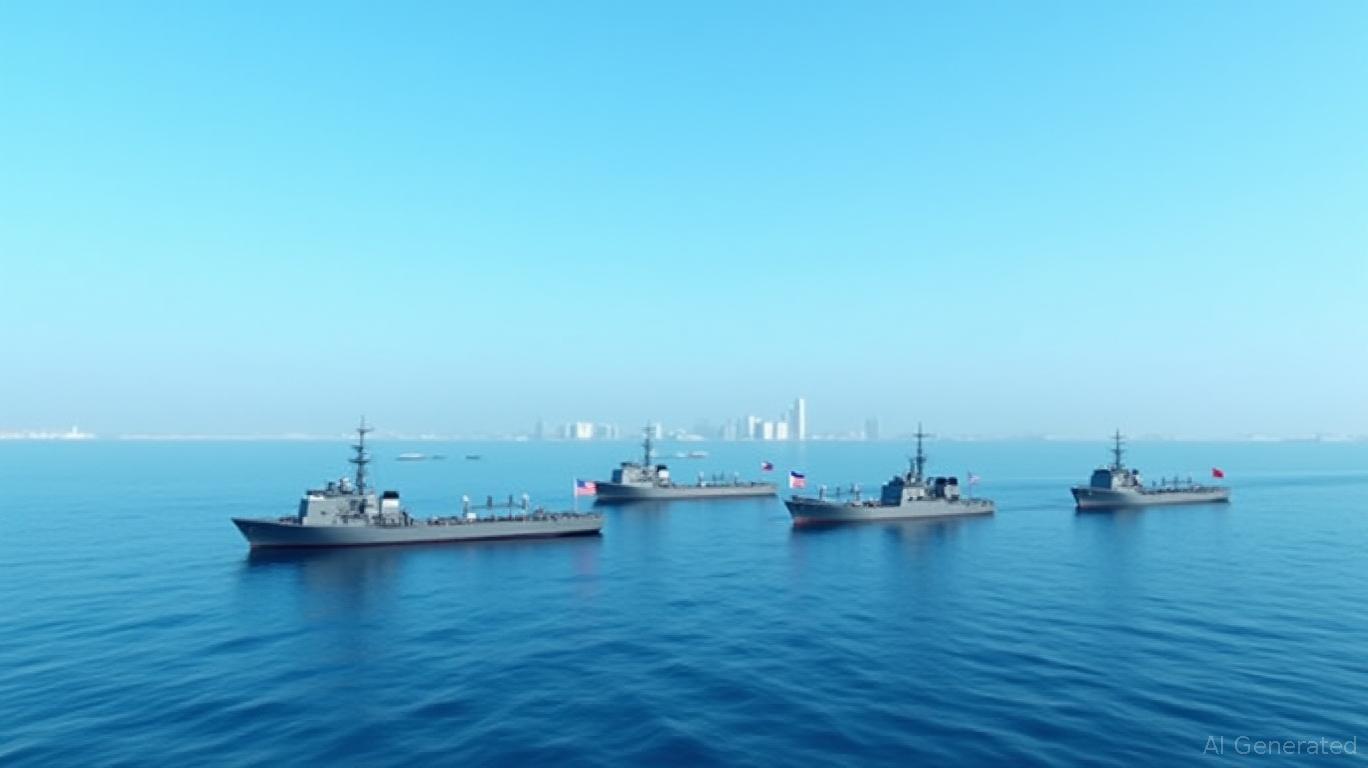
The recent verbal firestorm from Iran’s Islamic Revolutionary Guard Corps (IRGC) toward the American presidency is more than just a collection of taunts. When IRGC commanders tell a U.S. leader they are "fired" or mock ultimatums regarding the Strait of Hormuz, they are performing a choreographed act of asymmetric signaling. This isn't just about bravado. It is about the tactical reality of a chokepoint that handles roughly 20% of the world’s petroleum liquids. To understand the "why" behind the IRGC’s latest mockery, one must look past the headlines and into the geography of naval defiance.
The IRGC thrives on the optics of the David vs. Goliath narrative. By publicly dismissing American threats, the Iranian military apparatus reinforces its domestic legitimacy and its standing among regional proxies. However, the true story lies in the hardware and the specific maritime doctrine Iran has spent three decades perfecting. They aren't planning to win a traditional broadside naval battle against a U.S. Carrier Strike Group. They are planning to make the cost of entry into the Persian Gulf so high that the global insurance market collapses before a single shot is fired. You might also find this similar article insightful: Strategic Asymmetry and the Kinetic Deconstruction of Iranian Integrated Air Defense.
The Geography of a Chokepoint
The Strait of Hormuz is a narrow ribbon of water. At its narrowest point, the shipping lanes are only two miles wide in either direction, separated by a two-mile buffer zone. This physical constraint dictates the entire geopolitical chess match. If you control the heights of the Musandam Peninsula and the Iranian coastline, you effectively hold a shotgun to the throat of the global energy market.
Iran’s strategy is built on anti-access/area denial (A2/AD). While the U.S. Navy relies on massive, sophisticated platforms, the IRGC Navy (IRGCN) relies on "swarm" tactics. Imagine hundreds of fast-attack craft, some no larger than a standard speedboat, outfitted with anti-ship missiles or weighted with explosives. In a confined space like the Strait, these small targets are difficult for traditional radar to track and even harder for large-scale defensive systems to neutralize simultaneously. As highlighted in latest coverage by USA Today, the effects are widespread.
The mockery coming out of Tehran is a reflection of this perceived advantage. When they tell a U.S. President his ultimatums are meaningless, they are betting on the fact that the U.S. cannot protect every tanker, every minute, without triggering a full-scale conflict that would send oil prices into a vertical climb.
The Drone Factor and the Shift in Power Scales
The IRGC’s confidence has grown significantly due to their advancements in unmanned aerial vehicles (UAVs) and loitering munitions. We have seen these systems exported to various conflict zones, proving their effectiveness against much more expensive defensive arrays. In the Persian Gulf, these drones serve as the IRGC’s eyes and their long-range sting.
By utilizing low-cost, high-yield technology, Iran has shifted the economic math of a potential conflict. It costs a few thousand dollars to build a suicide drone; it costs millions of dollars for a destroyer to fire an interceptor missile to take it down. The IRGC knows this disparity. Their rhetoric is designed to remind the West that in a war of attrition, the side with the cheaper "bullets" often has the last laugh.
Beyond the Rhetoric of Firing a President
The "You're Fired" comments directed at Donald Trump or any sitting American official are tactical psychological operations. The IRGC understands Western media cycles perfectly. They know that a snappy, insulting quote will travel further and faster than a dry technical report on their new missile silos. This creates a feedback loop where the IRGC appears more powerful than their traditional military metrics might suggest.
But we must look at the internal pressure within Iran. The IRGC is not just a military branch; it is a massive corporate conglomerate that controls significant portions of the Iranian economy, from construction to telecommunications. Maintaining an external "Great Satan" is essential for justifying their grip on domestic power. When the U.S. imposes sanctions or issues ultimatums, it provides the IRGC with the perfect "external threat" to squash internal dissent. The mockery is a tool for domestic consumption as much as it is a message for Washington.
The Mine Warfare Reality
While drones and speedboats get the most camera time, the most "hard-hitting" threat in the IRGC arsenal is the humble sea mine. The waters of the Persian Gulf are relatively shallow, making them ideal for mine-laying operations. Iran possesses a vast stockpile of both sophisticated bottom-moored mines and "dumb" contact mines.
In any actual escalation, the IRGC doesn't need to sink the entire U.S. Fifth Fleet. They only need to sink one or two commercial tankers. Once the world sees a burning ship in the Strait, Lloyd’s of London will likely skyrocket insurance premiums to the point where shipping becomes unviable. The IRGC’s mockery is backed by the knowledge that they can paralyze the world economy with tools that date back to the 20th century.
The Proxy Network as a Force Multiplier
The IRGC’s influence extends far beyond the Iranian coastline. Through the Quds Force, they maintain a "Ring of Fire" around their interests. From the Houthis in Yemen to various militias in Iraq and Syria, the IRGC has the capability to open multiple fronts simultaneously.
When an IRGC general mocks a U.S. ultimatum, he is signaling to these proxies that the "center" remains defiant. This keeps the network motivated. If the U.S. were to strike the IRGC directly in response to a Hormuz provocation, the retaliation might not come from Iran at all. It could come from a drone launched in Iraq or a missile fired from Yemen. This layered defense makes any direct military action against the IRGC a logistical nightmare.
The Limits of Asymmetric Defiance
However, there is a ceiling to this strategy. The IRGC’s bravado often masks significant vulnerabilities. Their conventional air force is a collection of aging airframes held together by smuggled parts. Their domestic population is increasingly frustrated with an economy crippled by the very tension the IRGC fosters.
There is a risk of miscalculation. The IRGC bets on the idea that the U.S. is "war-weary" and will not risk a major conflict over a few "minor" provocations. But red lines are often blurry until they are crossed. If a "mockery" translates into a kinetic action that results in significant American or allied casualties, the asymmetric advantage vanishes in the face of a sustained, high-intensity conventional campaign. The IRGC is playing a high-stakes game of "chicken" where the sidewalk is the global energy supply.
The Economic Shockwave
If the IRGC were to ever move beyond mockery and actually attempt to close the Strait, the immediate impact would be a global recession. We aren't just talking about higher prices at the pump. We are talking about the disruption of global supply chains that rely on cheap energy.
- Crude Oil Volatility: Prices could jump by $30 to $50 per barrel within 48 hours.
- Liquefied Natural Gas (LNG): Qatar, one of the world's largest LNG exporters, sends almost all its gas through the Strait. A blockage would freeze the energy markets in Europe and Asia.
- Insurance Collapse: As mentioned, the maritime insurance industry would likely cease coverage for the region, effectively halting all traffic regardless of the actual military situation.
The IRGC knows that the mere threat of these outcomes is their greatest weapon. Their insults and memes are just the delivery mechanism for a very serious economic threat.
Tactical Innovation or Desperation?
Looking at the IRGC’s recent military exercises, we see an emphasis on "smart" naval mines and autonomous submersibles. These are the tools of a force that knows it cannot win a fair fight. They are doubling down on the invisible and the unpredictable.
The U.S. response has been to increase the "International Maritime Security Construct," a coalition of nations designed to provide overwatch for commercial shipping. But even with the best technology, protecting a tanker that is nearly a quarter-mile long against a submerged mine or a swarm of twenty speedboats is a statistical challenge. The IRGC’s mockery is grounded in this mathematical reality. They only have to be right once; the defenders have to be right every single time.
The IRGC’s taunts are not the ramblings of a disorganized militia. They are the calculated communications of a sophisticated regional power that has identified the exact pressure points of the global order. They use the language of the internet and the bravado of the street to mask a cold, hard strategy of maritime extortion. The "Fired" comments and the Hormuz ultimatums are two sides of the same coin. They are designed to keep the West off balance, to keep the Iranian public focused outward, and to ensure that the IRGC remains the most powerful entity in the Middle East.
Ignoring the rhetoric as "just talk" is a mistake. It is the soundtrack to a very real and very dangerous buildup of asymmetric capability. The next time an IRGC commander mocks a Western leader, look not at the words, but at the satellite imagery of the fast-attack craft bases lining the Persian Gulf. That is where the real conversation is happening.
Monitor the movement of the IRGC’s "spy ships" and the deployment of new drone batteries along the coast. Those are the true indicators of intent. The mockery is just the smoke; the capability is the fire.