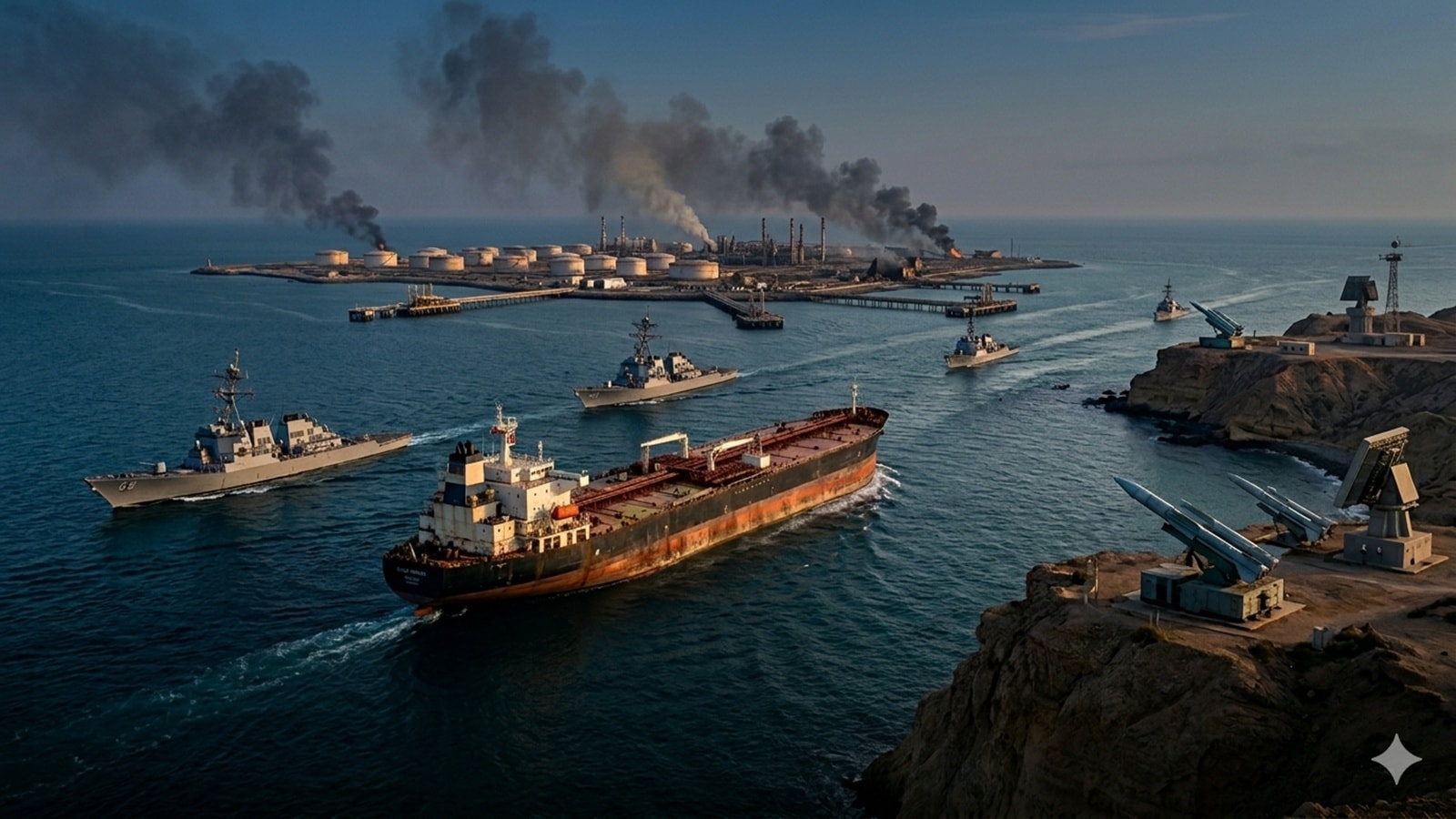
The prevailing wisdom in Washington and among armchair admirals is a dangerous fantasy. It suggests that if Iran decides to shutter the Strait of Hormuz, the United States military can simply execute a "police action" to kick the door back open. They talk about minesweeping as if it’s a chore and suppression of enemy air defenses as a weekend project.
They are wrong.
The belief that the US can "forcibly reopen" the Strait ignores the fundamental shift in 21st-century asymmetric warfare. We aren't looking at a conventional naval battle. We are looking at the world’s most claustrophobic killing zone. The Strait of Hormuz is not an ocean; it is a 21-mile-wide alleyway where the most expensive warships in history are essentially sitting ducks for dirt-cheap technology.
The Arithmetic of Failure
Think about the sheer physics of the chasm. At its narrowest, the shipping channels are only two miles wide. On one side, you have the jagged, mountainous coastline of Iran, a natural fortress perfect for hiding mobile missile launchers and swarms of fast-attack craft.
The "lazy consensus" assumes that US Carrier Strike Groups (CSGs) will sit in the Gulf of Oman and launch precision strikes until the threat evaporates. This assumes Iran plays by 1940s rules. It won't. Iran has spent thirty years perfecting Anti-Access/Area Denial (A2/AD).
If you want to open the Strait, you have to clear the mines. To clear the mines, you need minesweepers. Minesweepers are slow, vulnerable, and poorly armed. To protect the minesweepers, you need to bring in the destroyers and cruisers. Now you’ve just moved your billion-dollar assets into a "kill box" where they can be saturated by thousands of $20,000 drones and shore-based anti-ship cruise missiles (ASCMs) like the Noor or the Ghadir.
The math is brutal. An Aegis destroyer’s vertical launching system (VLS) has a finite number of interceptors. If Iran launches a swarm of 100 drones, 50 speedboats, and 10 cruise missiles simultaneously, the ship’s computer might prioritize correctly, but the magazine will eventually run dry. You cannot "force" a passage when the cost of the defense is a fraction of the cost of the offense.
The Mine Warfare Trap
Let’s talk about the "M" word that every naval strategist fears but rarely discusses with honesty: Mines.
The US Navy’s mine countermeasure (MCM) capabilities are, to put it bluntly, an afterthought. We have spent trillions on stealth fighters and nuclear submarines while letting our minesweeping fleet wither. Iran possesses an estimated 3,000 to 5,000 naval mines, ranging from "dumb" contact mines to sophisticated acoustic and magnetic influence mines that sit on the seafloor and wait for a specific hull signature.
When a mine goes off, the Strait is effectively closed. Not because the water is blocked by debris, but because no commercial insurance company on earth—not Lloyd's of London, not anybody—will insure a tanker to sail through a live minefield.
To "forcibly reopen" the Strait, the US would need to achieve total sea and air command. This isn't a quick fix. Experts like Dr. Joshua Tallis have pointed out that mine clearing is a slow, methodical process that takes weeks, if not months, under ideal conditions. Doing it while being shot at from the Iranian coast is a suicide mission.
The Myth of the "Surgical Strike"
The competitor's narrative often leans on the idea of a "surgical strike" against Iranian coastal batteries. This is a misunderstanding of geography and modern camouflage.
Iran doesn't have a few big missile bases you can just crater and go home. They have "missile cities"—vast underground complexes carved into the mountains along the Persian Gulf. They use highly mobile transporters (TELs) that can roll out of a cave, fire, and disappear back into the rock before a Tomahawk can even find its coordinates.
You don't "suppress" this kind of threat. You have to occupy the coastline. To truly secure the Strait, you would need a massive ground invasion of the Iranian mainland to seize the high ground overlooking the shipping lanes. Is the US public ready for a third Gulf War that makes the occupation of Iraq look like a scouting trip? Because that is what "forcibly reopening" actually looks like.
The Asymmetric Nightmare: The Swarm
In 2002, the US military conducted a war game called Millennium Challenge. The "Red" team, led by retired Marine Lt. Gen. Paul Van Riper, used a fleet of small, fast boats and civilian planes to launch a massive, uncoordinated strike against a superior "Blue" naval force.
The result? The US fleet was decimated. Sixteen major warships were sunk in the simulation.
The Pentagon's response was to reset the game and change the rules because they didn't like the outcome. But you can’t reset reality. Iran has internalized the lessons of Millennium Challenge. They don't want a fair fight. They want a "saturation attack."
- Fast Attack Craft (FAC): Hundreds of small boats, some manned, some autonomous, armed with rockets and torpedoes.
- Loitering Munitions: Low-cost suicide drones that can circle the area for hours, waiting for a radar signature to lock onto.
- Submarines: Not just the big ones, but the Ghadir-class midget subs that are incredibly difficult to track in the shallow, noisy waters of the Persian Gulf.
The Economic Suicide Pact
The most counter-intuitive part of this entire scenario is that "winning" the military battle might still mean losing the war.
The global economy relies on the 21 million barrels of oil that pass through the Strait daily. If the US starts a "forceful" reopening, the kinetic activity alone—missiles flying, ships burning, oil spilling—will send Brent Crude to $200 or $300 a barrel instantly.
The US military might technically "clear" the Strait after three months of grueling, high-casualty warfare, but by the time the first tanker moves, the global financial system will have already suffered a catastrophic heart attack. The "solution" of a forced opening is, in many ways, just as damaging as the closure itself.
The "Tanker War" Redux
People point to the 1980s "Tanker War" as proof that the US can protect shipping. They forget that during Operation Praying Mantis, the US was fighting a much less sophisticated Iranian military. Today’s IRGC Navy is a different animal.
Back then, we were worried about Silkworm missiles. Now, we have to worry about the Khalij Fars, a supersonic anti-ship ballistic missile. Trying to intercept a ballistic missile coming at a near-vertical angle while also fending off a swarm of drones and avoiding sea mines is a level of multi-domain complexity that has never been tested in actual combat.
The Real Power Play
The obsession with "reopening" the Strait is the wrong framework. It assumes the US is the only player with an interest in the water.
The reality is that China is the primary customer for that oil. If the Strait closes, Beijing feels the pain more than Washington does. By framing this as a US military problem that must be solved with carriers, we are playing into a 20th-century script.
The most effective way to "open" the Strait isn't through a VLS cell; it's through regional diplomacy that makes the closure too expensive for Iran’s partners to tolerate. But the hawks don't want to hear that. They want the spectacle of the carrier strike group, ignoring the fact that those carriers are now liabilities in the Gulf, not assets.
The Hard Truth of Naval irrelevance
We have reached a point where the "capital ship"—the aircraft carrier—is being pushed out of littoral waters by the democratization of precision strike technology.
If you put a $13 billion Ford-class carrier inside the Persian Gulf during a conflict, you are risking a national symbol for a mission that can be neutralized by a few million dollars worth of Iranian hardware. The Strait of Hormuz is the place where the era of US naval hegemony goes to die.
You cannot force open a door when the person holding it shut has a gun pointed at your head and doesn't mind if the whole house burns down. The "forcible reopening" is a myth sold to keep the defense budget bloated and the public complacent. In a real shooting war, the Strait stays closed until the political cost of the carnage forces a ceasefire.
Stop looking at the Strait as a tactical puzzle to be solved with more firepower. It is a strategic checkmate. If the mines go in the water, the global economy goes into the dark, and no amount of "force" from the Fifth Fleet is going to flip the switch back on in time to save us.
The US military can’t reopen the Strait of Hormuz because the weapons required to do so would destroy the very thing they are trying to protect.
The door is only open as long as both sides agree it should be. The moment that agreement ends, the US Navy becomes a spectator to a global economic collapse it is powerless to prevent.