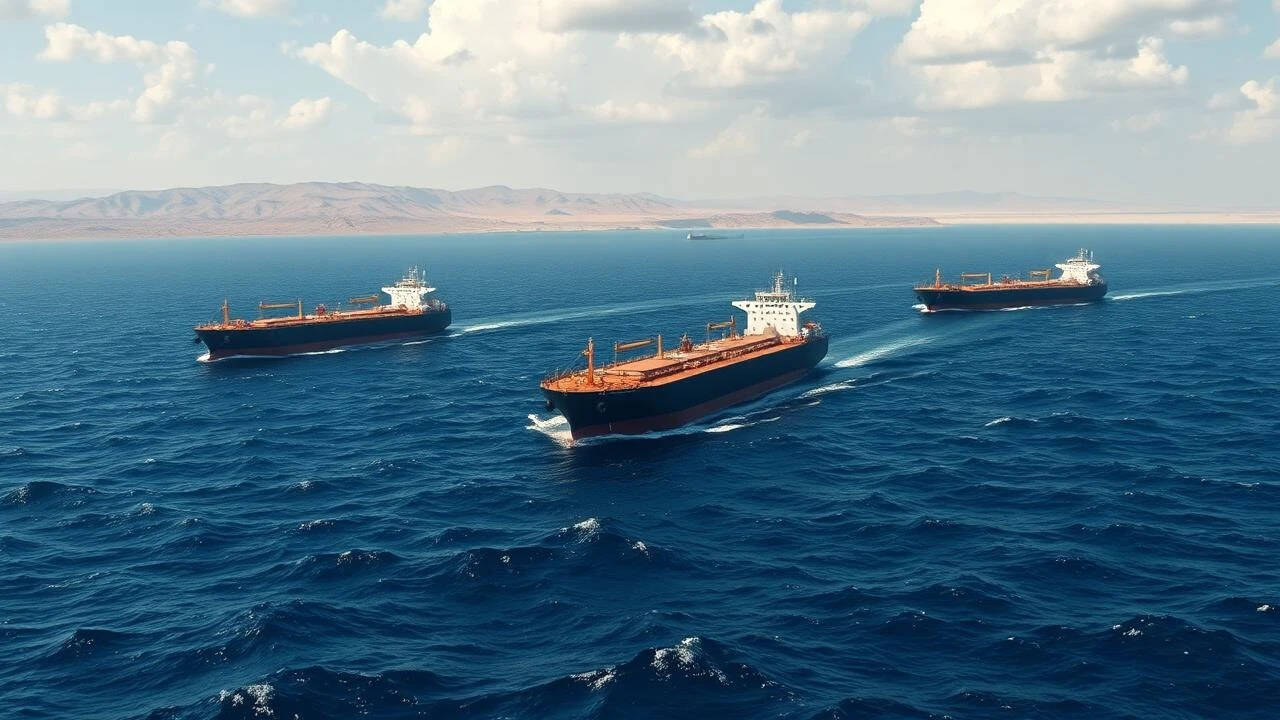
The world is currently staring at a 21-mile-wide choke point that could break the global economy in a matter of days. Forget the usual saber-rattling you’ve seen in the headlines for decades. This isn't just another round of diplomatic posturing or a minor skirmish in the Persian Gulf. In March 2026, the threat to the Strait of Hormuz has moved from "theoretical risk" to "active emergency."
When a top Iranian official vows to set tankers ablaze, people usually roll their eyes and wait for the de-escalation. But right now, ships are actually burning. The Islamic Revolutionary Guard Corps (IRGC) isn't just talking; they’ve effectively paralyzed one-fifth of the world’s oil supply. If you think your local gas prices are high now, you aren't ready for what happens if this corridor stays dark for another week. Recently making headlines in this space: The Kinetic Deficit Dynamics of Pakistan Afghanistan Cross Border Conflict.
The Reality of a Modern Blockade
On paper, the Strait of Hormuz is an international shipping lane. In practice, it’s a kill zone. Ebrahim Jabari, a senior adviser to the IRGC, recently made it clear: any vessel attempting to transit without permission will be "set on fire." It’s a blunt, terrifying statement that has already driven oil prices up by double digits.
We aren't just looking at words. Over the last 48 hours, at least four tankers have been struck by drones or projectiles. The Athe Nova, a fuel tanker, was left in flames after a drone strike. Another vessel, the Skylight, was hit just 5 nautical miles off the coast of Oman. This isn't a blockade in the traditional sense of a line of warships—it’s a blockade of fear. Additional details into this topic are detailed by The New York Times.
When maritime insurers like Gard and Skuld cancel "war risk" coverage, the trade stops. You don't need to sink every ship to close the Strait; you just need to make it uninsurable. As of this morning, over 150 tankers are sitting at anchor, drifting in the Arabian Sea, unwilling to roll the dice on a crossing.
Why You Should Care About This Specific Chokepoint
It’s easy to dismiss Middle Eastern tensions as "over there," but the math of the Strait of Hormuz is personal for everyone with a bank account.
- 20 million barrels: That’s how much crude and fuel moves through this gap every single day.
- 20% of Global LNG: Almost all of Qatar’s liquefied natural gas exports go through here. If the flow stops, heating bills in Europe and power costs in Asia skyrocket instantly.
- Asian Dependence: Countries like Japan and India are the most exposed. Japan gets 90% of its oil through this tiny stretch of water.
The "People Also Ask" crowd often wonders why we can’t just use pipelines to go around it. The answer is we can’t—at least not enough of it. Saudi Arabia and the UAE have pipelines that bypass the Strait, but they can only handle a fraction of the total volume. Roughly 15 million barrels per day simply have no other way out.
The Military Stalemate
The U.S. and Israel have been hitting Iranian naval bases, including the major hub at Bandar Abbas, trying to degrade Tehran’s ability to strike. U.S. Central Command (CENTCOM) claims to have sunk or crippled most of the Iranian navy’s surface fleet in the Gulf of Oman.
But here’s the problem: Iran doesn't need a traditional navy to cause chaos. They have thousands of "suicide drones," sea mines that cost a few thousand dollars but can destroy a billion-dollar tanker, and shore-based missiles tucked into coastal caves.
Even with B-2 bombers dropping 2,000-pound payloads on missile sites, the "death by a thousand cuts" strategy is working. It costs significantly more to intercept a $20,000 drone with a million-dollar missile than it does to launch the drone in the first place. It’s an asymmetric nightmare that the world’s most advanced militaries are struggling to solve in real-time.
Economic Fallout and the $100 Barrel
Analysts are already predicting oil could hit $100, $120, or even $150 if the closure lasts more than a few weeks. We're talking about a global macroeconomic shock that could trigger stagflation—low growth combined with high inflation.
For the average person, this isn't just about the "price at the pump." It’s about the cost of everything. If it costs more to fuel a cargo ship, it costs more to move grain, electronics, and medicine.
| Country | Dependence on Hormuz Oil |
|---|---|
| Japan | 90% |
| India | 50% |
| China | 45% |
| USA | 12% |
While the U.S. is less "directly" dependent on these barrels, oil is a global commodity. If China can’t get its 45% from the Gulf, they’ll outbid everyone else for oil from the Atlantic or Russia, driving prices up for you anyway.
What Happens Next
The situation is volatile. We’re in a period where "precautionary decisions" by shipping companies are doing the IRGC’s work for them. Even if Iran hasn't physically lined up ships to block the path, the risk profile has effectively shuttered the lane.
If you're looking for a silver lining, there isn't one right now. The immediate next steps involve watching the insurance markets. If "war risk" premiums don't come down, the tankers won't move. You should expect localized fuel shortages in high-dependence regions and a sharp spike in transportation surcharges across all consumer goods.
If you're an investor or just someone trying to plan a budget, keep a close eye on the "tanker anchors." When the cluster of dots on the marine traffic maps starts moving back toward the Persian Gulf, the crisis is over. Until then, we’re all just waiting to see who blinks first.
Monitor the daily Brent crude spot price and check for updates on the reopening of "war risk" insurance cover for the Persian Gulf. These are the two most reliable indicators of whether this blockade is breaking or hardening.

.png?format=1500w)