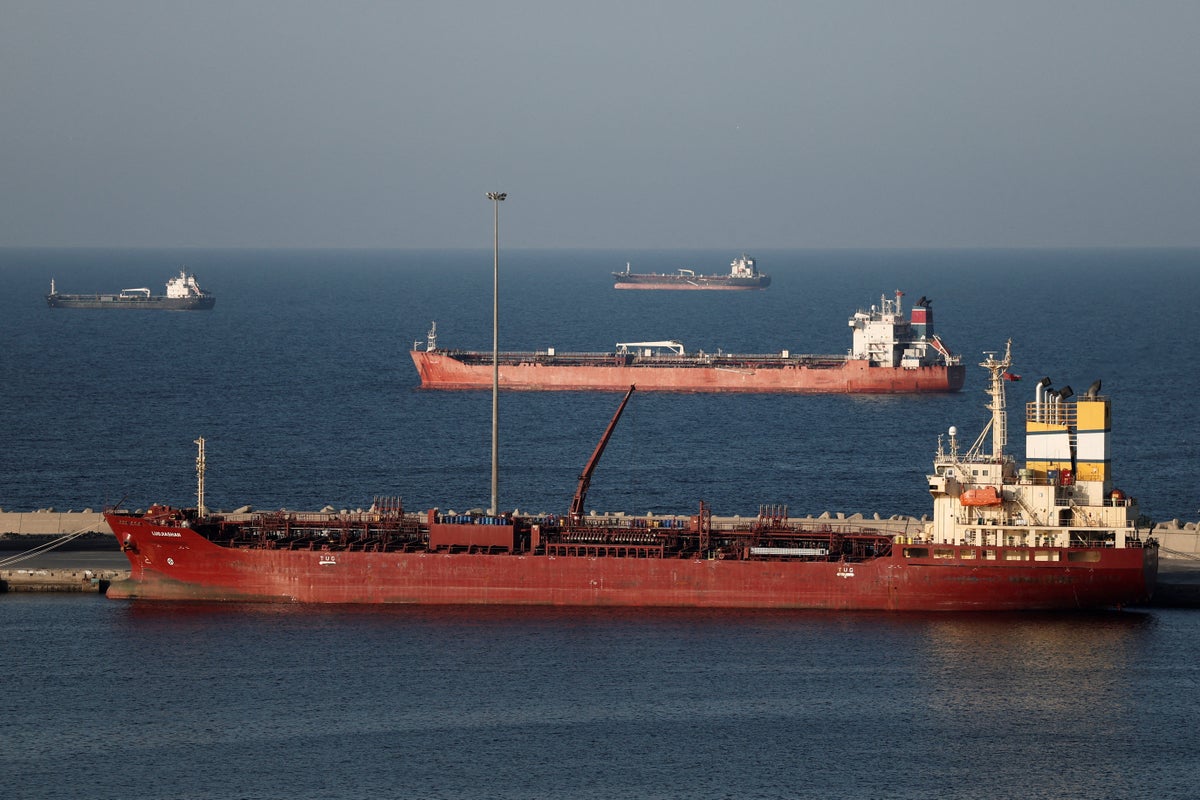
The Strait of Hormuz is not just a waterway. It is a jugular vein for the global economy, a thirty-nine-kilometer-wide strip of water where the geopolitical ambitions of Tehran collide with the energy demands of the West. While casual observers often view the threat of a closure as a simple matter of "ships stopped or ships moving," the reality is a sophisticated exercise in asymmetric warfare. Iran does not need a massive blue-water navy to paralyze the world. It only needs the threat of a single mine, the flight of a low-cost drone, or the psychological impact of a skyrocketing insurance premium to turn this passage into a graveyard for commerce.
Roughly 20 percent of the world’s daily oil consumption passes through this narrow corridor. If the flow stops, the shockwaves hit the gas stations of London, the factories of Shanghai, and the heating bills of New York within hours. The core of the issue is that there are no viable, immediate alternatives. Pipelines through Saudi Arabia and the UAE can only handle a fraction of the volume, leaving the global market tethered to a stretch of water that Iran views as its backyard.
The Asymmetric Architecture of a Blockade
Conventional military thinking often fails to grasp why a mid-tier regional power can hold the world hostage. The United States Fifth Fleet is, on paper, the most formidable maritime force in the region. However, the Strait of Hormuz is a confined space—a "littoral" environment where billion-dollar destroyers are vulnerable to "thousand-dollar" threats.
Iran’s Islamic Revolutionary Guard Corps Navy (IRGCN) has spent decades perfecting a "swarm" strategy. Instead of building large frigates that serve as easy targets for Harpoon missiles, they have invested in hundreds of fast-attack craft. These small, maneuverable boats can be equipped with heavy machine guns, rocket launchers, or short-range missiles. In a narrow channel, a swarm of fifty such boats can overwhelm the defensive sensors of a sophisticated warship. It is death by a thousand cuts.
The geography of the Strait compounds this advantage. The shipping lanes are divided into an inbound and outbound track, each only two miles wide, separated by a two-mile buffer zone. These lanes sit largely within Omani and Iranian territorial waters. Iran’s Qeshm Island and Larak Island provide natural "stationary aircraft carriers" from which coastal defense cruise missiles can be launched.
The Silent Threat of the Sea Mine
If the swarm is the visible fist, the sea mine is the invisible garrote. Experts estimate that Iran possesses thousands of mines, ranging from crude contact spheres to sophisticated "smart" mines that sit on the seabed and wait for the specific acoustic signature of a supertanker.
Clearing a minefield is a grueling, slow process. Even the suspicion of mines is enough to bring shipping to a standstill. No commercial captain will risk a $200 million vessel and its crew, and no insurer will cover them, if the water is deemed "contested." During the "Tanker War" of the 1980s, even primitive mines caused massive disruptions. Today, the technology is far more lethal.
Modern Iranian mines can be deployed by almost anything: dhows, submarines, or even converted civilian vessels. This "deniability" is a key part of the Iranian toolkit. By the time a mine is triggered, the vessel that laid it could be long gone, tucked back into one of the hundreds of jagged coves along the Iranian coastline.
The Drone Revolution and the End of Conventional Dominance
In the last five years, the calculus has shifted further in Tehran’s favor due to the proliferation of Unmanned Aerial Vehicles (UAVs). The Shahed-series "suicide" drones, now infamous for their use in global conflicts, provide Iran with a precision-strike capability that costs less than a luxury sedan.
These drones can be launched from the back of a truck deep within the Iranian mainland. They don’t need a runway. They can loiter over the Strait, identifying targets of opportunity—specifically the engine rooms or bridge wings of tankers—to cause maximum structural damage with minimal explosive weight.
The defensive equation is lopsided. A single interceptor missile used by a Navy destroyer can cost upwards of $2 million. A Shahed drone costs roughly $20,000. In a war of attrition, the math favors the disruptor. If Iran launches forty drones at a convoy, and only three get through, they have won. The shipping industry sees this math and reacts accordingly: by staying away.
The Insurance Crisis and the Financial Blockade
You don't need to sink a ship to close the Strait. You only need to make it uninsurable.
Lloyd’s of London and other major insurance syndicates maintain a list of "Listed Areas" where perceived risk is high. When the Strait of Hormuz is designated a war zone, the "War Risk" premiums skyrocket. In previous periods of tension, these premiums have jumped tenfold in a single week.
For a VLCC (Very Large Crude Carrier) carrying two million barrels of oil, a spike in insurance costs can add millions to the cost of a single voyage. If the risk becomes too high, the underwriters simply withdraw cover. Without insurance, a ship cannot dock at any major global port. In effect, the legal and financial architecture of global trade does the work of the Iranian Navy for them. Iran knows this. Their strategy is often one of "calculated escalation"—doing just enough damage to keep the risk premiums high without triggering a full-scale kinetic response from the West.
The Pipeline Myth and the Lack of Alternatives
Politicians often point to regional pipelines as the "solution" to the Hormuz problem. This is a dangerous oversimplification.
The Saudi East-West Pipeline (Petroline) has a capacity of about 5 million barrels per day. The UAE’s Habshan-Fujairah pipeline can handle about 1.5 million. Combined, these bypasses can move roughly 6.5 million barrels. But the Strait sees more than 20 million barrels pass through it daily.
Furthermore, these pipelines terminate at ports like Fujairah, which are themselves vulnerable to long-range missile or drone strikes. There is no physical way to bypass the Strait entirely without a decade-long, multi-billion-dollar infrastructure project that currently doesn't exist. The world is locked into this geography.
The Global Consequences of a "Temporary" Closure
What happens if the Strait closes for just fourteen days?
The immediate result is a supply-side shock that would dwarf the 1973 oil crisis. Crude prices would likely double or triple overnight. But the secondary effects are more insidious. Modern manufacturing relies on "just-in-time" supply chains. The petrochemicals used to make plastics, fertilizers, and pharmaceuticals all depend on the steady flow of hydrocarbons from the Gulf.
East Asian economies—China, Japan, and South Korea—are the most exposed. They receive the vast majority of their energy through this chokepoint. While the United States has increased domestic production, oil is a fungible global commodity. If the price goes up in Singapore, it goes up in Texas. A closure isn't a regional problem; it's a systemic failure of the global trade network.
The Escalation Ladder and the Risk of Miscalculation
The greatest danger isn't a planned Iranian blockade, but a tactical miscalculation. Both sides are constantly testing the "red lines" of the other. Iran seizes a tanker in retaliation for a sanctioned cargo; the U.S. increases its maritime patrols; a nervous commander on a fast-attack craft fires a warning shot.
In the cramped confines of the Persian Gulf, the time from "incident" to "international crisis" is measured in minutes. The communication channels between the IRGCN and the U.S. Navy are virtually non-existent. This lack of a "hotline" means that a minor collision or a misunderstood maneuver can trigger a cascade of escalation that leads to the very blockade everyone fears.
The Iranian leadership views the Strait as their "Final Option." They know that closing it would likely lead to a massive military strike on their soil. Therefore, they treat the threat as a form of "deterrence by denial." They want the world to know they can destroy the global economy, hoping that the mere possibility will prevent further sanctions or military pressure.
The Strait of Hormuz remains the most significant single point of failure in our modern world. We have built a high-tech, globalized civilization on the assumption that twenty miles of water will always remain open, despite it being controlled by a regime that has spent forty years learning how to shut it down.
The reality is that the Strait is never truly "open" or "closed." It exists in a permanent state of contested vulnerability. The ships keep moving, but they do so only at the pleasure of a complex, fragile, and increasingly dangerous geopolitical truce.