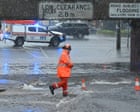
Fear sells, but boredom kills. Every time the clouds break over Sydney and the southern states, the media machine cranks out the same tired script. They want you to stare at the harbor, terrified of a dorsal fin, while you ignore the actual engineering failure rising around your ankles. The "shark alert" is a convenient distraction from the fact that our cities are built like concrete bathtubs with no drain.
The narrative is always the same: summer rain equals flood risk, which equals bull sharks in the Parramatta River. It’s a neat, linear story that hits every primal fear button. It’s also a lazy misinterpretation of how apex predators and urban ecosystems actually function. If you’re worried about a shark, you’ve already lost the plot. You should be worried about the $50,000 in property damage sitting in your basement because we refuse to admit that "one-in-a-hundred-year" floods now happen every Tuesday.
The Bull Shark Myth: Predators Aren't Following the Rain
The standard line is that heavy rain flushes nutrients into the estuaries, baitfish follow the nutrients, and bull sharks follow the bait. It sounds logical. It’s also largely a misunderstanding of Carcharhinus leucas behavior.
Bull sharks are already there. They don't "arrive" with the rain; they are year-round residents of our murky waterways, perfectly adapted to low-salinity environments thanks to their unique osmoregulation. When the heavens open, the massive influx of freshwater actually creates a "freshening" effect that can drive these animals further out toward the ocean to find stable salt levels, not bring them closer to your backyard.
The real danger isn't an increase in shark numbers. It’s the spike in turbidity. You aren't seeing more sharks; you’re just seeing less of the water. Swimmers getting nipped after a storm isn't a "shark invasion"—it's a visibility crisis. The shark isn't hunting you; it's confused by the literal tons of topsoil and urban debris we’ve allowed to wash into the harbor. If you jump into chocolate-milk water after a deluge, you aren't a victim of nature; you’re a victim of your own poor risk assessment.
The Infrastructure Lie: We Are Designing Disasters
We talk about "flood watches" as if they are acts of God. They aren't. They are design choices.
I’ve spent years looking at how urban sprawl interacts with natural drainage. The "lazy consensus" says we just need bigger pipes. Wrong. We need fewer surfaces that don't breathe. Every time a developer replaces a patch of grass in Western Sydney with a triple-garage McMansion and a paved driveway, the local hydrograph shifts.
The water has nowhere to go. In a natural system, the ground acts as a sponge. In a modern Australian suburb, the ground is a slip-and-slide. The water hits the concrete, picks up velocity, and slams into the nearest low-lying neighborhood. We aren't being hit by "unprecedented rainfall." We are being hit by the inevitable outcome of covering the earth in a waterproof skin.
The media focuses on the "bull shark in the street" meme because it’s funny and scary. But the real horror is the insurance industry. They are the only ones telling the truth right now. They aren't pricing for sharks; they are pricing for the catastrophic failure of municipal drainage systems that were designed for a climate that no longer exists.
The False Comfort of "Flood Watches"
A "flood watch" is a bureaucratic shrug. It’s an admission of powerlessness.
By the time the Bureau of Meteorology (BOM) issues the alert, the damage is already locked in. The real "watch" should have happened decades ago when we were building on floodplains and calling them "riverfront luxury." We are addicted to the aesthetics of water until the water decides it wants to live in our living rooms.
Imagine a scenario where we actually valued permeability. Every parking lot would be gravel or porous pavers. Every roof would be green. We would stop fighting the river and start giving it room to breathe. Instead, we spend millions on retaining walls that eventually crumble and sandbags that offer nothing but a false sense of security.
The Reality of Risks: Why You're Looking the Wrong Way
Let’s look at the actual stats, not the headlines.
The probability of a fatal shark encounter in Sydney Harbor, even during peak rain events, is statistically negligible. You are exponentially more likely to die from a falling tree branch during a storm or from electrocution while trying to save your flat-screen TV from a rising basement.
The focus on bull sharks is a classic case of availability bias. We remember the shark because it’s a monster. We ignore the mold in the drywall because it’s mundane. Yet, the mold is what will bankrupt you and ruin your respiratory health over the next five years.
If you want to be safe during the next "big wet," stop looking at the water for fins. Look at your gutters. Look at your local council’s zoning maps. Look at the fact that we are still building high-density housing in areas we know will be underwater by the mid-2030s.
The End of the "Lazy Summer" Delusion
The "last of the summer rain" isn't a seasonal coda. It’s a preview of the new baseline.
The competitor’s article wants to sell you a story of a temporary inconvenience—a week of wet socks and a scary fish. The truth is far more brutal. We are living in a permanent state of hydrological instability. The sharks are a sideshow. The real story is the slow, wet collapse of urban planning that prioritizes developer profit over topographical reality.
Stop waiting for the "all clear." The rain isn't going away, and the water isn't going back into the pipes.
Go home. Clear your drains. Buy some heavy-duty dehumidifiers. And for heaven's sake, stop swimming in the brown water. Not because of the sharks, but because you're literally swimming in a cocktail of street runoff and sewage overflow. That’s the real monster under the bed.
Would you like me to analyze the latest property development data for Sydney flood zones to show you exactly which neighborhoods are the next to go under?