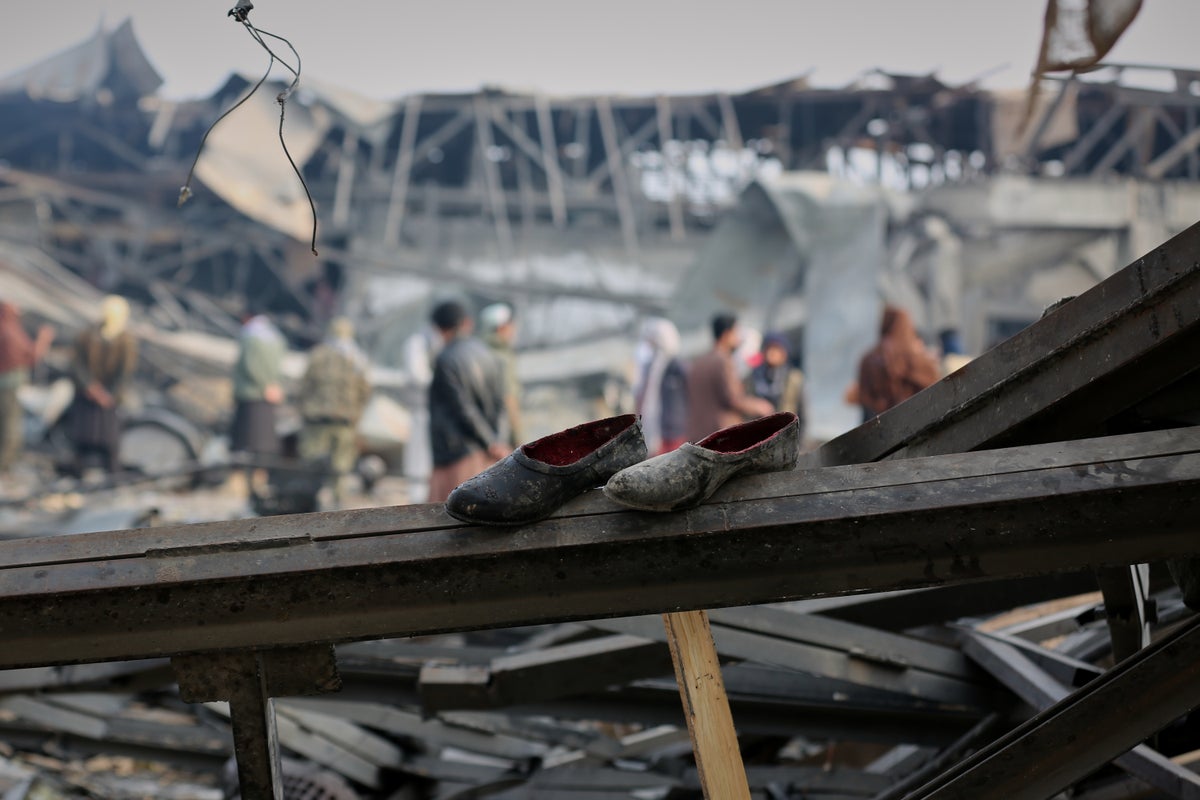
The camera lens is a liar. When a missile levels a compound in Kabul, the media industrial complex follows a tired, predictable script: close-ups of dusty sandals, wide shots of jagged concrete, and "rescue crews" performing the theater of the desperate. We are fed a diet of emotional ruin that serves as a convenient distraction from the cold, mathematical reality of modern kinetic warfare.
The "deadly Kabul airstrike" narrative is a relic. It focuses on the impact point—the most primitive part of the event—while ignoring the global, automated pipeline that made the strike a statistical certainty months before the trigger was pulled. If you want to understand the modern battlefield, stop looking at the photos of the rubble. Start looking at the data centers in Virginia and the component foundries in Taiwan. For a closer look into similar topics, we suggest: this related article.
The Myth of the Surgical Strike
The competitor's gallery wants you to believe in the "tragedy of errors" or the "surgical precision" of Western intervention. Both are fantasies. In the logic of 21st-century attrition, an airstrike isn't an isolated event; it is a data output.
We talk about "surgical strikes" as if a human surgeon is making a moral choice with a scalpel. In reality, the decision-making process is a bloated algorithmic consensus. The MQ-9 Reaper or the F-35 doesn't just "show up." It is the tip of a spear forged by SIGINT (Signals Intelligence) and MASINT (Measurement and Signature Intelligence). When a civilian building is hit, it isn't usually a "mistake" in the way a driver misses a turn. It is a failure of the training data or a conscious acceptance of "collateral" probability—a number crunched by a legal officer sitting 7,000 miles away. For additional background on this development, extensive coverage can also be found at Reuters.
The photos of rescue crews racing through the debris are powerful, yes, but they are intellectually dishonest. They suggest that the story begins when the dust rises. In reality, the story ended the moment the target’s MAC address was flagged on a cell tower three weeks prior.
The Architecture of Attrition
I have spent years watching defense contractors burn through billions of dollars to "shorten the kill chain." The goal is to remove the human from the loop because humans are slow, emotional, and prone to hesitation.
When you see a photo of a grieving family in Kabul, you are seeing the byproduct of an incredibly efficient business model. War is a logistics problem. The United States and its allies don't fight "wars" in the traditional sense anymore; they manage global security through "over-the-horizon" capabilities. This is a sanitized term for "we have enough sensors in the sky to automate the execution of anyone we deem a threat."
The Numbers the Media Ignores
Let’s look at the sheer scale of the overhead architecture required for a single Kabul strike:
- Satellite Constellations: Thousands of assets providing persistent 24/7 coverage.
- Data Processing: Roughly 2.2 petabytes of surveillance footage generated daily by the Department of Defense.
- Human Cost of Analysis: For every drone pilot, there are nearly 20 support staff, including intelligence analysts, sensor operators, and legal advisors.
The "rescue race" is a 19th-century response to a 22nd-century weapon. Shovels and ambulances cannot compete with a system that views a city block as a coordinate in a spreadsheet.
Why We Love the Disaster Gallery
Why do outlets publish these photo essays? Because empathy is cheap and easy to monetize. It's much harder to explain the geopolitical necessity of the Rare Earth element trade or the way autonomous loitering munitions are devaluing the concept of national sovereignty.
Photojournalism in war zones has become a form of "misery porn" that allows the viewer to feel a fleeting sense of moral superiority without requiring them to understand the mechanics of the violence. You see the rubble, you feel "bad," and then you click the next link. You have engaged with the symptom, never the disease.
The Contrarian Truth: Rubble is Irrelevant
In the grand scheme of the Afghan conflict and its aftermath, the physical destruction of a building is the least important factor.
- Infrastructure is Replaceable: Concrete is cheap. The knowledge lost in the strike—or the radicalization gained by the survivors—is the real currency.
- The Optics are the Goal: Often, the strike isn't about the target at all. It’s about signaling. It’s a message sent to local power brokers: "We can touch you anywhere."
- The Failure of Traditional Journalism: By focusing on the "rescue race," journalists ignore the contractors who sold the sensor arrays, the engineers who wrote the targeting code, and the politicians who signed the blank checks.
Stop Asking "How Many Died?" and Start Asking "Who Sold the Bolt?"
The industry insider knows that every piece of shrapnel in those Kabul photos has a serial number. Every fire started by a Hellfire missile is fueled by a specific defense appropriation bill.
If we actually cared about the "tragedy" of these strikes, we wouldn't be looking at the victims. We would be looking at the quarterly earnings reports of Raytheon, Lockheed Martin, and Northrop Grumman. We would be analyzing the shift from human-piloted aircraft to autonomous swarms.
The Kabul airstrike isn't a "news event." It’s a product delivery. The rubble is just the packaging.
The Ethics of the Algorithm
We are moving into an era where "accountability" is impossible because the decision-making is distributed across a thousand different nodes. When a strike goes wrong, who is to blame?
- The analyst who misidentified a water jug for an IED?
- The software developer whose computer vision algorithm had a 4% margin of error?
- The commander who approved the strike based on a "high confidence" report?
The photos of rescue workers don't answer these questions. They obscure them. They provide a human face to a process that is increasingly inhuman.
The Only Way Out
If you want to actually disrupt the cycle of violence, stop donating to the charities that show up after the bombs fall. That’s just cleaning up the mess for the people who made it. Instead, demand a total audit of the "Targeting Logic" used by drone programs. Force the declassification of the rules of engagement that allow for "signature strikes"—where people are killed based on their patterns of behavior rather than their identity.
The status quo loves your tears. It hates your curiosity about its hardware.
Next time you see a "harrowing" photo of a blast site, don't look at the smoke. Look at the sky. Think about the silent, invisible network that put that hole in the ground. That is where the power resides. That is where the war is actually being won and lost.
The shovel is a tool of the past. The algorithm is the weapon of the present. Stop pretending they are in the same fight.
The debris in Kabul isn't a sign of a failed mission. For the people who manufactured the hardware, it’s a successful proof of concept. Deal with that reality, or keep scrolling through the photos while the next coordinates are being uploaded.


