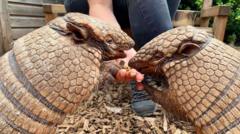
Nineteenth birthdays are for college sophomores and bad decisions, not for ancient, leathery tanks that should have been recycled by the ecosystem a decade ago.
When a zoo puts out a press release celebrating the "milestone" of a captive armadillo reaching nineteen, the public coos. They see a success story. They see "excellent husbandry" and "specialized diets." I see a biological anomaly being propped up by a caloric surplus and a lack of predators—a situation that tells us nothing about the health of a species and everything about our own pathological fear of death.
We are obsessed with the number on the odometer. We have reached a point where we value the mere duration of life over its biological purpose. Keeping a Screaming Hairy Armadillo alive for two decades in a climate-controlled box isn't a triumph of conservation. It’s a vanity project for the human ego.
The Longevity Trap
In the wild, an armadillo is lucky to see its eighth or ninth year. The environment is a meat grinder. Cars, coyotes, and disease ensure that only the most efficient genetic specimens survive long enough to pass on their traits. This is how the system works. It’s brutal, and it’s perfect.
When we interfere, we create a "geriatric bubble." By providing a steady stream of mealworms and removing the threat of being crushed by a Ford F-150, zoos extend the lifespan of these animals by 100% or more. But at what cost?
A nineteen-year-old armadillo is often a collection of failing systems. They develop cataracts. They lose bone density. Their metabolic pathways, evolved for a life of high-stress foraging and constant movement, begin to misfire in the stasis of captivity. We aren't celebrating the animal’s life; we are celebrating our ability to stall the inevitable.
The Survival Paradox
- Selection Pressure: In the wild, $S_{p} = f(P, R, C)$, where survival probability is a function of Predation, Resources, and Competition. In a zoo, these variables are deleted.
- Genetic Drift: If we keep every individual alive regardless of its fitness, we stop the clock on evolution. We aren't preserving the species; we are preserving a snapshot of it that can no longer survive the world outside the glass.
- Resource Misallocation: Every dollar spent on geriatric care for a single "ambassador animal" is a dollar not spent on protecting the actual habitats where these animals belong.
The Myth of the Happy Senior
The competitor articles love to focus on the "birthday treats"—usually a slurry of fruit or insects shaped like a cake. It’s cute. It’s also a lie.
Anthropomorphism is the industry’s greatest marketing tool and its biggest ethical failing. We project our human desire for a long, peaceful retirement onto a creature whose brain is hardwired for a totally different reality. An armadillo doesn't "know" it's nineteen. It doesn't feel a sense of accomplishment. It likely feels the slow, grinding ache of being an ancient creature in a body that wasn't designed to last this long.
I have spent years behind the scenes in wildlife management and zoo operations. I have seen the "celebrity" animals that the public loves. Often, they are the ones requiring the most pharmaceutical intervention just to keep their mobility scores high enough to remain on display. We keep them alive because the public finds death "sad," ignoring the fact that a quick death in the wild is often more "humane" than a decade of slow decline in a 10x10 enclosure.
Captivity is Not Conservation
Let’s dismantle the biggest lie in the room: that these elderly animals are "ambassadors" for their species.
A nineteen-year-old armadillo is a caricature. It is as much a representative of its species as a 110-year-old human on a ventilator is a representative of a marathon runner. By focusing on these extreme outliers, we distort the public’s understanding of biology.
People ask, "How can we help these animals live longer in the wild?"
The answer is: We shouldn't. We should be helping them live better in the wild, which often means allowing the natural cycle of birth and death to function without our clumsy interference. If we want to save the armadillo, we need to save the scrublands and the forests, not build better retirement homes for them in the suburbs.
The Cost of the PR Win
Zoo marketing departments love these stories because they are "safe." They generate clicks, likes, and donations. They make people feel that their ticket price is going toward a "happy ending."
But this focus on individual longevity is a distraction from the brutal reality of the Anthropocene. While we celebrate "Arthur the Armadillo" hitting nineteen, thousands of acres of habitat are being razed. Species that aren't "cute" enough to get a birthday cake are vanishing without a single headline.
We are choosing the comfort of a feel-good story over the discomfort of actual conservation work.
Imagine a scenario where we took the money spent on the specialized veterinary care for these geriatric outliers and funneled it exclusively into land acquisition. We would save more lives in a week than a century of zoo birthdays ever could. But land acquisition doesn't get 50,000 shares on social media. A wrinkly armadillo eating a "cake" made of waxworms does.
Real Data vs. Zoo Fluff
If you look at the peer-reviewed literature on captive longevity, the "success" is often more nuanced than the press releases suggest.
- Stress Hormones: Cortisol levels in captive animals often remain elevated even in "perfect" conditions because the lack of environmental stimuli is itself a stressor.
- Behavioral Abnormality: "Stereotypic behaviors"—pacing, repetitive digging, or over-grooming—are common in long-lived captive animals. They aren't "celebrating" life; they are coping with it.
- The Age Wall: There is a point where the cost of care per animal increases exponentially, while the "educational value" of that animal plateaus.
We are hitting a wall where we have to decide: are we running a museum of living relics, or are we trying to save a functioning planet?
The Brutal Advice No One Wants to Hear
If you actually care about wildlife, stop liking these birthday posts. Demand that institutions prioritize habitat preservation over individual longevity. Acknowledge that death is a necessary, healthy component of a functioning ecosystem.
Stop asking how old the animal is. Start asking how much of its native range still exists.
Stop supporting the "humanization" of biology. An armadillo is a master of its environment, a specialized digger, and a vital part of the food chain. It is not your grandmother. It doesn't need a birthday party. It needs a world where it can live fast, die young, and leave a genetically superior corpse to feed the next generation of the cycle.
The next time you see a headline about a nineteen-year-old zoo animal, don't smile. Ask yourself why we are so desperate to keep a ghost in a cage.
True conservation isn't about preventing death; it's about ensuring life has a place to happen.
Nature doesn't have a retirement plan. Neither should we.
Stop clapping for the survival of the individual while the species is on life support.