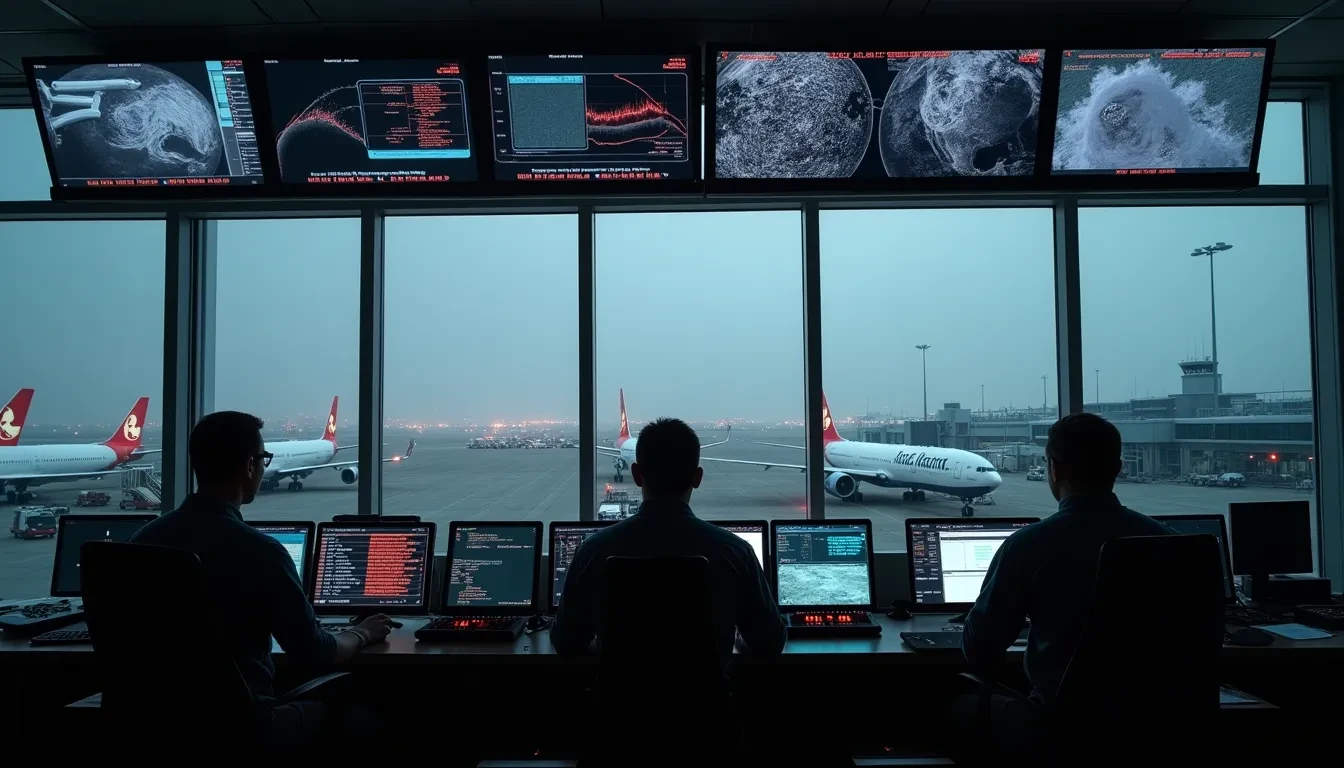
The headlines are always the same. "Air Canada Plane Clips Vehicle." "LaGuardia Shuts Down After Tarmac Incident." The public reads these and thinks of a clumsy pilot or a distracted truck driver. We treat a ground collision like a fender bender at a grocery store parking lot.
That perspective is not just wrong; it is dangerous.
When an Air Canada A320 winglet slices through a ground service vehicle at one of the world’s most congested hubs, the post-mortem shouldn't focus on the "human error" of the flight crew. That is the lazy path taken by regulators who don't want to admit that our aviation infrastructure is a relic of the 1960s held together by duct tape and hope.
I have spent years analyzing runway incursions and ramp safety protocols. I have seen airlines bleed millions in hull losses and delays because we refuse to automate the most predictable part of the flight: the taxi. We are still asking humans to navigate 80-ton machines through a maze of moving parts using nothing but eyeballs and a radio.
It is time to stop pretending this was an "accident." It was an inevitability.
The Myth of the "Controlled" Tarmac
The competitor reports will tell you LaGuardia was "safely evacuated" and the airport "resumed operations" quickly. This is PR fluff designed to mask a systemic failure.
Ground control at a major hub is a high-stakes game of Tetris played with real lives and $100 million assets. The "lazy consensus" is that if everyone follows the rules, nothing hits. But the rules are built on a fallacy. We assume that a pilot, sitting 20 feet in the air with limited peripheral visibility, can perfectly track a luggage tug moving at 15 mph in their blind spot.
Ground movements are the last analog frontier in a digital industry. We have Autoland systems that can put a plane down in zero visibility. We have TCAS (Traffic Collision Avoidance System) to keep planes from hitting in the sky. Yet, on the ground—where the density of obstacles is highest—we rely on a guy in a tower looking through binoculars.
Why "Human Error" is a Cop-Out
If you design a system where a three-second lapse in judgment by a tired driver or a misheard radio call results in a multi-million dollar collision, the system is the failure, not the person.
- Spatial Disorientation: An Airbus A320-214 has a wingspan of roughly 111 feet. At LaGuardia, where gates are packed tighter than a Manhattan subway car, the margin for error is measured in inches.
- Acoustic Overload: Ground crews operate in an environment of constant 100+ decibel noise. Expecting flawless verbal communication in this environment is a fantasy.
- The "Pushback" Problem: Most ground collisions occur during or immediately after pushback. This is the moment of peak vulnerability where the pilot is transitioning from ground-crew hand signals to cockpit instrumentation.
Imagine a scenario where we treated surgeons the way we treat ramp safety. If a surgeon tripped over a loose power cord in a dark operating room and dropped a scalpel, would we blame the surgeon's "lack of focus," or would we ask why the room was dark and the cords weren't managed?
The LaGuardia Tax: Why This Airport is a Deathtrap
LaGuardia (LGA) is the poster child for infrastructure claustrophobia. While the new terminals are shiny and look great in brochures, the taxiways remain a congested nightmare.
The airport sits on 680 acres. For context, Denver International (DEN) sits on over 33,000 acres. LGA is trying to move 30 million passengers a year through a space that wouldn't fit a modern shopping mall's parking requirements.
When an Air Canada plane clips a vehicle here, it’s because the physical constraints of the geometry have reached a breaking point. We are trying to fit 2026 traffic into a 1940s footprint. The result is a "high-velocity friction environment."
The Real Cost of a "Minor" Clip
The media calls it a "collision," implying a crash. The industry calls it "ground rash." But let’s look at the actual physics.
$F = ma$
When a 70,000 kg aircraft moving at even 5 knots hits a 2,000 kg service vehicle, the kinetic energy is massive. It isn't just a dent. It is a structural integrity question. One winglet strike can ground an aircraft for weeks, cost $500,000 in direct repairs, and trigger $2 million in downstream logistical nightmares.
The "People Also Ask" sections on search engines want to know if it's safe to fly into LGA. The answer is yes, because the pilots are elite. But the efficiency of that safety is non-existent. You aren't paying for a flight; you are paying for the "LaGuardia Tax"—the extra fuel burned and the time lost sitting in a queue because the taxiways are too narrow for simultaneous movements.
The Solution No One Wants to Fund
If we actually wanted to stop these collisions, we wouldn't just "investigate" the driver or the pilot. We would eliminate the human element of ground navigation.
- ADS-B for Everything: Every single vehicle on the ramp—from the catering truck to the honey wagon—should be equipped with ADS-B (Automatic Dependent Surveillance-Broadcast). This would allow the aircraft's cockpit displays to show "ghost" images of every vehicle within a 200-yard radius.
- Automated Ground Stop-Bars: We need physical or light-based "smart" barriers that sync with the aircraft's transponder. If a plane is moving, the vehicle lane is physically blocked. No "clearance" required; the hardware handles it.
- The "Tug" Revolution: Why are we letting planes taxi under their own power in congested gate areas? We should be using automated, electric, remote-controlled tugs (like Taxibot) for the entire journey from gate to runway. This saves fuel, reduces noise, and places the movement under a single, centralized digital controller.
The downside? It costs billions. Airlines don't want to pay for it. Airports don't want to shut down taxiways to install the sensors. So, we continue with the status quo. We wait for a wing to clip a truck, we fire a driver who makes $18 an hour, and we pretend we've solved the problem.
Stop Asking the Wrong Questions
The media asks: "How long will the airport be closed?"
The traveler asks: "Will I get a refund?"
The correct question is: "Why are we still navigating 150-passenger jets using the same technology we use to park a Kia?"
We are obsessed with "Flight Safety" but we ignore "Ramp Safety" because it isn't "sexy." A plane crashing from 30,000 feet is a tragedy. A plane hitting a truck at 5 mph is an "inconvenience."
But until we bridge the gap between our sophisticated avionics in the air and our primitive movements on the ground, LaGuardia will continue to be a gambling hall where the house always wins, and the passenger always waits.
If you are flying through a congested hub, look out the window during taxi. Notice how close that wingtip comes to the fuel truck. Notice the chaos of three different vehicles crossing the taxiway at once. Then realize that the only thing keeping you from a four-hour delay—or worse—is a set of mirrors and a prayer.
Fix the dirt, or stop complaining when the metal crunches.