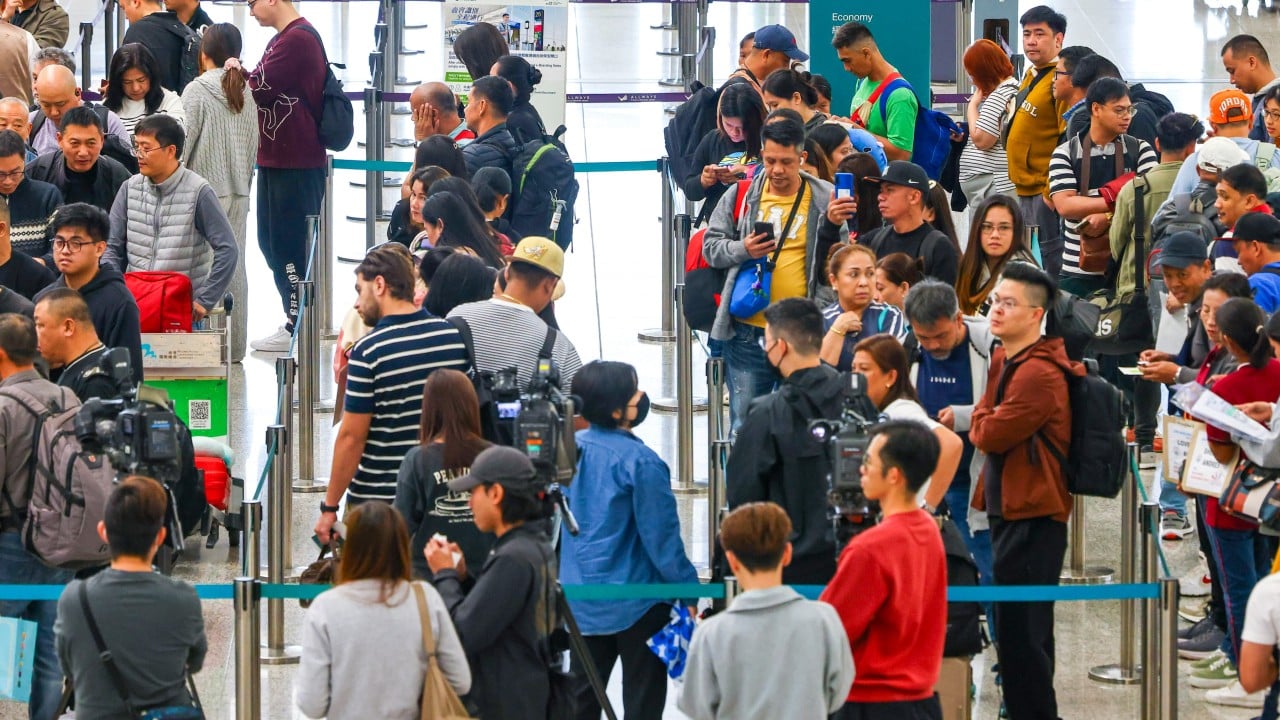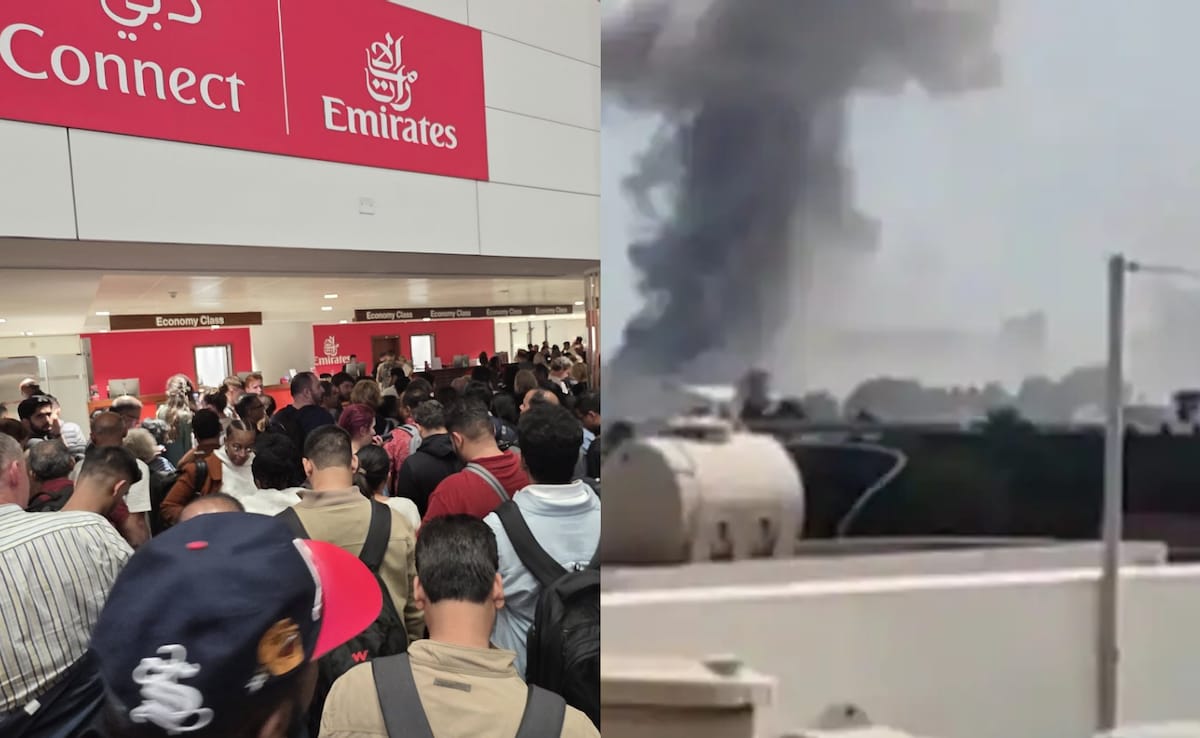
The headlines are predictable. "Chaos." "Meltdown." "Stranded." When the Iranian missile strikes lit up the sky over the Middle East, the media did what it always does: it interviewed a crying tourist in Terminal 3 and blamed the geopolitical powder keg for the collapse of global aviation.
They are lying to you. Or, at the very least, they are wildly misdiagnosing the disease.
The missiles weren't the cause of the Dubai airport meltdown. They were merely the stress test that the aviation industry’s brittle, over-optimized, and frankly arrogant infrastructure was destined to fail. If you were stuck on a marble floor in DXB for forty-eight hours, don’t look at Tehran. Look at the C-suite and the algorithmic worship of "lean" operations.
We’ve built a global transit system that has zero margin for error, then we act shocked when an error occurs.
The Myth of the "Unforeseeable" Event
Industry insiders love the term "Black Swan." It’s a convenient shield. It implies that what happened—the complete paralysis of one of the world's busiest hubs—was a statistical impossibility that no one could have prepared for.
Nonsense.
Regional instability in the Middle East is not a Black Swan; it is a permanent feature of the geographic ledger. Flying through the Persian Gulf and expecting 100% uptime is like building a house on a fault line and being "personified chaos" when the plates shift.
The real failure isn't the strike itself. It’s the Hub-and-Spoke Fragility.
Airlines like Emirates have mastered the art of the mega-hub. It’s an incredible business model for moving millions of people with maximum efficiency during peacetime. But the hub-and-spoke model is a single point of failure. When you funnel the entire world’s connectivity through a single 2.5-mile strip of asphalt in the desert, you aren't building a "global gateway." You are building a bottleneck.
When that bottleneck clogs, the system doesn't just slow down. It suffers a total cardiac arrest. The "chaos" passengers experienced wasn't a result of the missiles; it was a result of an industry that has traded redundancy for profit margins.
The Just-In-Time Logistics Trap
Modern aviation runs on "Just-In-Time" (JIT) principles. This works beautifully for car manufacturing and iPhone deliveries. It is a disaster for human beings.
In a JIT aviation world:
- Crew scheduling is optimized to the minute. One diverted flight puts a pilot over their legal flying hours, which ripples out to cancel ten other flights.
- Gate turnarounds are so tight that a twenty-minute delay in a boarding bridge causes a six-hour delay in the departure queue.
- Customer service is outsourced to chatbots and skeletal ground crews because "efficiency" dictates that you don't pay for staff you don't need on a sunny Tuesday.
I’ve sat in those operations rooms. I've seen the spreadsheets where "buffer" is treated as "waste." In any other engineering discipline, a 0% buffer is considered a design flaw. In the airline industry, it’s rewarded with a bonus.
When the airspace closed, the algorithms didn't know how to handle the human element. They couldn't re-route fast enough because there was no "slack" left in the system. Every seat on every other flight was already booked to 98% capacity. There was nowhere for the displaced people to go. That’s not a tragedy; it’s a math problem that the airlines chose not to solve.
The "Safety First" Smokescreen
"We value your safety above all else."
It’s the most overused line in the history of the PA system. During the Dubai meltdown, it was used to justify everything from the lack of food vouchers to the refusal to provide clear information.
Let’s be honest: Grounding flights during a missile barrage is a baseline requirement, not a badge of honor. The "safety" argument is used as a PR sedative to stop passengers from asking why the airline’s recovery systems are so pathetic.
True safety includes the post-event recovery. If you can land a plane safely but you can't feed 50,000 people or provide them with a place to sleep for three days, you haven't managed a crisis. You’ve just moved the crisis from the air to the terminal floor.
The industry hides behind "Force Majeure" clauses to avoid liability. By labeling every disruption an "Act of God" or a "Geopolitical Event," they wash their hands of the financial responsibility to maintain a resilient backup plan. They want the upside of a globalized, hyper-connected world without the cost of the insurance policy required to run it.
Stop Asking "When Will My Flight Leave?"
If you find yourself in the middle of a hub meltdown, you are asking the wrong question.
People ask, "When is the next flight?" or "Can I get a hotel voucher?" These are the questions of a victim.
The question you should be asking is: "Why did I trust a system that has no plan B?"
The conventional advice is to wait in line. To be patient. To "understand the difficulty of the situation."
The contrarian move? The moment the first missile is reported, you leave the airport.
Don't wait for the cancellation email. It’s coming, but the algorithm is slower than the reality. If you are in a hub like Dubai and the airspace closes, the recovery time follows a non-linear decay. A two-hour closure does not equal a two-hour delay. It equals a forty-eight-hour systemic reboot.
- Exit the terminal immediately. While 10,000 people are queuing at the "Transfer Desk," you should be in a taxi to a hotel ten miles away from the airport.
- Book a different airline on a different route. If you wait for your original carrier to "re-protect" you, you are at the mercy of their depleted inventory.
- Understand the physics of the backlog. Consider the math:
If a hub handles 250,000 passengers a day and closes for 6 hours, you have a 62,500-person deficit. Even if the airport reopens and operates at 110% "catch-up" capacity (which it never does), it would take days to clear that backlog.
$$T_{recovery} = \frac{P_{displaced}}{C_{excess}}$$
Where $T$ is time, $P$ is displaced passengers, and $C$ is the excess capacity per hour. Since $C$ is usually near zero in our "optimized" world, the recovery time $T$ approaches infinity.
The False Idols of Technology
We were promised that "Smart Airports" would solve this. Biometrics, AI-driven scheduling, and real-time apps were supposed to make the passenger experience "seamless."
The Dubai meltdown proved the opposite. Technology has made the industry more fragile, not less.
When the systems went down or became overloaded, the staff on the ground were paralyzed. They have been trained to follow the screen, not to think. They have no agency to make decisions. I have seen ground managers refuse to hand out water because "the system hasn't authorized the voucher yet."
We have replaced human intuition and localized decision-making with a centralized, rigid digital architecture. This works great when the weather is 72 degrees and the borders are open. It is a death trap in a crisis. The tech didn't fail because the power went out; it failed because it was never designed to account for the irrational, messy reality of a world that doesn't always follow a logic gate.
The Industry’s Dirty Secret: They Don’t Want to Fix This
Why would they?
Building redundancy costs money. Keeping spare planes and "standby" crews costs millions in "dead" capital. Maintaining a 20% seat vacancy for emergencies would drive ticket prices up and stock prices down.
The airlines have calculated that it is cheaper to let you sleep on a terminal floor once every two years than it is to build a resilient system. They have outsourced the "cost" of the crisis to you—your time, your missed weddings, your lost wages, and your physical exhaustion.
As long as we keep buying the cheapest ticket available on a hub-and-spoke carrier, we are voting for this chaos. We are complicit in the fragility. We prioritize the $400 savings over the assurance of actually arriving at our destination.
The "meltdown" wasn't a failure of the system. It was the system working exactly as it was designed: to prioritize maximum throughput at minimum cost, with the passenger acting as the ultimate shock absorber.
If you want to avoid the next "Chaos Personified" headline, stop looking for better apps or more "empathetic" airline responses. Start demanding—and paying for—redundancy. Until then, pack a blanket and get used to the floor. The next missile, or thunderstorm, or IT glitch is already on the schedule.
Go to the hotel. Book the train. Stop waiting for a "system" that stopped caring about your arrival the moment your credit card cleared.