The grass at the Rose Bowl doesn’t care about economic sanctions. It doesn't flinch at the mention of uranium enrichment or the intricate dance of international diplomacy. To the blades of grass, a cleat is just a cleat, whether it belongs to a striker from Florida or a midfielder from Tehran. But for the men standing on that pitch, and the millions watching from the shadows of a fractured geopolitical map, the ground beneath their feet is heavy with a weight that has nothing to do with sport.
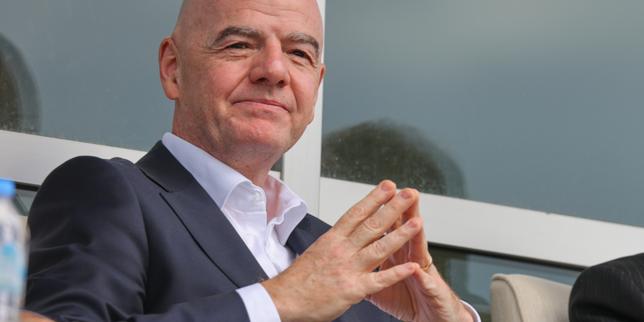
Gianni Infantino knows this weight. He carries it in the way he speaks—a careful, measured cadence that attempts to bridge the gap between a soccer ball and a ballistic missile. Recently, the FIFA President sat before a room of reporters and addressed the question that has been simmering like a dormant volcano: Will the Iranian national team actually be allowed to play on American soil during the 2026 World Cup?
His answer was a defiant "yes."
But "yes" is a complicated word when it involves two nations that haven't exchanged an official handshake in decades.
Imagine a young boy in Isfahan. Let’s call him Omid. Omid doesn't read the financial tickers or follow the nuances of the nuclear deal. He knows one thing: Sardar Azmoun is his hero. To Omid, the 2026 World Cup represents a rare window where his country isn't a headline about regional instability, but a group of eleven men in white jerseys trying to find the back of the net. For Omid, the tournament is the only time the world looks at Iran and sees a teammate rather than a threat.
This is the human heartbeat behind the cold logistics of visa approvals and security protocols.
The friction is real. For months, whispers from Tehran suggested a deep-seated anxiety about sending their national icons into what they perceive as the "lion’s den." There were demands, posture, and the usual rhetorical fireworks that precede any interaction between these two powers. The Iranian government expressed concerns about the safety of their players and the potential for political demonstrations in the stands of Los Angeles or New York. They hinted at a boycott, a withdrawal that would have ripped a hole in the fabric of the tournament’s "United" theme.
Infantino’s job is to play the role of the secular priest, convincing everyone that the cathedral of the stadium is a neutral sanctuary. He has been clear: The World Cup belongs to the world, and that includes the Islamic Republic of Iran.
The Invisible Visa
Football has a funny way of making the impossible seem ordinary. In 1998, the two teams met in France. It was billed as the most politically charged match in history. Instead of hostility, the players exchanged white roses. They posed for a joint photo that remains one of the most poignant images in sports history.
But 1998 was a different world.
Today, the stakes are tangled in a web of digital surveillance, global protests, and a generational divide within Iran itself. When the Iranian team takes the field in 2026, they won't just be playing against an opponent; they will be playing against the expectations of their own government and the hopes of a diaspora that is often at odds with that very government.
Consider the logistics of a single Iranian player landing at JFK. Under normal circumstances, the vetting process is a labyrinth. Now, multiply that by a full squad, coaching staff, and support personnel. There are the legalities of the U.S. State Department and the mandates of FIFA, which require host nations to provide equal access to all qualifying teams.
Infantino has spent the last several months acting as a high-stakes mediator. He has had to assure Washington that the tournament remains a sporting event, not a political platform, while simultaneously assuring Tehran that their players won't be treated as political pawns the moment they clear customs.
It is a tightrope walk over a canyon of history.
The Ghost in the Stands
The real tension isn't on the pitch. It's in the rows of seats.
The United States is home to one of the largest Iranian populations outside of Iran. In cities like Los Angeles—affectionately dubbed "Tehrangeles"—the 2026 World Cup is more than a series of games. It is a family reunion, a protest, a celebration, and a source of profound anxiety all at once.
If you are a member of the Iranian national team, who are you playing for? Are you playing for the officials in Tehran who sign your paycheck? Or are you playing for the woman in the third row wearing a "Woman, Life, Freedom" shirt, her eyes brimming with tears as she hears a national anthem that represents both her home and her heartache?
This is the "invisible stake" that the dry news reports miss. The 2026 World Cup in North America will be the first time this specific cultural tension plays out on such a massive, televised scale. Every goal scored by Iran will be a complicated catharsis. Every loss will be dissected for signs of internal dissent or external pressure.
Infantino’s assurance that the team "will be present" is a logistical victory, but it barely scratches the surface of the emotional reality. He is promising a seat at the table, but he cannot control the conversation that happens once everyone sits down.
A Game of Geopolitical Chess
Soccer is often called the beautiful game, but it is also a brutal mirror. It reflects our tribalism, our borders, and our stubborn refusal to see the "other" as human.
The decision to keep Iran in the tournament, despite the friction, is a calculated move by FIFA to maintain the illusion of a world without politics. If FIFA starts banning teams based on the actions of their governments, the tournament collapses. Where would the line be drawn? Who gets to hold the pen that crosses out a nation’s name?
By insisting on Iran’s participation, Infantino is betting on the idea that the spectacle of the game is more powerful than the rhetoric of the regime. He is betting that for ninety minutes, the world will care more about a corner kick than a centrifuge.
But logic doesn't always win in the stadium.
Think about the pressure on a twenty-four-year-old goalkeeper. He has spent his life training for this moment. He has sweated through the heat of Persian Gulf summers to earn his spot. Now, he stands in a tunnel in a stadium in the United States. He knows that back home, the electricity might be flickering, the economy might be struggling, and his family is huddled around a television, praying for a moment of pride.
He also knows that the eyes of the world are on him, looking for a sign—a refused handshake, a black armband, a certain look in his eye—that signals where his true loyalties lie.
That is not just sport. That is an endurance test of the soul.
The Sound of the Whistle
The 2026 World Cup will be the largest ever, a sprawling behemoth of three nations and forty-eight teams. It is designed to be a celebration of unity, a "North American party" invited to the world.
Yet, the presence of the Iranian team acts as a sharp, necessary reminder that unity is a fragile, manufactured thing. It requires the suspension of disbelief. It requires us to look at a man in a jersey and see a player, not a policy.
Infantino’s guarantee is a piece of paper. It’s a signature on a host agreement. It’s a quote in a press release.
The reality will be found in the parking lots of the stadiums, where fans from opposing sides of a geopolitical divide will share charcoal grills and stories. It will be found in the silence that falls over a crowd right before a penalty kick—a silence that is the same in English as it is in Farsi.
We often talk about sports as an escape from the "real world." But for the Iranian players and the fans who follow them to the U.S., the World Cup isn't an escape. It is a collision. It is the one place where the "real world" and the "beautiful game" are forced to look each other in the eye and decide which one matters more.
When the whistle blows for Iran’s first match on American soil, the politicians will still be talking. The sanctions will still be in place. The warships may still be in the strait.
But for a brief, flickering moment, the only thing that will matter is the flight of the ball, the speed of the grass, and the collective breath of a million people who, for just a second, forgot to be enemies.
The stadium has no borders, even if the world outside is covered in them.