The speedometer of a Dodge Charger Pursuit is a glowing, digital confession. It does not care about the adrenaline flooding a driver’s veins or the blue uniform of the man behind the wheel. It only records the physics of a machine tearing through the quiet air of a New York afternoon. On that day in December, the number climbed past eighty. Then ninety. Finally, it touched one hundred miles per hour.
At that speed, the world outside the reinforced glass becomes a smear of gray asphalt and winter-dead trees. Perspective narrows. The distance between a car and the family in front of it vanishes in a heartbeat. You might also find this similar coverage useful: The $2 Billion Pause and the High Stakes of Silence.
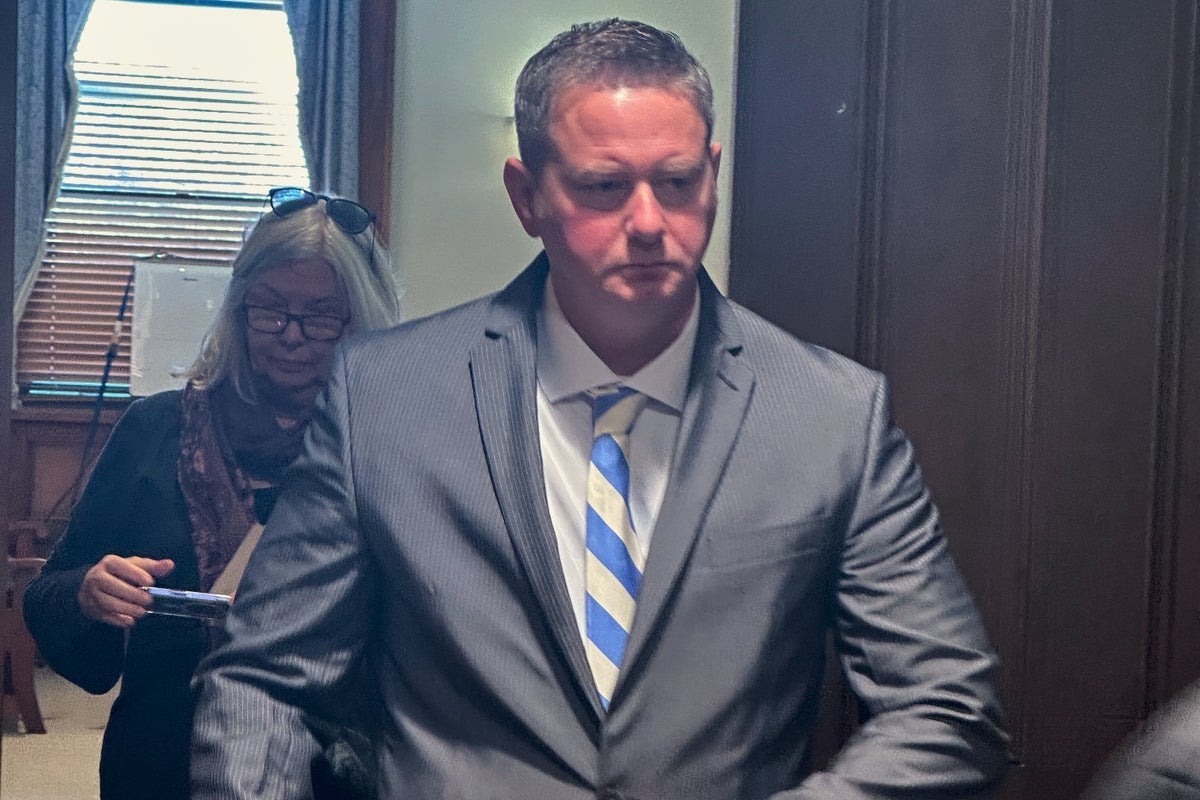
Christopher Baldner was a New York State Trooper, a man sworn to protect the very people sharing the Thruway with him. But when he saw a car he wanted to stop, the oath became a secondary concern to the chase. The result was not a successful traffic stop or a heroic apprehension. It was a crumpled heap of metal and the sudden, violent end of an eleven-year-old girl named Monica Goods.
The Weight of a Pursuit
Police chases are often depicted as cinematic triumphs of justice over lawlessness. We watch them on news feeds, gripped by the tension of the hunt. Yet, behind the grainy helicopter footage lies a terrifying reality: a two-ton vehicle traveling at triple-digit speeds is a weapon of mass destruction. When that weapon is wielded by the state, the margin for error must be zero. As discussed in detailed reports by NBC News, the implications are worth noting.
In the case of Christopher Baldner, the error was systemic and repeated. This wasn’t a one-time lapse in judgment or a freak accident born of unpredictable road conditions. It was a pattern.
Years before the tragedy that claimed Monica’s life, Baldner had been involved in similar high-speed maneuvers. He practiced a technique known as "ramming"—using a police cruiser to physically strike a fleeing vehicle to force it off the road. It is a tactic reserved for the most extreme threats, a last resort when a suspect poses an immediate danger to the public.
Monica Goods and her family were not that threat. They were a family in a car, headed toward a destination that Monica would never reach.
A Morning Shattered
Consider the interior of the Goods family car moments before the impact. It is the mundane, beautiful chaos of a family road trip. There are snacks, perhaps a tablet playing a movie, the low hum of a heater fighting the December chill. Monica, at eleven, was at that age where the world is just beginning to open up. She was old enough to understand the jokes her parents told, but young enough to still feel entirely safe in the back seat.
Then come the lights. The siren. The sudden, jarring realization that you are being targeted by the very people meant to keep you safe.
The prosecution built a case not just on the final impact, but on the seconds leading up to it. They described a trooper who didn't just follow; he hunted. He used his vehicle to ram the Goods' car twice. The second strike was the killing blow. It sent the family car spinning, flipping, and ultimately resting in a state of ruin that no child should ever inhabit.
The court didn't see a tragic accident. They saw manslaughter. They saw a man who acted with a depraved indifference to human life, a legal term that sounds cold but feels like fire when applied to the death of a child. To act with depraved indifference is to look at a situation where death is a near-certainty and proceed anyway because your own ego or objectives outweigh the lives of others.
The Myth of the Necessary Chase
We are often told that these chases are necessary to keep the streets safe. The logic follows that if we let one person go, the rule of law collapses. But we must ask: safe for whom?
Statistics across the United States show that a staggering percentage of high-speed chases begin over minor traffic infractions. A broken taillight. An expired registration. A failure to signal. In the pursuit of a fine or a misdemeanor, we authorize officers to turn public roads into battlefields.
The invisible stakes of these encounters are the lives of the bystanders—the "collateral damage" that the system often tries to brush aside. When a trooper decides to push a car to 100 mph, they are making a bet. They are betting their career, the suspect's life, and the lives of every family in every minivan within a five-mile radius that they can control the uncontrollable.
Christopher Baldner lost that bet. But he wasn't the one who paid the highest price.
Accountability in the Aftermath
The conviction of an officer for actions taken during a pursuit is a rare occurrence. Usually, the "heat of the moment" defense acts as an impenetrable shield. It suggests that because an officer's job is stressful and dangerous, we cannot possibly hold them to the same standards of logic and care as a civilian.
But this conviction suggests a shifting tide. It acknowledges that a badge is not a license to create more danger than you are preventing. It asserts that the life of an eleven-year-old girl is more precious than the ego of a trooper who felt slighted by a driver who didn't immediately pull over.
The legal proceedings were long. They were painful. They required the Goods family to relive the terror of that December night over and over again, dissecting the physics of the crash that stole their daughter. They had to listen to defense arguments that tried to shift the blame, to make the victim the cause of her own demise.
But the jury saw through the smoke. They understood that the power of the state carries a heavy burden of restraint. When that restraint is abandoned, the state becomes the predator.
The Empty Chair
At the end of the legal battles, after the sentencing and the headlines fade, there remains only the human element. There is a bedroom in a house that stays exactly as it was. There is an empty chair at the dinner table. There is a mother and a father who have to find a way to breathe in a world that allowed a man in a blue uniform to ram their car into oblivion.
We talk about policy changes. We talk about "restrictive pursuit policies" and "technological alternatives" like GPS tracking darts. These are important, necessary conversations for a modern society to have. We should demand that no officer ever engages in a high-speed chase for a non-violent offense. We should demand an end to the "ramming" culture that treats public roads like a demolition derby.
But those policies are just words on paper until we address the core issue: the valuation of human life versus the enforcement of authority.
The story of Monica Goods isn't just a news report about a tragic accident. It is a mirror. It asks us what we are willing to tolerate in the name of "law and order." It asks if we are comfortable living in a society where a child's life can be snuffed out because a grown man couldn't control his temper or his vehicle.
The digital speedometer in that Dodge Charger stopped at the moment of impact. The numbers froze. But for the Goods family, the clock didn't stop. It just began ticking through a new, hollow reality where justice is a small comfort for an unimaginable loss.
The road is long and gray, stretching out toward a horizon that Monica Goods never got to see. Every time we see those blue lights in our rearview mirror, we should remember her name. We should remember that the power to protect is inseparable from the power to destroy, and that the difference between the two is often nothing more than a split-second choice to be human.
There is no victory in a conviction like this. There is only the somber recognition of a truth we often try to ignore: that the most dangerous thing on the road isn't always the person running away, but the person who decides that catching them is worth any cost.


.jpg?width=1200&auto=webp&trim=0%2C0%2C0%2C0)
