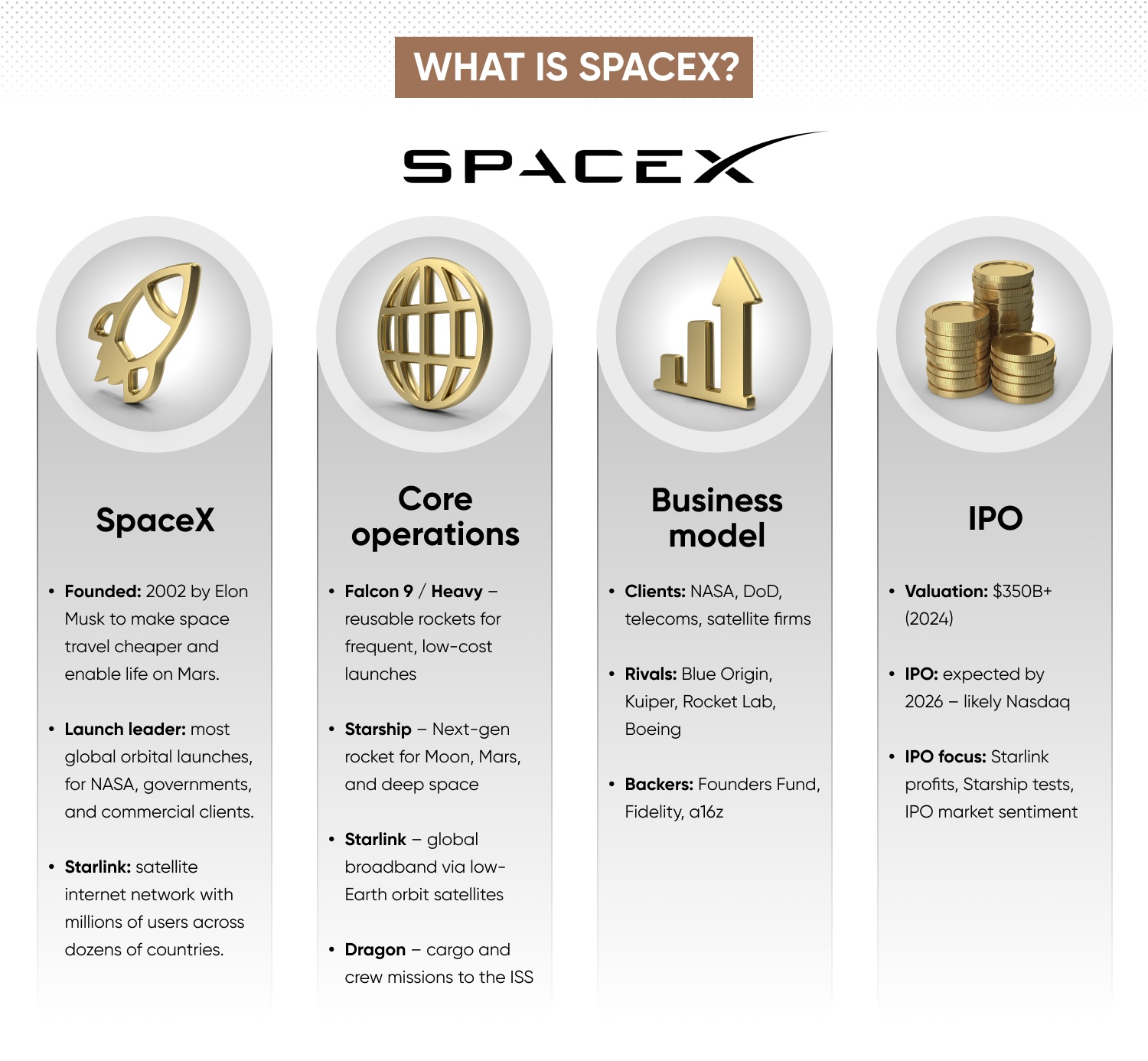
Elon Musk doesn't need your money. That’s the hard truth facing every retail investor staring at SpaceX’s $250 billion-plus valuation with envy. While the financial media loves to churn out "SpaceX IPO" headlines every time a Falcon 9 touches down on a drone ship, the reality of the situation is far more boring—and frustrating—for the average person. SpaceX is currently the most successful private company on the planet, and its internal structure is designed specifically to keep it that way.
If you’re waiting for a ticker symbol to appear on Robinhood so you can "get in early," you’ve already missed the boat. The early rounds happened a decade ago. Now, the company operates as a closed ecosystem where Musk maintains absolute control, and employees get rich through internal secondary markets. There’s no ticking clock forcing a public debut. In fact, going public might be the worst thing that could happen to Musk’s Martian ambitions.
The Starlink Spinoff Myth
The most common theory is that SpaceX will carve out Starlink, its satellite internet business, and take it public as a standalone entity. It makes sense on paper. Starlink is a predictable, subscription-based revenue machine. It’s the "utility" side of the business that Wall Street understands. Unlike the R&D-heavy Starship program, which involves blowing up prototypes in the Texas desert, Starlink has millions of customers and clear margins.
Musk himself teased this idea years ago, saying he’d take Starlink public once cash flow became "smooth and predictable." Well, in 2024 and 2025, that cash flow arrived. But the IPO didn't.
Why? Because Starlink is the piggy bank for Mars. Developing the Starship launch system costs billions. If Starlink stays private, SpaceX can funnel every cent of profit from those satellite subscriptions directly into rocket development without answering to a board of directors or quarterly earnings calls. Public shareholders hate "unnecessary" spending on long-term, high-risk projects. They want dividends and buybacks. Musk wants a city on another planet. Those two goals don't align.
How the Big Dogs Are Already Playing
You might not be able to buy SpaceX stock, but the "smart money" is already there. The company doesn't raise capital from the public because it doesn't have to. Whenever SpaceX needs a billion dollars, it just opens a private funding round. Blue-chip institutional investors like Fidelity, Google (Alphabet), and various sovereign wealth funds fall over themselves to get a piece.
These aren't speculative bets. These are calculated entries into a company that has effectively monopolized the global launch market. When the European Space Agency or even NASA needs a heavy-lift launch on short notice, they call SpaceX. This dominance creates a valuation trap for retail investors. By the time an IPO actually happens, the valuation will be so high that the "explosive growth" phase will likely be over. You’ll be buying the top.
If you’re desperate for exposure, you’re forced to look at indirect routes:
- Alphabet (GOOGL): They took a significant stake back in 2015.
- Fidelity Funds: Several of their blue-chip and growth funds hold SpaceX shares.
- Destiny Tech100 (DXYZ): A closed-end fund that actually holds private SpaceX shares, though it often trades at a massive premium to its actual net asset value.
These options aren't pure plays. They’re diluted. You’re buying a whole lot of search engine or mutual fund fluff just to get a tiny sliver of rocket fuel.
The Quarterly Earnings Death Trap
The biggest hurdle to a SpaceX IPO is the transparency requirement. Public companies have to disclose everything. They have to explain why a prototype exploded. They have to justify why they’re spending $5 billion on a rocket that might not carry a paying customer for years.
Look at Boeing. Look at Blue Origin’s slow progress. Public scrutiny often leads to risk aversion. SpaceX’s entire culture is built on "fail fast, learn faster." They intentionally push hardware to the breaking point. On a public balance sheet, an exploded rocket looks like a loss. In South Texas, it looks like data.
Musk has seen the headaches of being public with Tesla. Between the "funding secured" tweets and the constant pressure from short sellers, he’s expressed deep regret over taking Tesla public so early. He won't make that mistake with his life’s work. SpaceX is his legacy. He isn't going to hand the steering wheel to a group of hedge fund managers who care more about the Q3 2027 guidance than the colonization of the solar system.
The Secondary Market Is the Real Exchange
If you think there's no liquidity for SpaceX, you're wrong. There’s a thriving secondary market, but it’s a members-only club. SpaceX frequently allows employees to sell their shares back to the company or to approved investors in "tender offers."
This serves two purposes. First, it keeps employees happy and wealthy without needing an IPO. Second, it allows Musk to hand-pick who owns the company. In 2024, these tender offers valued the company at roughly $210 billion. By early 2026, those numbers have only climbed as Starship achieves more successful orbital flights.
For the average person, platforms like Forge Global or EquityZen sometimes list SpaceX shares. But don't get your hopes up. You usually need to be an "accredited investor," which means having a net worth of over $1 million (excluding your house) or a high annual income. If you don't fit that criteria, the door is locked.
Starship Is the True Value Driver
Forget the satellites for a second. The real reason SpaceX's valuation is hitting outer space is the Starship HLS (Human Landing System). NASA has banked the entire Artemis program on SpaceX’s ability to land humans on the moon.
Starship is designed to be fully and rapidly reusable. We're talking about a world where the cost per kilogram to orbit drops from thousands of dollars to double digits. If SpaceX achieves this, they don't just lead the market; they own the market. They become the railroad, the shipping lane, and the port authority for the entire space economy.
Why would anyone share that upside with the public before it’s fully realized? If I’m Musk, I’m waiting until Starship is as routine as a 747 flight before I even think about an S-1 filing.
Moving Beyond the Hype
Stop checking for IPO dates. They aren't real. Every "report" suggesting a 2025 or 2026 Starlink IPO is based on speculation from analysts who want the investment banking fees associated with the deal. They aren't based on what's actually happening inside Hawthorne.
If you want to invest in the space economy right now, you have to look elsewhere. You have to look at the companies that provide the components, the specialized gases, or the ground infrastructure. Or, you accept that you're an observer in this particular chapter of history.
Your next steps for actual space exposure:
- Audit your current portfolio: Check if your "Total Market" or "Large Cap" mutual funds have holdings in Alphabet or specific Fidelity funds that carry private SpaceX equity. You might already own more than you think.
- Research the "picks and shovels": Look into companies like Rocket Lab (RKLB). They're public, they're launching regularly, and they're actually building a diversified space business that you can buy into today.
- Monitor the Starlink cash flow: Watch for SpaceX’s announcements regarding Starlink’s profitability. If they ever stop using that money for Starship development and start hoarding it, that’s your only real signal that an IPO might be on the horizon. Until then, it's all just noise.
The "final frontier" of IPOs is closed for renovations. Don't waste your time waiting at the gate.