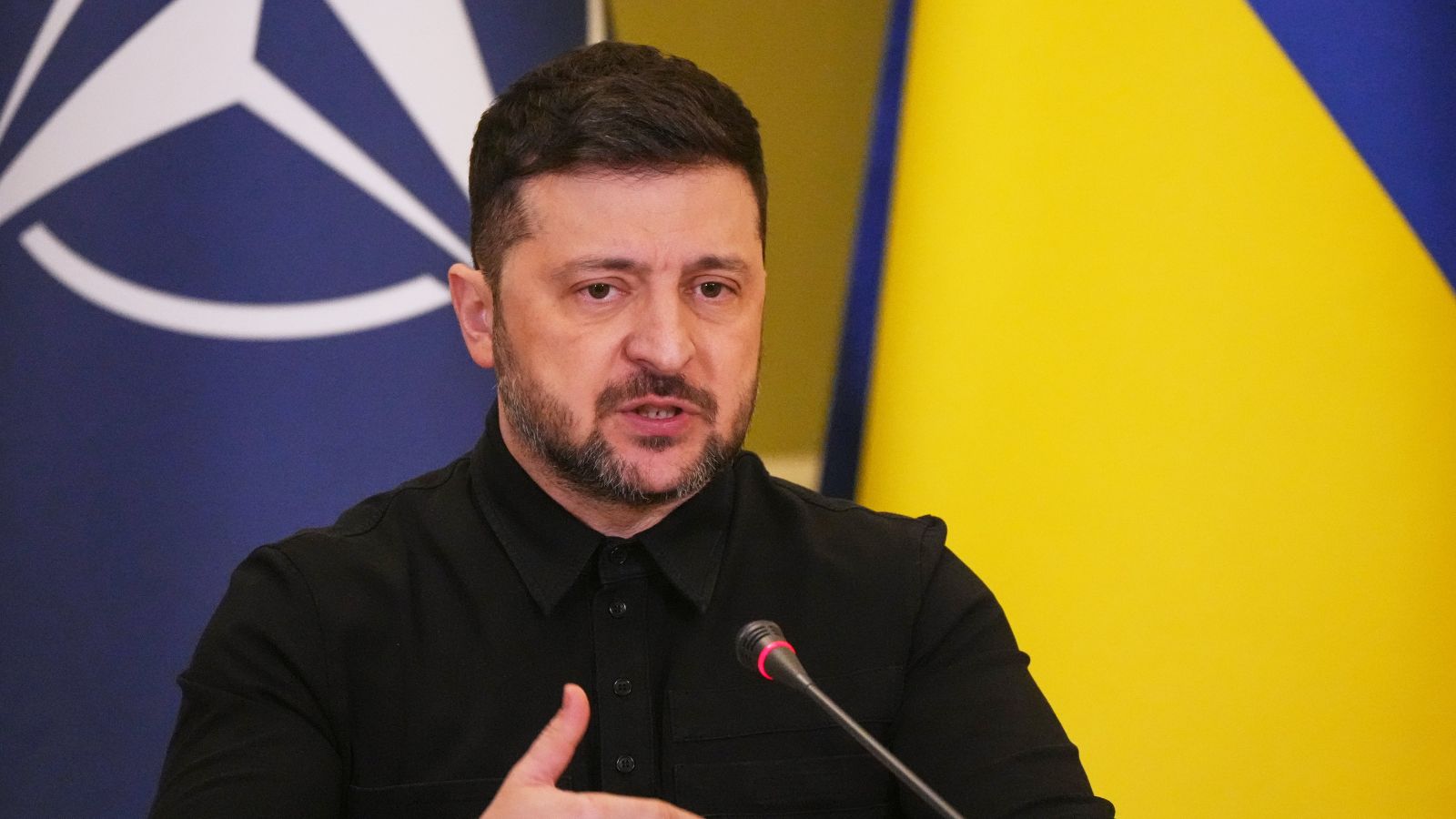
Low-Earth orbit is no longer a neutral observer. When Iranian missiles struck U.S. and allied interests with uncanny precision, the world looked at Tehran’s domestic drone program, but the real story was hovering several hundred miles above the Earth. The timeline suggested by President Volodymyr Zelenskyy and corroborated by emerging orbital data points to a disturbing new reality of the modern battlefield: Russian satellite imagery is now the primary targeting engine for Iranian long-range strikes. This isn't just about two "pariah states" sharing a handshake; it is the birth of a sophisticated, real-time intelligence pipeline that bypasses Western detection and renders traditional camouflage obsolete.
For decades, the United States maintained an undisputed "high ground" in space-based reconnaissance. That monopoly has evaporated. Russia’s Soyuz-2 and Angara rockets have been busy, and while the Kremlin’s ground forces struggle in the mud of the Donbas, its satellite constellations are proving their worth as a currency of war. By providing Iran with high-resolution imagery of U.S. bases in the Middle East just days before kinetic actions, Moscow has shifted from a diplomatic ally to an active, albeit remote, fire-control officer.
The Mechanics of the Moscow Tehran Orbital Handshake
Modern ballistic missiles are only as good as their coordinates. Iran’s Fatah and Shahab series missiles have impressive range, but their terminal guidance systems require fresh, accurate data to account for moving assets, new fortifications, or temporary deployments. This is where the Russian Kanopus-V and Resurs-P constellations come into play. These satellites aren't just taking pretty pictures; they are providing the raw data for Digital Scene Matching Area Correlation (DSMAC) and Global Navigation Satellite System (GNSS) corrections.
When a Russian satellite passes over a U.S. installation in Iraq or Syria, it captures more than just building layouts. It tracks the specific placement of Patriot missile batteries, the fuel bladder locations, and the density of personnel housing. This data is downlinked to Russian ground stations, processed, and then transmitted to Iranian Revolutionary Guard Corps (IRGC) command centers. Within forty-eight hours, those coordinates are baked into the flight computers of an Iranian drone swarm or a medium-range ballistic missile.
This speed is the crucial factor.
Traditional intelligence-sharing used to take weeks of diplomatic vetting. Today, the technical integration between Russian orbital assets and Iranian ground-strike capabilities happens in a near-instantaneous loop. Zelenskyy’s warning wasn't a shot in the dark; it was an observation of a pattern seen repeatedly in Ukraine, where Iranian "Shahed" drones use similar Russian-provided data to navigate around Ukrainian air defenses. The same playbook is being used against American targets.
Why the Kremlin is Willing to Trade its Eyes
Russia does nothing for free. The motivation behind providing this high-level intelligence is a calculated trade for survival. In exchange for orbital targeting data, Iran provides the very drones and missiles that allow Russia to keep its "Special Military Operation" alive. It is a symbiotic relationship born of desperation and mutual isolation.
However, there is a deeper, more cynical layer to this cooperation. By enabling Iranian strikes on U.S. assets, Russia forces Washington to divert resources away from Eastern Europe. Every Patriot battery sent to protect a base in the Persian Gulf is one fewer battery available to defend Kyiv or Kharkiv. It is a textbook example of multi-theater distraction. Moscow is using Iranian proxies to bleed American military readiness without ever firing a shot from a Russian vessel or aircraft.
This creates a massive gray zone in international law. Is Russia a co-belligerent if its satellite was the "trigger" for a strike? In the traditional sense, no. In the practical sense, they are as involved as the person who loads the gun.
The Failure of Western Space Denial
The West has been slow to react to this orbital threat. Sanctions on the Russian space agency, Roscosmos, have done little to stop the shutter speed of their cameras. The assumption was that by cutting off Western components, Russian satellites would slowly go blind. That was a catastrophic miscalculation. Russia has maintained enough domestic production and illicit "gray market" supply chains to keep its military-grade satellites operational.
Furthermore, the proliferation of commercial satellite imagery has unintentionally aided this axis. While Russian state satellites provide the high-resolution military "kill shot" data, the massive influx of commercial imagery allows Iranian analysts to monitor general patterns of life at U.S. bases. They know when the shifts change, when the tankers arrive, and when the guards are most likely to be distracted. Russia simply provides the final, precise layer of data that ensures the missile hits the exact tent or hangar intended.
The Problem of Proximity and Predictability
Orbital mechanics are governed by physics, making them predictable. We know exactly when a Russian satellite is overhead. Yet, U.S. bases are massive, static targets. You cannot "hide" an airfield or a massive logistics hub from a satellite that passes by several times a day.
The Iranian strikes have shown a terrifying level of accuracy, often hitting within meters of the intended target. This level of precision is impossible with GPS alone, especially when the U.S. employs local jamming. It requires optical or radar-matching technology—the kind of tech that relies on the fresh imagery Russia is suspected of providing.
The Shadow of the Ukrainian Proving Ground
Ukraine has served as the laboratory for this new form of warfare. The world watched as Russia integrated Iranian hardware into its inventory, but few noticed the reciprocal flow of data. Zelenskyy’s administration has documented multiple instances where Russian orbital sweeps were immediately followed by Iranian-made drone strikes on critical infrastructure.
The "timeline" Zelenskyy suggests isn't a theory; it's a recorded frequency.
- Step One: A Russian reconnaissance satellite performs a high-resolution pass over a target.
- Step Two: Signal intelligence detects a spike in data transmission between Moscow and Tehran.
- Step Three: Within 72 hours, a coordinated strike occurs using flight paths designed to exploit gaps in radar coverage identified in the satellite imagery.
This isn't a coincidence. It is a refined military process.
Reevaluating the Red Lines in Orbit
If the U.S. continues to treat these satellite passes as "business as usual," it invites further strikes. The challenge is that interfering with a sovereign nation's satellite is often viewed as an act of war. This gives Russia a shield of invulnerability. They can "participate" in an Iranian strike with total impunity, knowing that the U.S. is unlikely to shoot down a Russian satellite in response to an Iranian missile.
This creates a massive tactical disadvantage. The U.S. must operate under the assumption that every movement at its overseas bases is being watched, recorded, and transmitted to its most hostile adversaries in near real-time. The "fog of war" has been lifted, but only for the other side.
The solution isn't as simple as more camouflage or deeper bunkers. It requires a fundamental shift in how we view space-based intelligence. We are moving toward a period where "neutral" space no longer exists. If a satellite's data is used to kill, that satellite is a weapon system.
The New Axis of Information
The alliance between Russia and Iran is often described in terms of ideology or anti-Western sentiment. That is too abstract. This is a technical alliance. It is a merger of Russian "eyes" and Iranian "arms."
As Iran's missile technology continues to advance, the bottleneck was always going to be the "kill chain"—the process of finding, fixing, and finishing a target. Russia has solved that problem for them. This partnership has turned Iran from a regional nuisance into a precision-strike power that can challenge U.S. naval and ground assets with a high probability of success.
The U.S. must now decide if it will continue to allow its adversaries to use the orbital commons as a targeting range. Every day that passes without a counter-strategy is a day that a Russian satellite provides the coordinates for the next American casualty. We are no longer waiting for a "future" war in space. The war is already here, and the satellites are winning.
The next time a missile hits a target with pinpoint accuracy, don't just look at the wreckage on the ground. Look at the sky and ask who was watching three days before.
Track the orbital passes of the Kanopus-V constellation against the strike logs in Iraq; the overlap is no longer a matter of debate, it is a matter of record.