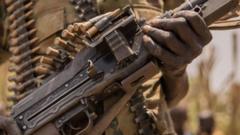
The bodies in Ruweng were buried in a mass grave on Monday, 169 in total, though the count remains as fluid as the front lines. On Sunday, February 1, 2026, armed youth from Mayom County in neighboring Unity State descended on Abiemnom. They didn't just raid for cattle, the historical currency of violence in this region; they executed a three-hour systematic sweep. Of the confirmed dead, 90 were civilians, including 82 children, women, and the elderly.
This was not a "surprise" in any sense that a veteran observer would recognize. It was the predictable fallout of a political strategy that has intentionally weaponized intercommunal grievances to stall the December 2026 general elections. By framing these massacres as "spontaneous tribal clashes" or "cattle raids gone wrong," the administration of President Salva Kiir and the fragmented opposition under the now-indicted Riek Machar maintain a convenient layer of deniability.
The reality is far grimmer. The Ruweng massacre is a data point in a national trend where the 2018 peace deal hasn't just failed; it has been inverted. Armed actors now use the peace agreement's stagnant "responsibility-sharing" mechanisms as a shield while they mobilize "White Army" militias and local youth groups to settle scores and clear territories before a single ballot is cast.
The Ruweng Massacre and the Strategy of Chaos
The attack on Abiemnom County was a surgical strike disguised as a riot. Among the 169 dead were the County Commissioner and the Executive Director, the very pillars of local governance. These were not collateral victims of a cattle theft. They were targeted to decapitate the administrative structure of a region that has become a flashpoint for political loyalty.
James Monyluak Mijok, the information minister for the Ruweng Administrative Area, has labeled the event a policy of extermination. He is not entirely wrong, though his terminology serves his own political narrative. The violence in Ruweng is part of a broader "arc of instability" stretching through Jonglei, Unity, and Warrap states. In these areas, the distinction between a government soldier and a tribal militiaman has effectively vanished.
When the youth from Mayom County crossed into Ruweng, they did so with modern weaponry that a pastoralist community cannot afford on its own. The proliferation of small arms in South Sudan is no longer just a leftover from the 2013 civil war. It is an active supply chain. Local leaders in Unity State have been accused of facilitating these movements to distract from the political vacuum left by Riek Machar’s house arrest and subsequent treason trial in Juba.
The Breakdown of Military Discipline
- Aerial Bombardments: The South Sudan People’s Defence Forces (SSPDF) have increasingly used air assets against populated areas under opposition control, particularly in Upper Nile and Jonglei.
- Command Collapse: In Eastern Equatoria and Jonglei, UN observers note that military discipline has evaporated. Troops operate more like local warlords than a national army.
- The Humanitarian Cost: Over 1,000 civilians fled to the UNMISS base in Abiemnom following Sunday’s attack. They are the lucky ones. In Jonglei, 26 MSF staff members remain missing after a similar surge in violence.
The Election Mirage
The December 2026 deadline for South Sudan's first-ever general elections is the primary driver of this carnage. President Salva Kiir has committed to the date, yet the fundamental prerequisites—a census, a voter registry, and a permanent constitution—remain nonexistent.
The regime is currently engaged in what analysts call "political theater." High-profile arrests of senior officials, framed as an anti-corruption drive, are actually a method of purging potential dissenters within the SPLM party before the campaign begins. By keeping the country in a state of low-intensity conflict, the government creates a perpetual "security emergency" that justifies the lack of electoral preparation while simultaneously consolidating power.
The SPLM-IO, once the primary opposition, has declared the current government illegitimate and suspended cooperation. This has left a power vacuum that local militias are more than happy to fill. When there is no path to power through a ballot box that doesn't exist, the path to power returns to the gun.
The Economic Engine of Conflict
South Sudan’s economy is almost entirely dependent on oil, which accounts for more than 90 percent of government revenue. Ruweng is oil-rich. Control over this territory isn't just about ethnic pride; it’s about controlling the flow of petrodollars.
The conflict in neighboring Sudan has only exacerbated this. As Sudanese refugees and South Sudanese returnees pour across the border—over 800,000 since 2023—the competition for land and resources has reached a breaking point. The Ruweng attack happened in this context: a desperate scramble for land that carries both political weight and mineral wealth.
The Failure of International Oversight
The United Nations Mission in South Sudan (UNMISS) and the African Union find themselves in an impossible position. They are tasked with protecting civilians in a country where the state is often the primary aggressor or a silent partner in the aggression.
The arms embargo is routinely ignored. Uganda recently deployed troops into Upper Nile at the request of Juba to "provide technical support" against the White Army. This deployment occurred without the required UN Security Council exemptions. It is a clear signal that regional players are picking sides, further internationalizing a conflict that the world has largely forgotten.
International donors, weary of a peace process that has been "extended" for nearly a decade, are beginning to pull back. But withdrawal is not a neutral act. It leaves the field open to the most brutal actors. The 2025 Human Rights Watch report noted that 5,100 people were killed or injured last year alone—a 40 percent increase from 2024. The 169 deaths in Ruweng are merely the opening chapter of what promises to be a blood-soaked 2026.
There is no "surprise" in Ruweng. There is only the grim, methodical execution of a plan to ensure that when December 2026 arrives, there is no one left to vote against the status quo. The mass grave in Abiemnom is a testament to a peace deal that has become a death warrant for the civilians it was supposed to protect.