The silence in a war zone is never actually silent. It is a thick, pressurized hum composed of idling diesel engines, the distant crackle of radio static, and the rhythmic thud of boots on gravel. But there is another kind of silence—one manufactured in air-conditioned rooms thousands of miles away. It is the silence of a story that isn't allowed to be told.
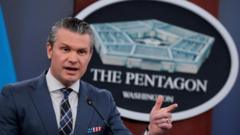
For years, a quiet friction has existed between the lens of a camera and the barrel of a gun. It came to a head recently in a courtroom where the abstract ideals of the First Amendment collided with the rigid machinery of the Pentagon. A federal judge finally looked at the restrictive web woven around journalists attempting to cover military operations and saw it for what it was: a violation of the very bedrock of American liberty.
This isn't just about press passes or media credentials. It is about whether the public has a right to see the face of the decisions made in their name.
Imagine a journalist named Elias. He is a hypothetical composite of the dozens of freelancers and veterans who have spent the last decade trying to navigate the Department of Defense’s shifting labyrinth. Elias doesn't want to reveal troop movements or put lives at risk. He wants to document the way a soldier’s hands shake when they write a letter home, or the way a village looks after the dust of a convoy settles.
Under the previous restrictions, Elias found himself trapped in a bureaucratic purgatory. To get "embed" status—the golden ticket that allows a reporter to travel with a unit—he had to agree to conditions that felt less like ground rules and more like a gag order. The Pentagon had developed a habit of denying access not based on security risks, but on "tone." If a reporter’s previous work didn't paint a sufficiently glowing picture of military efficacy, the door simply didn't open.
The court's ruling centers on the fact that the government cannot use "discretionary" standards to pick and choose who gets to witness history. When the Pentagon creates a system that favors friendly coverage and punishes critical inquiry, it stops being a security measure. It becomes a PR department with a military budget.
The Myth of Absolute Secrecy
The argument from the brass has always been grounded in "operational security." It’s a powerful phrase. It evokes images of leaked blueprints and compromised ambushes. We are told that the presence of a journalist with a satellite uplink is a variable that the modern battlefield cannot afford.
But the math doesn't add up.
In the digital age, information is a liquid. It leaks through the cracks of encrypted apps and personal smartphones. Yet, while a private might accidentally post a geotagged photo to Instagram, a professional journalist is often subjected to a vetting process so grueling it borders on the Kafkaesque. The judge noted that the First Amendment does not grant the government the power to act as a global editor-in-chief.
The stakes are invisible until they are suddenly, violently visible. When we lose the eyes of independent observers on the ground, we lose our grip on the reality of conflict. War becomes a series of clean, bloodless statistics delivered at a 2:00 PM briefing in a room with no windows. We see the "surgical strike" on a map, but we don't see the jagged hole it leaves in the side of a family home.
The Psychological Wall
There is a specific kind of exhaustion that comes from fighting a ghost. Reporters who have challenged these restrictions often describe a "soft" censorship. It isn't always a flat "no." Sometimes it’s a delay that lasts longer than the story’s relevance. Sometimes it’s a requirement for "security review" that turns into a debate over adjectives.
Consider the implications of a government that can curate its own legacy. If the only images allowed to emerge from a conflict are those that have been pre-approved by the people starting the conflict, then history is no longer a record. It’s a brochure.
The First Amendment was never intended to be convenient. It was designed to be a nuisance. It exists specifically to protect the speech that the powerful find annoying, unpatriotic, or "unhelpful." The judge’s ruling underscores a vital truth: the military serves the Constitution, not the other way around.
The Pentagon’s lawyers argued that the battlefield is a unique environment where normal rules don't apply. They are right, but not in the way they think. Because the battlefield is where the most extreme actions are taken in the name of the people, it is exactly where the most rigorous oversight is required.
The Cost of the Dark
When the lights go out on a specific part of the world, we stop empathizing with the people in it. We start thinking in terms of "theaters of operation" and "assets." The human element evaporates.
I remember talking to a photographer who spent months trying to get permission to cover a specific medical evacuation unit. He was told his presence would be "disruptive." When he finally got in—after a legal back-and-forth that cost him thousands—he captured a single image of a medic holding the hand of a wounded soldier. There was no blood in the shot. No secret technology. Just a grip so tight the knuckles were white.
That image did more to explain the reality of the war to the American public than a thousand pages of declassified reports. The Pentagon’s restrictions were designed to prevent that kind of emotional transparency because transparency is unpredictable. It’s messy. It makes people ask questions that don't have easy answers.
The court’s decision is a crack in that wall. It dictates that the Department of Defense must create clear, objective, and content-neutral standards for press access. No more "I know it when I see it" denials. No more blacklisting journalists for being "difficult."
This isn't a victory for the media alone. It’s a victory for the person sitting at their kitchen table, three thousand miles away, trying to understand what their tax dollars are doing on the other side of the planet. It’s a victory for the truth, which is often the first casualty of any conflict, usually buried under a pile of "denied" press applications.
The hum of the war zone continues. The diesel engines still idle. The radios still crackle. But now, hopefully, there will be someone there to write down what the silence feels like when the engines finally stop.
The door that was slammed shut has been pried open by a few pages of legal prose, proving that even the most powerful military on earth must eventually answer to a piece of paper written in 1791.
Justice, much like war, is rarely swift and never clean. But in this instance, it was clear. The light is coming back into the room, and the people in charge will just have to learn to live with the glare.
Everything else is just noise.