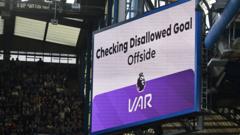
We've all been there. Your team scores a brilliant, flowing goal that pulls you out of your seat. You're screaming, high-fiving, and then the dreaded yellow rectangle pops up on the screen. Enter the Video Assistant Referee. Lines are drawn. Pixels are zoomed in on. Three minutes later, the goal gets chalked off because the striker's armpit or toenail was two millimeters ahead of the defender. It kills the stadium vibe. It sucks the joy right out of the sport.
Soccer has a massive problem with the current offside law, and everyone knows it.
That's why the Canadian Premier League is stepping up as the ultimate guinea pig. FIFA and the International Football Association Board approved a massive trial in the Canadian top flight to test a concept popularized by Arsene Wenger. They call it the daylight offside rule.
But don't let the corporate speak about flow and attacking intent fool you. This isn't just a minor tweak to the rulebook. It's a radical overhaul that could fundamentally change how teams play, how coaches think, and how defenders do their jobs. Honestly, it might even make the game worse.
What Is the Daylight Offside Rule Anyway
Right now, a player is offside if any part of their head, body, or feet that can legally score a goal is closer to the opponents' goal line than both the ball and the second-to-last opponent. It's an exact science in the era of semi-automated cameras, and that's precisely why fans hate it.
Wenger's proposed daylight offside rule flips the script entirely.
Under this new interpretation, an attacker is onside as long as any part of their body that can score a goal is level with or behind the defender. To be called offside, there must be a visible gap, literally daylight, between the attacker and the defender.
If your trailing heel is level with the defender's front shoulder while the rest of your body is leaning toward the goal, you are onside. It hands a massive, borderline unfair advantage back to the attacking team.
Wenger's logic makes sense on paper. He wants to bring back the benefit of the doubt for the striker. He wants more goals, more entertainment, and less time spent drawing digital lines on a screen. But soccer is a game of fine margins, and shifting those margins so drastically creates a massive ripple effect.
The Massive Defensive Nightmare Nobody Is Talking About
I've played and watched enough soccer to know that when you give attackers an inch, they take a mile. Give them a full body length of daylight, and you completely break defensive structures.
If this rule becomes the global standard, it spells the death of the high defensive line.
Think about teams like Tottenham or Manchester City that love to compress the pitch and squeeze opponents by holding a line right near the halfway mark. They rely on the offside trap to catch strikers who mistime their runs by a fraction of a second. If you give strikers a whole body length of leeway, pulling off a successful offside trap becomes practically impossible. Strikers with electric pace will just hover on the shoulder of the last defender and explode into space.
So, what will coaches do to counter this? They won't just let fast strikers run free.
They will instruct their defensive lines to drop deeper and deeper. We are going to see a surge in low blocks. Teams will park the bus right on the edge of their own 18-yard box because leaving 40 yards of open green grass behind them is a suicide mission.
Instead of a beautiful, open game filled with goals, we could easily end up with incredibly boring matches where one team sits ten men behind the ball and the other team endlessly recycles possession with nowhere to go. It's a classic case of unintended consequences.
Why Canada Is the Perfect Guinea Pig
You might wonder why a major rule change pushed by FIFA's Chief of Global Football Development is starting in Canada instead of the English Premier League or La Liga.
The truth is, European heavyweights didn't want it. UEFA outright rejected the idea. Traditionalists are terrified of what this will do to the tactical balance of the sport, and they aren't ready to let Wenger experiment with their multi-billion dollar leagues.
The Canadian Premier League, on the other hand, was more than happy to raise its hand. League commissioner James Johnson stated that they want to be at the forefront of innovation. It's a smart branding move for a young league looking to grab international headlines.
But there is a massive practical reason why Canada is the perfect test environment. The Canadian league doesn't use the full, expensive VAR systems you see in Europe. Instead, they are rolling out Football Video Support alongside this trial, a lighter system where coaches get a limited number of challenges per match.
Testing the daylight offside rule in a league without heavy, semi-automated technology is the ultimate stress test. If assistant referees can't accurately spot a gap of daylight with the naked eye at full game speed, then the rule fails at the grassroots level where 99% of soccer is played without cameras.
Moving the Line Doesn't Kill the Controversy
Let's debunk the biggest myth surrounding this trial. Proponents claim this will eliminate the annoying, millimeter-thin offside calls that drive fans crazy.
It won't. It just moves the line.
Right now, we argue over whether a striker's toe was ahead of a defender's knee. Under the daylight rule, we are going to spend five minutes looking at a freeze-frame arguing over whether there was a tiny sliver of green grass visible between the defender's backside and the striker's trailing foot.
Controversy is hardwired into the offside law because it requires a human or a computer to judge two moving objects at the exact microsecond a third object, the ball, is kicked. You can't escape that with a simple rule tweak.
Keep Your Eyes on the North
This trial is officially underway in Canada, and the rest of the footballing world is watching very closely. If the league turns into a goal-fest with fluid, exciting attacking play, IFAB might push to make this the global standard in a few years. If it turns into a cagey, defensive nightmare where assistant referees get abused for missing tight calls, it'll get scrapped and thrown into the bin of bad ideas.
If you want to understand where the global game is heading, you need to stop looking at Europe for a second and pay attention to what's happening on the pitches in Canada.
Go watch a couple of Canadian league games this month. Look at how the center-backs are positioning themselves. Are they dropping deep? Are strikers cherry-picking and hanging out behind the back line? Pay attention to how long it takes officials to make decisions. Form your own opinion on whether the daylight rule actually improves the spectacle or just invents a whole new set of problems.