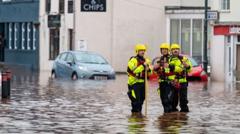
The water didn't just rise. It exploded. Imagine waking up at 3:00 AM to a sound like a freight train barreling through your front yard, only to realize the river you usually skip stones across has transformed into an ocean of debris. That’s exactly what happened when a river hit 18 times its normal level in a matter of hours, turning a quiet sleeping town into a literal disaster zone. It wasn't a slow creep. It was carnage.
Most people think they’ll have time to pack a bag or move the car. They're wrong. When a river surges to nearly twenty times its base flow, the physics of the water changes. It’s no longer just liquid. It’s a battering ram of mud, uprooted trees, and asphalt. If you’re waiting for an official siren to tell you to move, you’ve already lost the window to get out safely.
The Brutal Physics of an 18 Fold Surge
When we talk about a river hitting 18 times its normal volume, we aren't just talking about a bit of extra splashing over the banks. We’re talking about a complete failure of the local geography to contain the energy. Hydrologists look at "discharge rates," which is basically how many cubic feet of water pass a certain point every second.
In a typical flash flood scenario, a river might double or triple its flow. That’s manageable with sandbags. But an 18-fold increase? That’s a geological event. The weight of that much water moving at high velocity can strip the soil right off the bedrock. It turns cars into projectiles and houses into driftwood.
The town caught in this specific path of destruction didn't stand a chance because of the "funnel effect." If you have high ground or hills surrounding a valley town, every drop of rain for miles is directed into a single, narrow channel. When the sky dumps months of rain in a single night, that channel becomes a pressure cooker.
Why Your Flood Map Is Probably Lying to You
Here’s the part that really stings. Many residents in these devastated areas checked their maps years ago. They saw "Low Risk" or "500-Year Flood Plain" and figured they were safe. Honestly, those maps are often dangerously outdated. They don't account for modern concrete sprawl or the way climate volatility has rewritten the rules of the game.
When you pave over the upstream land with parking lots and strip malls, the ground can’t soak up the rain anymore. Instead of the earth acting like a sponge, it acts like a slide. The water hits the pavement and races toward the lowest point—the town center. We’re seeing "once in a lifetime" floods happening every three to five years now. If your town was built on the assumption that the river stays in its lane, you’re living on borrowed time.
The Terrifying Speed of a Midnight Crest
Flash floods are monsters of the night. There’s a psychological horror to losing power and hearing the water rushing under your floorboards while you’re still half-asleep. In this recent disaster, the river crested while most people were in REM sleep.
- Zero Visibility: You can't see where the road ends and the river begins.
- Structural Echoes: The sound of a house shifting on its foundation is something you never forget.
- Trapped Heat: Emergency services often can't reach you because the current is too strong for standard boats.
By the time the sun came up, the town didn't look like a town anymore. It looked like a junkyard. Mud caked every surface, reaching heights that seemed impossible just 24 hours prior.
Concrete Steps to Survive the Next Surge
If you live near any body of water, even a creek that looks dry most of the year, you need to stop overthinking and start acting. Hope is not a strategy.
First, get a NOAA Weather Radio. Don't rely on your phone. Cell towers are the first things to go when the wind picks up or the water hits the base of the station. A battery-powered or hand-crank radio will give you the actual alerts when the grid goes dark.
Second, understand the difference between a "Watch" and a "Warning." A watch means the ingredients are there. A warning means the cake is baking and it’s about to explode. If a Flash Flood Warning is issued for your area, move to higher ground immediately. Do not wait to see the water. If you see it, it's often too late to drive through it.
Third, look at your drainage. If your basement has ever felt damp after a normal rain, imagine what 18 times that volume will do. Invest in high-capacity sump pumps with battery backups. Better yet, move your valuables to the highest floor of your home today. Not tomorrow. Today.
The reality is that we can build all the levees we want, but nature has a way of finding the crack in the armor. When a river decides to reclaim its floodplain, it does so with a violence that no engineering project can fully stop. You have to be faster than the water.
Keep an emergency "go-bag" in your car, not just in your house. If the river hits 18 times its level again, you might only have seconds to jump in the driver's seat and head for the hills. Make sure that bag has your ID, insurance papers, and a way to purify water. The carnage in that sleeping town is a wake-up call for everyone else living in the shadow of a river.
Check your local elevation levels against the nearest river gauge on the USGS website. Know exactly at what stage the water reaches your doorstep. If the gauge shows a rapid vertical spike, don't wait for the knock on the door. Just go.