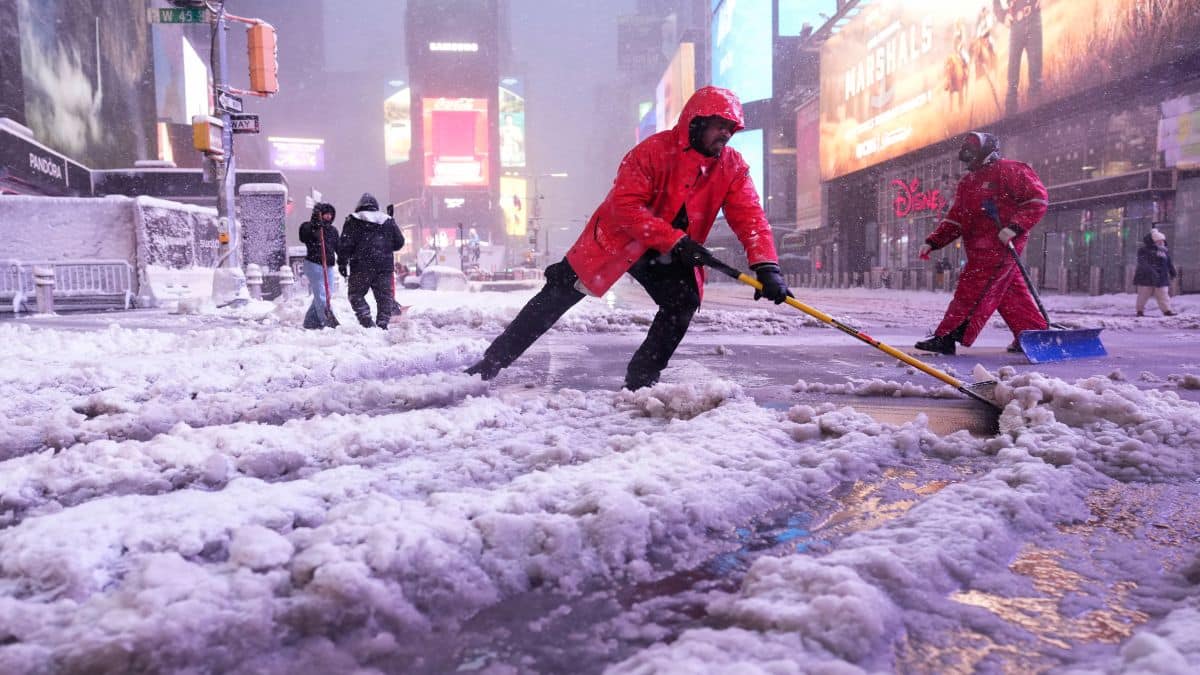
The barometer in Sarah’s kitchen didn’t just tip; it plummeted. It was a Tuesday in late December, the kind of afternoon where the light turns a bruised purple before the clock even strikes four. For Sarah, a nurse in Buffalo who had seen her fair share of lake-effect snow, this felt different. The air had a metallic tang, a sharpness that burned the back of the throat. Within three hours, the temperature outside her window dropped twenty degrees.
The world was about to vanish.
What Sarah was witnessing wasn't just a "big storm." It was a meteorological phenomenon known as a bomb cyclone, a term that sounds like hyperbole until you are standing in the center of one. Scientifically, it is defined by a process called explosive cyclogenesis. To earn the name, a storm’s central pressure must drop by at least 24 millibars in 24 hours. This one, the strongest to hit the U.S. interior in a decade, did it in less than twelve.
Pressure is the heartbeat of the atmosphere. When it drops that fast, the air rushes in to fill the vacuum with a violence that mimics a category-two hurricane. But instead of tropical rain and warm winds, this vacuum pulls down the arctic soul of the North Pole.
The Anatomy of the Collapse
To understand the scale of a bomb cyclone, you have to look at the collision. Imagine a wall of warm, moist air moving up from the Gulf of Mexico, thinking it has a right to the continent. Now, imagine a jagged, freezing blade of high-pressure air sliding down from the Canadian Rockies. When these two meet, they don't just mix. They fight.
The warm air is forced upward, spiraling counter-clockwise. As it rises, it cools, and the moisture it carries doesn't just turn to snow—it flash-freezes into a blinding, horizontal curtain. Because the pressure gradient is so steep, the winds reach eighty miles per hour. This isn't the kind of snow that falls gently on cedar trees for a Christmas card. This is whiteout turbulence.
For the millions of people caught in the path of this particular storm, the stakes weren't about delayed flights or salted driveways. They were about the thin margin of survival. In Ohio, the power grids groaned under the weight of ice and wind, leaving thousands in homes that were rapidly losing the battle against the cold. In the Dakotas, ranchers struggled to reach livestock through drifts that had swallowed fence lines whole.
A Mile Below the Clouds
The numbers are staggering. Over 200 million people were under some form of weather alert. The "feels like" temperatures in places like Montana hit -50 degrees Fahrenheit. At those temperatures, exposed skin freezes in less than five minutes. It is a biological shutdown. The blood retreats from the extremities to protect the heart, a desperate internal hunker-down that mirrors what the entire country was doing.
But the human element of a bomb cyclone is best measured in the quiet, terrifying moments inside a stalled car.
Consider a traveler on I-90. The visibility goes from a mile to an inch in the span of a heartbeat. This is the "whiteout." It is a sensory deprivation tank filled with screaming wind. You can't see the hood of your car. You can't see the brake lights of the person in front of you. If you stay in the car, the exhaust pipe might clog with drifting snow, sending carbon monoxide into the cabin. If you step out, you lose your sense of direction instantly. People have been found frozen just ten feet from their front doors, lost in a world that had no landmarks left.
This is why meteorologists use such aggressive language. When they talk about a "bomb," they are trying to pierce the noise of a world that has grown cynical about weather forecasts. They are trying to tell you that the physics of the sky have shifted into an unstable, predatory gear.
The Invisible Infrastructure
Why does a storm like this paralyze a modern superpower? We like to think of our world as a series of interconnected, invincible systems. We have fiber-optic cables, heated seats, and logistics networks that can deliver a package in twenty-four hours. A bomb cyclone exposes the fragility of that arrogance.
The electric grid is a delicate balance of supply and demand. When the mercury hits those arctic lows, everyone turns their heat up at once. Simultaneously, the wind is snapping power lines like dry twigs. In some regions, the wind was so intense that repair crews couldn't even raise their buckets to fix the lines; the wind would have tipped the trucks over.
We saw the "strongest storm in a decade" not just in the snow totals—which topped fifty inches in some pockets—but in the total cessation of movement. Thousands of flights were canceled, not because pilots were afraid of snow, but because the ground crews couldn't physically stay outside long enough to de-ice the planes or luggage belts. The machines froze. The grease in the gears turned to wax.
The Cold Truth
There is a temptation to look at these events as freak accidents of nature. We want to believe they are outliers. However, the warming of the atmosphere actually contributes to the intensity of these "bombs." A warmer atmosphere holds more moisture. When that moisture meets a wandering polar vortex—nudged south by a weakened jet stream—the energy release is catastrophic.
It is a paradox: a warming planet creates more frequent and more intense deep-freeze events.
By the time the sun finally broke through the clouds over Buffalo on Friday, the landscape was unrecognizable. Houses were encased in several inches of solid ice, looking like sculptures from a nightmare. Sarah, the nurse, finally made it home after a double shift that lasted thirty-six hours because her relief couldn't make it through the drifts. She sat in her kitchen, watching the barometer finally begin its slow, shaky climb back to normalcy.
The silence after a bomb cyclone is heavy. It isn't the peaceful silence of a snowfall; it is the exhausted silence of a city that has been under siege. You realize then that we don't "conquer" the weather. We survive it. We build our brick houses and our heating systems and our GPS networks, and for 360 days a year, they work beautifully. But for those other five days, when the pressure drops and the sky turns purple, we are reminded exactly who is in charge.
The snow will melt, the flights will eventually take off, and the headlines will fade into the next news cycle. But for those who felt the house shake as the central pressure bottomed out, the memory remains. It is the chilling realization of how quickly the air we breathe can turn into a weapon, and how small we are when the atmosphere decides to explode.
Would you like me to look into the specific recovery efforts for the regions most affected by this storm?