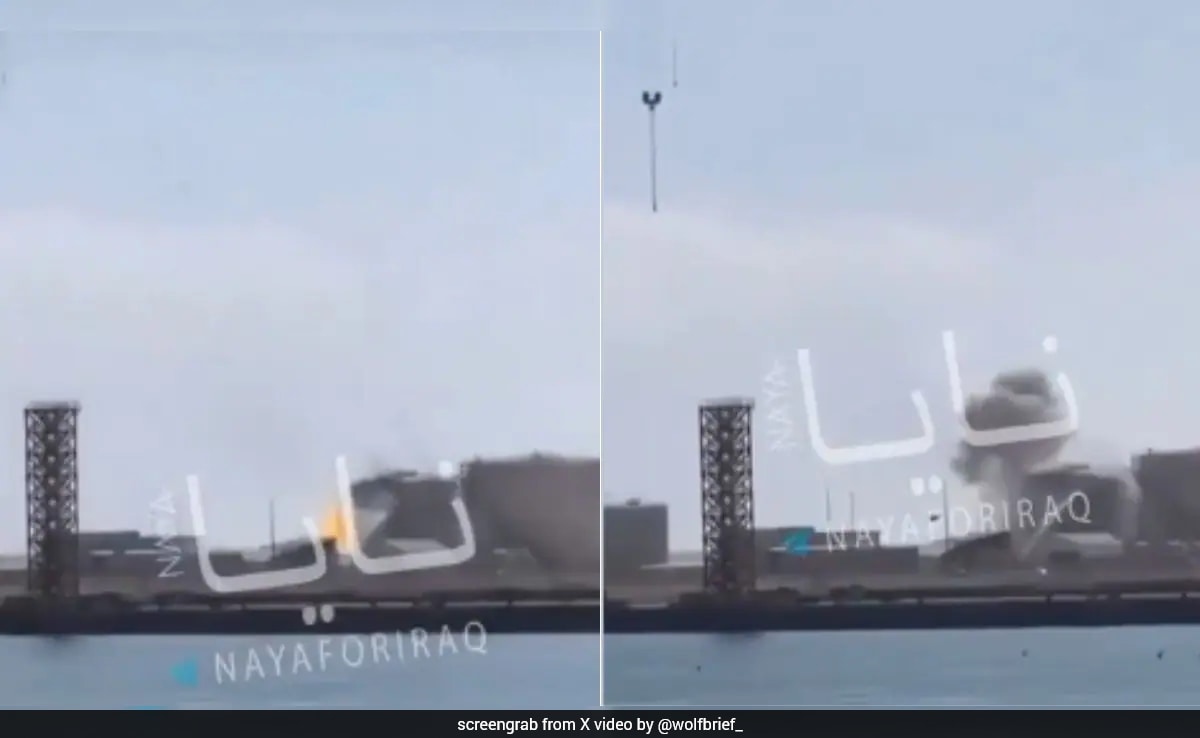
The morning shift at the Port of Duqm usually smells of salt spray and industrial grease. It is a place where the desert meets the Arabian Sea, a sprawling expanse of concrete and steel designed to be Oman’s crown jewel of commerce. For the dockworkers and engineers stationed there, the rhythm of life is dictated by the slow, rhythmic groan of shipping cranes and the distant hum of tankers. On a Tuesday that felt like any other, that rhythm was shattered by a sound that didn't belong to the sea.
It was a whine. High-pitched. Persistent. It sounded less like an engine and more like a swarm of angry bees amplified through a megaphone.
Then came the flash.
When an Iranian-made kamikaze drone strikes a maritime target, the transition from peace to chaos happens in a fraction of a second. There is no siren. There is no warning. There is only the sudden, violent realization that the sky has become a delivery system for fire. In the moments following the impact at the Omani port, the air didn't just turn hot; it turned thick. A column of oily, charcoal-colored smoke began to climb into the blue, visible for miles across the flat horizon of the Al Wusta Governorate.
The Physics of a Shadow
To understand what happened in Duqm, you have to look past the charred metal and the grainy cell phone footage captured by terrified bystanders. You have to look at the machine itself. These are not the sleek, multimillion-dollar Predators seen in Hollywood films. These are the Shahed variants—delta-winged, low-cost, and terrifyingly effective.
They are built with off-the-shelf components, powered by engines that sound like lawnmowers, and guided by GPS coordinates that turn them into precision-guided sledgehammers. They represent a shift in the way wars are fought. For decades, controlling the seas required a navy. Now, it requires a garage and a launch rail.
Think of it as the democratization of destruction. When a state or a proxy group can launch a $20,000 drone to disable a vessel or a port facility worth hundreds of millions, the math of global security breaks. The "asymmetric" nature of this threat means the defender has to be right one hundred percent of the time. The drone only has to be lucky once.
A Port Under Pressure
The Port of Duqm isn't just a collection of piers. It is a strategic lynchpin. Situated outside the volatile Strait of Hormuz, it was designed to be the safe harbor—the place where global trade could bypass the "choke point" of Persian Gulf tensions. By striking here, the message sent was loud and clear: Nowhere is outside the reach of the swarm.
Imagine standing on the deck of a nearby vessel when the impact occurred. The shockwave hits your chest first. It’s a physical push, a sudden displacement of air that makes your ears pop and your stomach drop. Then the smell reaches you—burning fuel, melted rubber, and the metallic tang of vaporized paint.
The smoke seen rising in the viral videos wasn't just a byproduct of a fire. It was a signal. In the world of maritime intelligence, black smoke indicates a "dirty" burn—rich in hydrocarbons, likely from a fuel tank or a specialized cargo hold. It lingered over the water like a funeral shroud, drifting slowly toward the desert, a grim reminder that the invisible lines of geopolitical conflict had just been redrawn in soot.
The Human Cost of High-Tech Friction
We often talk about these strikes in terms of "assets" and "infrastructure." We talk about regional stability and oil prices. We rarely talk about the person holding the camera, their hand shaking as they record the black plume. We don't talk about the merchant mariners who now look at every speck on the radar with a new, cold kind of dread.
For the Omani authorities, the incident is a diplomatic nightmare. Oman has long prided itself on being the "Switzerland of the Middle East," the neutral ground where enemies come to talk. To have a strike occur on their soil, targeting their burgeoning economic hub, is a violation of that hard-won neutrality. It forces a quiet nation into a loud conversation it never wanted to have.
The technology used in these attacks is evolving faster than the laws of sea. We are witnessing a transition where the "front line" no longer exists. If a drone can be launched from a truck in a remote desert, fly hundreds of miles using nothing but satellite waypoints, and strike a specific coordinate on a dock, then every port is a front line. Every ship is a target.
The Echo in the Engine Room
The fire was eventually contained. The smoke dissipated into the vastness of the Arabian sky. But the soot remains, layered on the surfaces of the port and in the lungs of those who were there. The physical damage to the Port of Duqm might be repaired with enough concrete and capital, but the psychological damage is more stubborn.
Security firms are now scrambling. Companies are investing in "soft-kill" electronic jamming and "hard-kill" kinetic interceptors. The cost of doing business in the region just went up, not because of taxes or tariffs, but because of the price of protecting the sky.
The next time you see a grainy video of a black plume rising from a distant coast, don't just see a news cycle. See the end of an era. The era where being "out of the way" meant being safe is over. The drone didn't just hit a port; it punctured the illusion that distance is a defense.
Somewhere in the silence of the Al Wusta desert, the wind is already beginning to cover the tracks of the launch site, but the shadow of that delta-wing remains burned into the deck of the world's consciousness.
The bees are still swarming. The sky is no longer just the sky. It is a corridor for things that don't belong there, and the salt spray of Duqm will never smell quite the same again.


