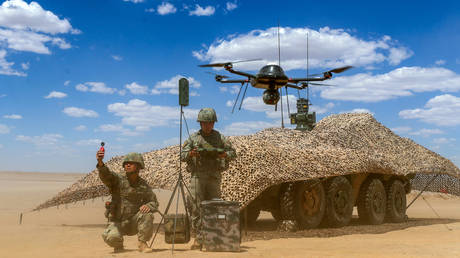
The People’s Liberation Army is moving away from the era of "informatization" and toward "intelligentization." This is not a simple upgrade of radio systems or satellite uplinks. It is a fundamental shift in how violence is managed. Beijing is betting its regional dominance on the belief that a computer can process a chaotic battlefield faster than a human general. By integrating machine learning into every level of its command structure, China aims to create a "battlefield singularity"—a point where the speed of automated combat exceeds the human ability to understand or resist it.
This strategy relies on a massive domestic ecosystem of private tech firms and state labs working in a forced marriage. While the West debates the ethics of algorithmic bias, the Chinese military is focused on algorithmic supremacy. They are building a system where swarms of low-cost drones, autonomous underwater vehicles, and AI-driven cyber weapons act as a single, distributed organism.
The Strategy of Algorithmic Attrition
Most analysts focus on the hardware—the stealth fighters and the growing naval fleet. That is a mistake. The real evolution is the "brain" connecting these assets. The goal is to paralyze an opponent’s command and control. If you can move ten times faster than your enemy, you don't need a bigger gun. You just need to hit them before they realize the fight has started.
The Chinese military command structure is historically rigid and top-down. This has always been its greatest weakness. AI offers a way to bypass this bottleneck. By using decentralized networks, a frontline unit can receive real-time intelligence and targeting data processed by a remote server, allowing for high-speed execution without waiting for orders from a central headquarters. It is an attempt to automate the "OODA loop" (Observe, Orient, Decide, Act) to a degree that makes human intervention look like a glitch in the system.
The Great Data Harvest
You cannot train a war-fighting AI without data. China has spent the last decade gathering it through any means necessary. This includes intellectual property theft, state-sponsored hacking of Western defense contractors, and the massive collection of "dual-use" data from civilian infrastructure.
When a Chinese company builds a port in Africa or a 5G network in Europe, they aren't just selling a service. They are installing sensors. This global footprint provides a continuous stream of information that feeds into the PLA’s predictive models. They are mapping the world’s logistical arteries in real-time. This isn't just about knowing where a US carrier strike group is today; it’s about predicting where it will be three weeks from now based on subtle shifts in commercial shipping patterns and regional energy consumption.
Swarm Intelligence and the End of High-Value Targets
The era of the "exquisite" weapon system is closing. The US military spends billions on single assets like the F-35 or a Ford-class carrier. These are powerful, but they are also "single points of failure." If you lose one, it is a national catastrophe.
Beijing’s tactical pivot is toward mass. They are developing "attritable" systems—cheap, autonomous drones that can be produced by the thousands. In a conflict over the Taiwan Strait, the PLA wouldn't just send a wave of missiles. They would release a cloud of thousands of interconnected drones.
These swarms use emergent behavior. Much like a school of fish or a flock of birds, the individual units don't need a leader. They communicate with each other to overwhelm defenses. If a ship’s radar can track 50 targets, you send 500. The math is brutal and favor the side that can manufacture at scale. China’s status as the "world's factory" gives them a structural advantage in this type of attrition that no other nation can match.
The Black Box Problem in Command
There is a terrifying reality at the heart of this transition. AI models are often "black boxes." We know the input and we see the output, but the logic in between is opaque. If a Chinese commander turns over tactical decision-making to an algorithm, they lose the ability to explain why a specific action was taken.
This creates a high risk of accidental escalation. Imagine two AI systems—one American, one Chinese—monitoring a tense situation in the South China Sea. If the Chinese AI detects a pattern it interprets as an imminent threat, it might initiate a "pre-emptive" strike in milliseconds. The human commanders on both sides would be left trying to figure out why a war started while the missiles are already in the air.
Civil-Military Fusion is the Secret Sauce
In the West, there is a clear, if sometimes blurry, line between civilian tech companies and the Pentagon. Google employees have famously protested working on Project Maven. In China, that friction does not exist. The policy of "Military-Civil Fusion" (MCF) ensures that any breakthrough in the private sector is immediately available to the PLA.
Turning Consumer Tech into Weaponry
- Facial Recognition: Companies like SenseTime and Megvii, which lead the world in surveillance tech, provide the foundation for autonomous drones that can identify and target specific individuals in a crowd.
- Logistics: Alibaba’s automated warehouse systems are being adapted to manage the complex supply chains required for a high-intensity modern war.
- Quantum Computing: Massive investment in quantum sensing could soon make the oceans "transparent," rendering the US Navy’s submarine advantage obsolete.
This integration means the PLA isn't just competing with the US Army; it is piggybacking on the entire Chinese tech economy. Every time a Chinese teenager uses a new app or a Chinese factory optimizes its robotics, the military’s data set grows more refined.
The Cognitive Warfare Frontier
War is no longer just about breaking things. It is about breaking the enemy's will to fight. The PLA is investing heavily in "cognitive domain" operations. This involves using AI to generate deepfakes, manipulate social media narratives, and conduct precision-targeted psychological operations.
The goal is to win without firing a shot. By flooding a target country’s information space with AI-generated chaos, they can trigger domestic unrest, undermine faith in democratic institutions, and paralyze the political process. If a population is convinced their government is incompetent or that a war is already lost, the military defense becomes irrelevant.
Subverting the Truth
During a crisis, the first casualty is usually the truth. With AI, the truth can be buried under a mountain of hyper-realistic fabrications. We are entering an era where a video of a world leader announcing a surrender could be indistinguishable from the real thing. The speed at which these "information fires" spread is faster than any fact-checking organization can handle. This is the new front line, and it is already active.
The Hardware Bottleneck
For all the talk of software, the entire Chinese AI dream rests on a foundation of silicon. This is their Achilles' heel. The US-led export controls on high-end semiconductors and the machinery to make them (EUV lithography) have thrown a massive wrench in Beijing’s plans.
Without access to the latest Nvidia chips or the ability to manufacture their own 3nm or 5nm processors, the PLA’s AI will eventually hit a ceiling. You can have the best code in the world, but if your hardware is two generations behind, your algorithms will run slower. In a world where victory is measured in milliseconds, that lag is fatal.
The Domestic Workaround
Beijing is pouring hundreds of billions into "semiconductor independence." They are trying to innovate around the sanctions by using older chip architectures in more creative, parallel configurations. It’s less efficient, it’s bulkier, and it generates more heat, but it might be "good enough."
Never underestimate a motivated actor with unlimited resources. History is full of examples where "inferior" technology won because it was used more effectively or produced in greater volume. The Chinese are not trying to build a better Ferrari; they are building ten thousand reliable tractors and arming them.
The Ghost in the Machine
There is a final, philosophical hurdle that the PLA has yet to clear. AI thrives on data, but combat is the ultimate "black swan" event. Real war is characterized by "friction" and "fog"—events that have never happened before and cannot be predicted by looking at historical data.
An AI trained on 1,000 simulations of a Taiwan invasion will be exceptionally good at fighting those 1,000 battles. But what happens if the 1,001st battle looks completely different? Machine learning models are notoriously brittle when they encounter "out-of-distribution" scenarios. They don't just fail; they fail catastrophically and confidently.
A human corporal has something an AI doesn't: intuition. The ability to look at a weird situation and say, "This doesn't feel right," is a survival mechanism that hasn't been coded yet. By removing the human from the loop, the PLA risks creating a military that is incredibly efficient at winning the last war, but dangerously incapable of adapting to the next one.
The Price of Speed
The move toward an AI-powered army is not a choice; it’s an arms race. If one side automates, the other must follow or risk being overwhelmed. We are drifting toward a world where the most important decisions—those involving the life and death of thousands—are made by cold, unfeeling logic gates.
The strategic gamble here is that the machine will be more rational than the man. But rationality is not the same as wisdom. An AI might determine that the most "rational" way to win a conflict is to escalate to nuclear use before the enemy can react. Once you cede control to the algorithm, you lose the ability to hit the brakes.
The next conflict won't be won by the side with the bravest soldiers. It will be won by the side with the most resilient code and the most reliable power grid. We have spent decades worrying about a "Terminator" scenario, but the reality is more subtle and more dangerous. It isn't a single rogue AI we should fear; it's the systemic collapse of human agency in the face of machine-speed warfare.
Audit your supply chains and harden your digital infrastructure. The era of the human soldier as the primary actor on the battlefield is over.