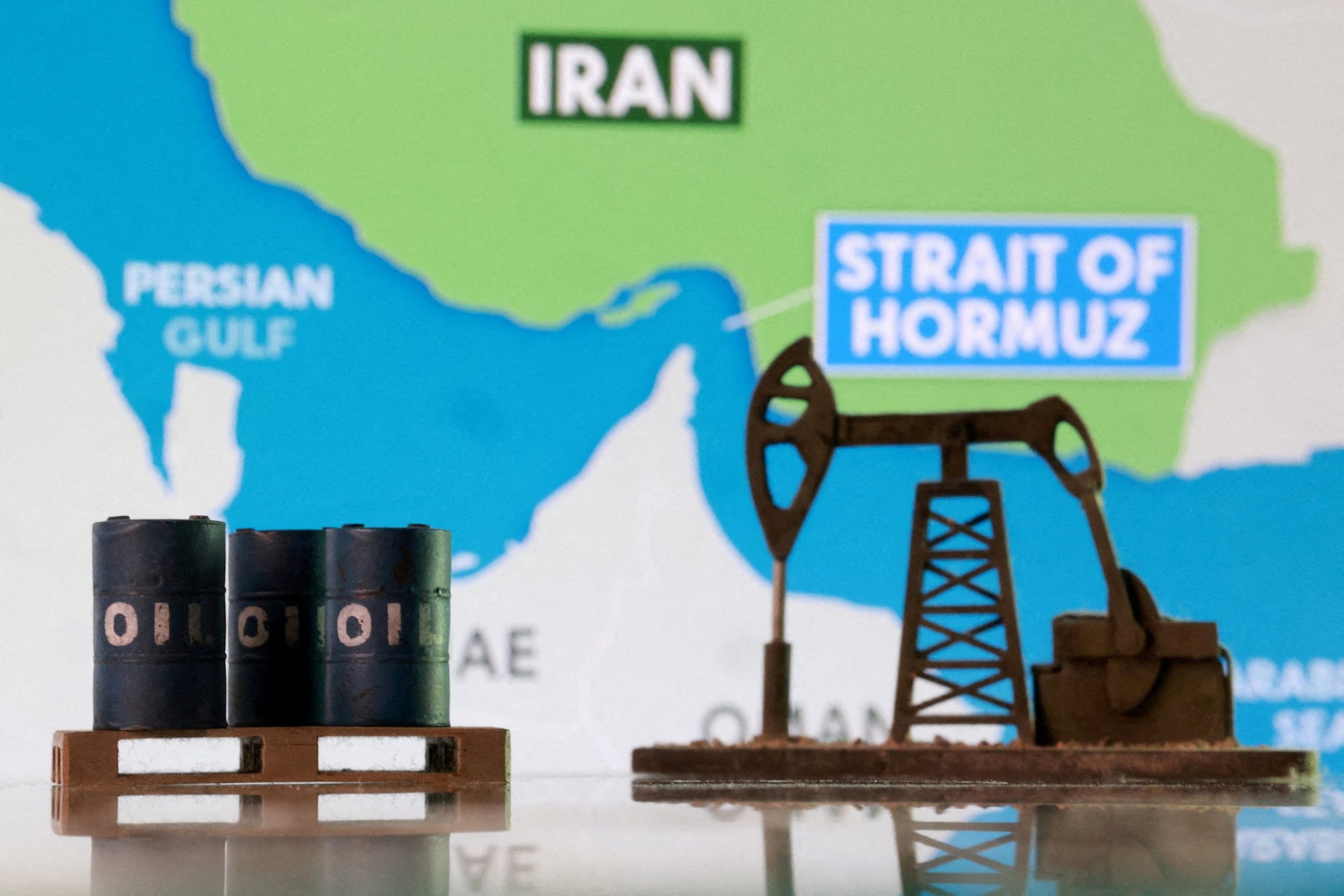
The sea is usually a place of relentless, rhythmic noise. In the Strait of Hormuz, that noise is a mechanical symphony: the low-frequency thrum of massive diesel engines, the churning of propellers the size of houses, and the constant crackle of bridge-to-bridge radio chatter in a dozen different languages. It is the throat of the global economy.
Today, that throat is tight. It is almost silent.
If you stood on the jagged cliffs of Oman's Musandam Peninsula and looked out across the twenty-one miles of water toward Iran, you would usually see a slow-motion parade. Steel leviathans, each carrying two million barrels of crude oil, follow one another like beads on a string. They provide the lifeblood for glass factories in Ohio, trucking fleets in Munich, and the plastic IV bags in a neonatal ward in Tokyo.
But according to the latest data from Kpler, the parade has stopped. Following the precision strikes by U.S. and Israeli forces on Iranian infrastructure, tanker traffic through this vital artery hasn't just slowed. It has cratered. A 90% drop.
Numbers like that feel abstract until you consider the scale of a single ship.
The Ghost Fleet
Imagine a captain named Elias. He is a hypothetical composite of the men currently sitting in darkened mess halls on the Indian Ocean, staring at radar screens that show nothing but empty blue. For twenty years, Elias has timed his life by the transit of the Strait. He knows the exact moment the heat from the Arabian desert hits the deck. He knows the tension of the "choke point," where the navigable channel narrows to just two miles wide in each direction.
Now, Elias is told to wait. His ship, a Very Large Crude Carrier (VLCC) worth over $100 million, is idling five hundred miles out at sea. He is burning fuel just to stay still.
The 90% drop isn't just a statistic about oil. It is a story about fear. When the missiles flew, the insurance markets reacted with the cold, mathematical speed of a guillotine. The cost to insure a hull passing through the Strait didn't just rise; for many, it vanished. No insurance means no transit. No transit means the world's most essential commodity is trapped in a cage of geography.
The Invisible Wire
We often speak of the global economy as something digital, something existing in the cloud. We forget that it is made of heavy, greasy, physical things.
When the flow through Hormuz stops, a hidden wire is pulled taut across the globe. You don't feel it immediately at the pump. The world has reserves. But the traders in London and Singapore feel it in their marrow. They see the "90%" figure and they understand the physics of a vacuum. If 20 million barrels of oil a day aren't moving, the vacuum has to be filled from somewhere else.
But there is no "somewhere else" that can handle this volume.
The strikes on Iran were designed to be surgical, targeting the nodes of a regional power play. Yet, the secondary infection is systemic. By choking the Strait, the conflict has moved from a map of military targets to the kitchen tables of people who couldn't find the Persian Gulf on an atlas.
Consider the "dark fleet"—the shadow tankers that Iran has used for years to bypass sanctions. These ships often operate with their transponders turned off, ghosting through the waves. Even they have gone to ground. When the sky is full of high-altitude surveillance and the water is patrolled by nervous destroyers, being "dark" is no longer a shield. It's a bullseye.
The Friction of Fear
Logistics is the art of friction. Usually, we spend billions of dollars trying to reduce it. We build faster ports, deeper channels, and better engines.
War is the ultimate friction.
It turns a twenty-one-mile stretch of water into a wall of glass. The 90% drop in traffic represents a massive recalculation of risk. Shipping companies are not just worried about a stray missile. They are worried about the "gray zone" tactics that follow: drifting mines, limpet attachments, and the sudden, violent seizure of crews.
For the people who live on these ships, the stakes are not about "energy security" or "geopolitical leverage." They are about the sound of a helicopter overhead at 3:00 AM. They are about the realization that their 300,000-ton vessel is essentially a giant, floating incendiary device.
The Ripple on the Shore
What happens when the throat stays closed?
The first sign is a change in the light. In the industrial heartlands of East Asia, where refineries depend on a constant, rhythmic pulse of Middle Eastern crude, the flares start to dim. When the ships don't arrive, the machines must slow down.
Business analysts use words like "volatility" and "supply chain disruption." Those are sanitized terms. The reality is more visceral. It is the owner of a small logistics firm in Mumbai realizing his margins have been eaten by a 30% surge in fuel costs overnight. It is the cargo flight carrying life-saving medicine that is cancelled because the kerosene surcharges made the route insolvent.
The strikes were a display of hard power. The 90% drop is the shadow of that power, stretching long and cold over the global market.
We have spent decades building a world that assumes the oceans are a public commons, a neutral space where commerce is sacred. We forgot that the commons are only as safe as the shorelines that border them. When those shorelines catch fire, the ocean becomes a desert.
The Weight of Empty Water
There is a strange loneliness to a vacant shipping lane.
For the first time in the modern era, one of the busiest spots on Earth is quiet. The dolphins that usually dodge the massive bows of tankers are finding the water strangely still. The satellite imagery shows a blue void where there used to be a frantic, crowded highway.
This void is a warning.
It tells us that our complexity is our frailty. We have optimized our world for efficiency, not for resilience. We have created a system where a handful of explosions in a desert can effectively paralyze the movement of energy across the planet.
The 90% drop reported by Kpler is a fever dream for the global economy. It is the moment the body realizes it is losing oxygen. The strikes may have achieved their tactical goals, but the unintended consequence is a masterclass in economic fragility.
As night falls over the Strait, the Iranian coast is a silhouette of jagged rock and silent batteries. Across the water, the lights of the Arabian Peninsula glitter, waiting for a horizon that remains empty. The tankers are still out there, huddling in the open ocean, their crews watching the radar, waiting for the insurance underwriters and the admirals to decide when the world can breathe again.
The silence is the loudest thing in the world right now. It is the sound of a gear being stripped in the great machine of civilization, a reminder that all our high-tech dreams still rely on the safe passage of heavy rust through a narrow gate of fire.