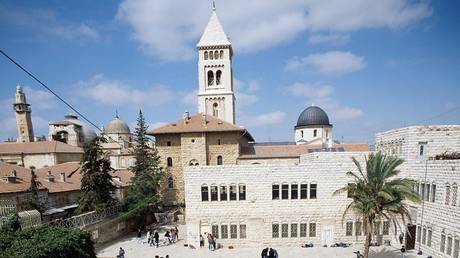
In the narrow stone corridors of Jerusalem’s Old City, a centuries-old educational tradition is being dismantled by administrative decree. Since January 2026, the Israeli Ministry of Education and the Interior Ministry have tightened a bureaucratic noose around 15 historic Christian schools, effectively barring nearly 230 Palestinian teachers from their classrooms. By refusing to renew work permits and mandating that only teachers with Israeli-issued certifications can lead these institutions, the state is doing more than updating its payroll requirements. It is fundamentally altering the demographic and religious character of the Holy City.
The crisis reached a tipping point on March 10, 2026, when school principals received a formal directive. For the upcoming 2026-2027 academic year, no work permits will be issued to teachers residing in the West Bank who hold "green cards." These educators, many of whom have spent decades commuting from Bethlehem or Ramallah to teach in Jerusalem, are now categorized as security risks or unqualified interlopers. This policy does not just leave vacancies; it leaves a void that the local Jerusalem Christian population—depleted by decades of emigration—cannot possibly fill. Expanding on this topic, you can find more in: Why the Green Party Victory in Manchester is a Disaster for Keir Starmer.
The Certificate Trap
The primary mechanism of this displacement is a new legislative standard for academic qualifications. Under a law finalized in July 2025 and enforced with renewed vigor this year, degrees obtained from Palestinian Authority-regulated universities in the West Bank are no longer recognized for teachers working within the expanded municipal boundaries of Jerusalem. To keep their jobs, these veteran educators must obtain Israeli teaching certificates within a two-year window, a process that requires navigating a Hebrew-language bureaucracy and adopting a state-sanctioned pedagogical framework.
This is not a simple matter of professional development. It is an existential ultimatum. For a teacher in her fifties who has taught at the Sisters of the Rosary school for 30 years, returning to an Israeli college to "re-verify" her lifelong career is a practical impossibility. Analysts at USA Today have provided expertise on this trend.
The Security Pretext and Sunday Bans
Even for those who managed to secure temporary permits during the early months of 2026, the conditions of entry have become increasingly erratic. School administrators have dubbed these "humiliation permits." In several instances, teachers were granted entry for weekdays but explicitly barred from the city on Saturdays and Sundays.
For Christian schools, which traditionally operate on Saturdays and observe Fridays and Sundays as their weekend, this "weekday-only" permit renders the staff useless for 20 percent of the instructional week. When the General Secretariat of Christian Schools launched a strike in protest, the authorities temporarily relented, only to return with the March 10 mandate that effectively ends the permit system altogether for West Bank residents.
The official justification leans heavily on national security and the need to "standardize" education to prevent incitement. However, the schools affected—including the prestigious Christian Brothers (De La Salle) and St. George’s—have long been regarded as some of the most stable and integrated institutions in the region. They serve a mixed student body of Christians and Muslims, acting as rare neutral zones in a city defined by its partitions.
A Diplomatic Fault Line
The fallout has reached as far as Washington. In a sharp departure from traditional alliances, US Ambassador Mike Huckabee issued a formal warning to the Israeli Interior Ministry in late 2025 and again in early 2026. The friction stems from the ministry’s decision to subject evangelical and Catholic organizations to invasive "security screenings" that require detailed disclosures of religious beliefs and financial assets.
Huckabee’s letter, which threatened reciprocal visa restrictions for Israeli citizens entering the US, highlights a growing realization among Israel’s international supporters: the current policy does not distinguish between political activists and the religious infrastructure that has existed since the Ottoman era.
The Interior Ministry has defended these measures as "standardizing procedures" and ensuring that all non-governmental organizations operate under the same transparency rules as domestic Israeli entities. Yet, the targeted nature of the teacher bans suggests a different priority. By making it impossible for West Bank Christians to work in Jerusalem, the state accelerates the "Israelization" of the East Jerusalem school system.
The Vanishing Middle Ground
If the 230 teachers currently under threat are forced out, each of the 15 affected schools will lose an average of 15 staff members overnight. There is no local reserve of qualified Christian teachers in Jerusalem to replace them. The city’s Christian population has plummeted from roughly 20 percent a century ago to less than 2 percent today.
The result is a forced choice for school boards:
- Adopt the Israeli Curriculum: Receive state funding and permission to hire Israeli-certified staff, but lose the Palestinian "Tawjihi" accreditation and the specific Christian character of their mission.
- Slow Attrition: Continue with a skeleton crew, face fines for employing "illegal" staff, and eventually watch the school collapse under administrative pressure.
This is not a sudden demolition; it is a slow-motion eviction by paperwork. When a teacher cannot cross a checkpoint to reach a chalkboard, the school eventually ceases to be a school. It becomes a museum, and eventually, it becomes real estate. The teachers of Bethlehem are the backbone of the Jerusalem church; without them, the "Living Stones" of the Holy City are being replaced by silent monuments.
The termination of these contracts does more than disrupt a semester. It severs the last remaining professional and social ties between the fractured Palestinian communities of the West Bank and Jerusalem. For the families of the affected teachers, the loss of a Jerusalem-grade salary in an economy already shattered by regional conflict is often the final push needed to seek a future in Europe or the Americas. Each revoked permit is a one-way ticket out of the Holy Land.