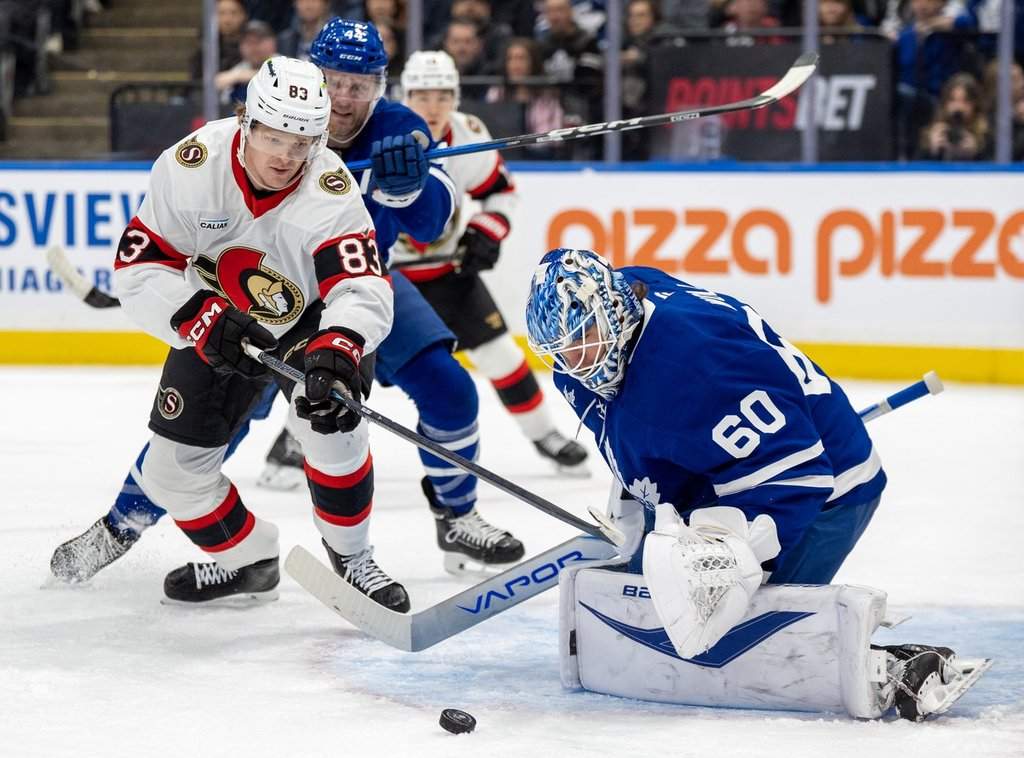
The Victory That Meant Nothing
Everyone is looking at Drake Batherson and Dylan Cozens as the "story" of the Ottawa Senators’ latest win over the Toronto Maple Leafs. The box score says the Senators won. The highlight reels show clinical finishes. The pundits are talking about "momentum" building in the capital.
They are all wrong.
The scoreboard is a liar. This game wasn't about Ottawa’s sudden competence or some tactical masterclass by their coaching staff. It was a 60-minute diagnostic report on the terminal identity crisis currently suffocating the Toronto Maple Leafs. If you’re a Sens fan celebrating this as a turning point, you’re missing the forest for the trees. If you’re a Leafs fan blaming the goaltending or a "bad bounce," you’re delusional.
This was a game where one team played like they had something to prove, and the other played like they had a dinner reservation.
The Cozens Fallacy
Let’s talk about Dylan Cozens. The narrative is that he’s the "missing piece" or the spark plug the Senators needed. It’s a convenient story. It’s also lazy.
Cozens didn't win this game because of some transcendent skill set that Toronto couldn't match. He won because he operated in the "soft zones" that Toronto’s defense treats like a suggestion rather than a territory to be guarded. I’ve watched enough defensive zone breakdowns to tell you exactly what happened: Toronto’s structural integrity is built on the assumption that their opponents will eventually get bored and turn the ball over.
When you face a player like Batherson—who has a high-level offensive IQ—that "wait-and-see" approach is suicide.
The Senators didn't outplay the Leafs; they simply exploited a team that refuses to adjust its defensive gap. In professional hockey, "gap control" is the distance between a defender and the puck carrier. Toronto plays with a gap so wide you could park a Zamboni in it. Cozens and Batherson didn't need to be elite; they just needed to be present.
Stop Blaming the Goalies
The easiest thing in sports media is to point at the guy in the crease and scream about save percentages. It’s the ultimate shield for underperforming skaters.
Was the goaltending great? No. Was it the reason for the loss? Not even close.
When you allow clean entries into the zone and fail to clear the front of the net, you are asking your goalie to perform miracles. Expecting a .930 save percentage when you’re giving up high-danger chances from the slot is statistically illiterate. The "Expected Goals Against" (xGA) for Toronto in this matchup was a flashing red light. They weren't "unlucky." They were defensively negligent.
The Myth of the "Core Four" Maturity
Every year, we hear the same song. "The leadership group has matured." "They’ve added grit."
Look at the tape.
When the Senators pushed back in the second period, the Leafs didn't tighten up. They didn't simplify their game. They tried to "skill" their way out of a physical problem. That is the fundamental flaw of this roster construction. You cannot fix a lack of physical pushback with more secondary scoring.
The Senators aren't a powerhouse. They are a flawed team with a mediocre blue line. Yet, they made the Leafs look like they were playing an exhibition game in September. That’s not a talent gap. That’s a culture gap.
The Analytics Trap
I’ve spent a decade looking at proprietary data sets that would make a math professor sweat. One thing I know for certain: possession metrics (Corsi/Fenwick) are the most overrated stats in the modern game if you don't account for intent.
Toronto often wins the possession battle. They look great on a spreadsheet. But they play "low-event" hockey in high-stakes moments. They pass up the dirty shot for the perfect cross-seam pass that never arrives. Meanwhile, Ottawa played "high-intent" hockey. Every time Batherson touched the puck, he was looking to create a chaotic variable.
Chaos kills structured teams that lack heart.
Why Ottawa Fans Should Be Worried
If you think this win means the Senators are "back," you’re setting yourself up for heartbreak. Beating the Leafs in the regular season is the Senators’ Super Bowl. It’s their default setting. But look at how they won. They relied on individual brilliance from Batherson and a few opportunistic plays from Cozens.
That is not a sustainable system. That is a sugar high.
A sustainable system involves a forecheck that forces turnovers consistently, not just when the opponent is lazy. Ottawa’s defensive zone exits are still a mess. They spent far too much time hemmed in their own end. Against a team with a pulse and a defensive conscience—think Florida or Carolina—the Senators would have been dissected.
The "People Also Ask" Delusion
People are asking: "Is this the start of an Ottawa playoff run?"
No. It’s the start of another cycle of false hope. Until this team can beat a structured, defensive-minded squad without relying on a "rivalry boost," they are just a lottery team with a few nice pieces.
People are asking: "Should the Leafs trade for a defenseman?"
No. You can’t trade for a soul. You can bring in a top-pairing guy, but if the five skaters in front of the goalie don't understand back-checking as a fundamental requirement of the job, the jersey won't matter.
The Financial Reality of Failure
I’ve seen organizations flush tens of millions down the drain trying to "tweak" rosters that are fundamentally broken at the molecular level. Toronto is in the middle of a "Sunk Cost Fallacy" masterclass. They’ve invested so much in their top-heavy structure that admitting it doesn't work would mean a total teardown.
So they stay the course. They lose to Ottawa. They talk about "learning moments."
The Senators, meanwhile, are the beneficiaries of a low-bar environment. They win a game like this and the fans act like they’ve hoisted the Cup. This mutual delusion—Toronto’s belief that they are "close" and Ottawa’s belief that they are "rising"—is what keeps both teams in the middle of the pack.
Hard Truths for the "Insider" Class
Most hockey writers will tell you this was an "exciting back-and-forth affair."
It wasn't. It was sloppy. It was a display of two teams with massive structural flaws colliding in a vacuum.
If you want to understand the modern NHL, stop looking at the goals. Look at the neutral zone. Look at who is willing to take a hit to make a play. In this game, the Senators were willing to pay the price. The Leafs were looking for the receipt so they could return the experience for a refund.
The Tactical Breakdown
- The Batherson Factor: He isn't just scoring; he’s manipulating the defenders' feet. He freezes the D-man with a head-fake, then explodes into the space they just vacated. Toronto’s D-men bit on every single fake.
- Cozens’ Integration: He’s being used as a decoy as much as a finisher. His speed forces the defense to respect the stretch pass, which opens up the middle for the trailing wingers.
- The Leaf Collapse: It starts at the blue line. When the puck is turned over, the transition defense is non-existent.
The Verdict
The Senators didn't "find a way to win." The Maple Leafs found a way to lose, and Ottawa was simply the team standing there to collect the points.
If you’re looking for a hero, look at the schedule. The Senators caught a tired, complacent team and did exactly what they were supposed to do. Anything more than that is just fan-fiction.
Stop looking for "momentum." Start looking for a defensive structure that doesn't resemble a sieve. Until then, these games are just noise in a long, mediocre season for both franchises.
Throw out the jerseys and the names on the back. Watch the feet. Watch the gaps. Watch the lack of urgency. You’ll see that this wasn't a game won by Batherson and Cozens; it was a game surrendered by a team that has forgotten how to fight.
The Senators are still a work in progress. The Leafs are a work in regression.
Pick your poison.