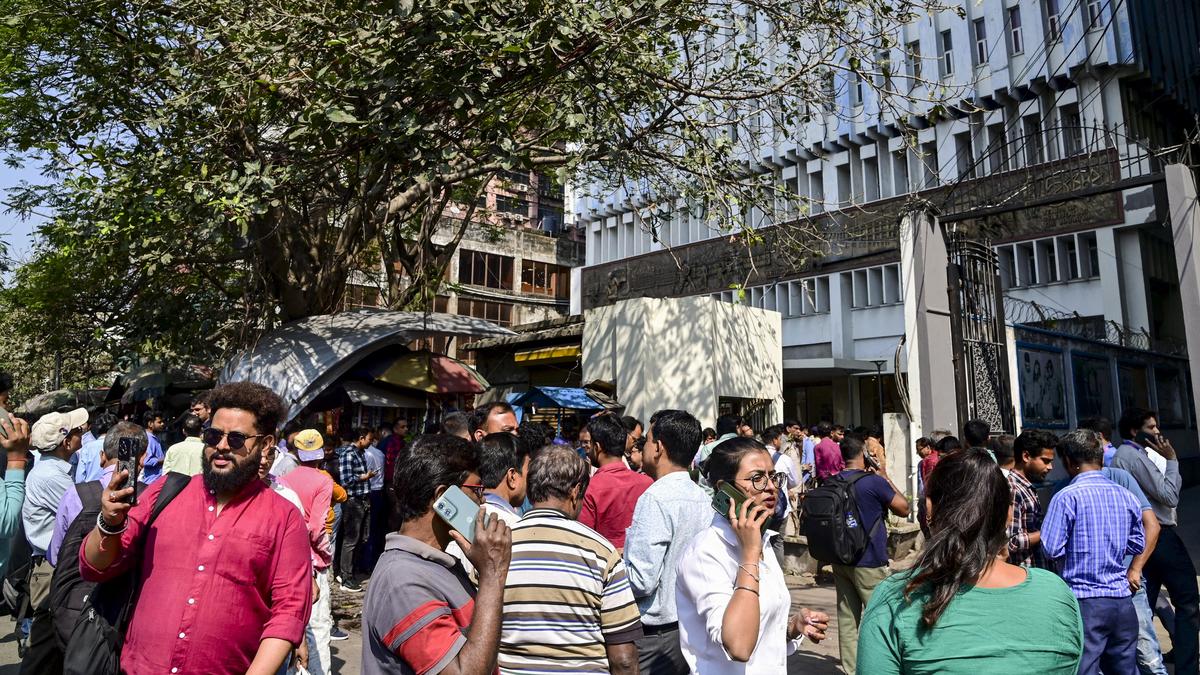
The recent tremors felt across Kolkata and the surrounding districts are not isolated geological events but symptoms of a complex interaction between the Indian Plate’s northward subduction and the high-density sedimentation of the Bengal Basin. While superficial news reports focus on the immediate sensation of "jolts," a structural analysis reveals that the perceived intensity in this region is disproportionately influenced by the Basement Depth Effect and the Amplification Factor of soft alluvial soil. Understanding the risk profile of the Kolkata Metropolitan Area (KMA) requires moving beyond the Richter scale and examining the specific wave propagation mechanics of the Eocene Hinge Zone.
The Geologic Engine of the Bengal Basin
The seismic profile of West Bengal is dictated by its position atop one of the thickest sedimentary successions in the world. The "Kolkata Hinge," a deep-seated structural feature trending northeast-southwest, separates the stable shelf of the Indian Shield from the deeper basinal part to the east. When an earthquake occurs—whether it originates in the Indo-Myanmar ranges or the Himalayan plate boundary—the energy must transit through this sediment-filled trough.
The mechanism of energy transfer here follows a three-stage progression:
- Source Rupture: Initial kinetic energy release at the hypocenter.
- Path Attenuation: The gradual loss of energy as waves travel through the crust.
- Site Response: The localized modification of seismic waves by the top 30 meters of soil (Vs30).
In Kolkata, the "Site Response" is the primary driver of panic. The city sits on a thick layer of Quaternary sediments—mostly clay, silt, and sand. When seismic waves hit these soft layers, they slow down. According to the law of conservation of energy, as the velocity decreases, the amplitude must increase. This results in the Soil Amplification Phenomenon, where a moderate deep-seated tremor is felt as a sharp, prolonged jolt at the surface.
Quantifying the Vulnerability Matrix
The danger to the Kolkata metropolitan region is defined by the intersection of three specific variables: Hazard, Exposure, and Vulnerability. ### The Hazard Variable: The Hinge Zone and Beyond
While Kolkata is classified under Seismic Zone III (Moderate Risk), this classification assumes a uniform crustal response. It fails to account for the "blind" faults hidden beneath the Ganges delta's silt. The Hinge Zone acts as a gravitational anomaly where the crust bends sharply. This bending creates internal stresses that can trigger "intraplate" earthquakes, which are harder to predict than those at plate boundaries.
The Exposure Variable: Urban Density and Built Environment
Exposure in Kolkata is categorized by an aging infrastructure deficit. The city contains a high concentration of "unreinforced masonry" (URM) structures. Unlike modern steel-reinforced concrete, URM buildings lack ductility. They cannot absorb seismic energy through deformation; instead, they fail catastrophically once their shear strength is exceeded.
The Vulnerability Variable: The Liquefaction Constant
Perhaps the most significant overlooked factor is Soil Liquefaction. In areas with high groundwater tables and loose, sandy deposits—prevalent in the salt lake and bypass regions of Kolkata—shaking causes the soil to behave like a liquid. This results in:
- Differential settlement (buildings tilting).
- Lateral spreading (ground "sliding" toward riverbanks).
- Loss of bearing capacity for foundations.
Structural Resonance and the Tall Building Paradox
A critical observation during recent tremors was the varying experience of residents based on their vertical location. This is explained by Natural Frequency Resonance. Every building has a natural frequency at which it vibrates. If the frequency of the earthquake waves matches the natural frequency of the building, the shaking is amplified significantly.
In the Bengal Basin, the thick soft soil tends to filter out high-frequency waves (which affect short, rigid buildings) and allow low-frequency, long-period waves to pass through. These long-period waves are the exact frequency that affects high-rise structures. This creates a paradox where residents in modern "luxury" towers feel more intense and sustained swaying than those in smaller, older homes, despite the modern towers being built to higher nominal standards.
The Failure of Current Early Warning Logic
The current notification system for the Indo-Gangetic plain relies on sensors placed near the Himalayan arc. However, there is a significant lag in the dissemination of "P-waves" (Primary) versus "S-waves" (Secondary/Shearing). P-waves travel faster but cause little damage; they serve as the warning signal. S-waves are slower and cause the actual destruction.
The bottleneck in Kolkata’s preparedness is the Blind Zone—the area so close to a potential epicenter that the S-wave arrives before a warning can be processed. For an earthquake originating in the nearby Sundarbans or the Hinge Zone, the lead time would be less than five seconds. This renders mobile-app-based warnings secondary to physical engineering solutions.
The Logistics of the Post-Tremor Feedback Loop
When tremors occur, the immediate economic and social cost is driven by "Secondary Cascades" rather than primary structural collapse. These include:
- Telecommunications Congestion: Simultaneous data surges crash local nodes, preventing emergency coordination.
- Infrastructure Stress: Power grids in Kolkata are often overhead or poorly insulated against swaying, leading to short circuits and localized fires.
- Human Factor Dynamics: The "Vertical Evacuation" problem. In high-density districts like Burrabazar, narrow egress routes create crush risks that far exceed the risk of the building actually falling.
Engineering a Resilient Urban Core
To transition from a reactive posture to a proactive strategic defense, the focus must shift toward Microzonation. The city cannot be treated as a monolithic risk block.
- Site-Specific Spectra: Developers must be mandated to perform deep-borehole seismic testing to determine the specific "Period of Vibration" for each plot. Building heights should then be regulated to ensure the building's frequency does not align with the soil's frequency.
- Retrofitting Masonry: For the historic core, the application of "Fibre Reinforced Polymers" (FRP) can provide the necessary ductility to URM buildings without requiring total demolition.
- Liquefaction Mitigation: Ground improvement techniques, such as stone columns or vibro-flotation, must be standard for any construction within 5 kilometers of the Hooghly riverbank or in reclaimed wetland areas.
The repeated jolts in West Bengal are data points on a trend line indicating increasing crustal tension. The stability of the region depends on acknowledging that the ground beneath Kolkata is not a solid foundation, but a dynamic, amplifying medium that requires specialized engineering protocols far beyond standard national codes.
Municipal authorities must prioritize the digitisation of the city's structural health records. This involves installing accelerometers on critical infrastructure—bridges, flyovers, and hospitals—to monitor "modal shifts" in real-time. A shift in a bridge's natural frequency after a minor tremor is a leading indicator of internal fatigue that visual inspections will miss. The strategic objective is to move from "feeling" the earthquake to measuring the structural decay it leaves behind.