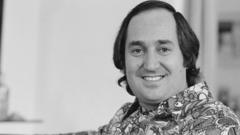
Neil Sedaka’s career trajectory provides a primary case study in the transition of the music industry from a centralized "factory" model to the era of the singer-songwriter and, eventually, the digital nostalgia economy. His death at 86 marks the end of a seventy-year longitudinal experiment in musical adaptation. To understand Sedaka is to understand the technical evolution of the American pop song as a reproducible commodity. He did not merely sing hits; he engineered them using a specific set of harmonic and rhythmic constraints that allowed for maximum market penetration across three distinct economic cycles of the music business.
The Brill Building Production Function
The initial phase of Sedaka's career (1958–1963) operated within the Brill Building ecosystem, a vertical integration model where songwriting, arrangement, and performance were segmented into specialized labor. Sedaka, alongside lyricist Howard Greenfield, optimized this "factory" output.
The Sedaka-Greenfield partnership relied on a mathematical approach to composition. Their output followed a rigid structural formula:
- The Hook-First Entry: Sedaka often utilized a non-verbal or rhythmic vocal hook (e.g., the "tra-la-la" sequence in "Breaking Up Is Hard to Do") to establish immediate cognitive recognition within the first five seconds of a radio broadcast.
- Harmonic Conservative Continuity: Utilizing the I-vi-IV-V chord progression, Sedaka leveraged the dominant harmonic language of the era to ensure listener comfort while applying sophisticated classical counterpoint—a byproduct of his Juilliard training—to the vocal arrangements.
- Lyrical Universalism: By avoiding specific cultural or political markers, the compositions achieved a high "utility" for a broad demographic, making them easily exportable to international markets.
During this period, Sedaka achieved a level of vertical integration rare for the time. He was one of the first "teen idols" to write his own repertoire, effectively capturing a larger share of the publishing royalties ($P$) in addition to performance fees ($F$). This dual-revenue stream provided the capital buffer necessary to survive the structural shocks of the mid-1960s.
The British Invasion and the Disruption of the Brill Model
The arrival of the Beatles in 1964 represented a fundamental shift in the music industry's supply chain. The "Self-Contained Band" model rendered the Brill Building’s fragmented labor force obsolete. Between 1964 and 1970, Sedaka’s domestic commercial relevance plummeted—a phenomenon common to "pre-invasion" artists who failed to pivot their brand identity.
This era highlights the Obsolescence Risk inherent in artists tied to a specific sonic zeitgeist. Sedaka’s response was a geographical and stylistic arbitrage. By relocating his focus to the United Kingdom in the early 1970s, he identified a market lag where his melodic sensibilities were still valued, but required a contemporary "prestige" veneer.
The mechanism of his comeback was a strategic alliance with the band 10cc and Elton John’s Rocket Record Company. This was not a change in his core competency (melody) but a radical redesign of his Packaging and Distribution. The 1975 re-recording of "Breaking Up Is Hard to Do" as a slow ballad is a masterclass in asset repurposing. By altering the tempo and harmonic density, he transformed a "teenybopper" commodity into "Adult Contemporary" intellectual property, effectively doubling the lifecycle of the original composition.
The Technicality of Melodic Permanence
Sedaka's longevity is rooted in his technical proficiency as a pianist and composer. While his contemporaries often relied on instinct, Sedaka utilized formal music theory to manipulate listener psychology.
Rhythmic Displacement and Syncopation
In tracks like "Laughter in the Rain," Sedaka employs subtle rhythmic displacement. The vocal melody often begins on the "and" of the beat, creating a sense of forward momentum that contrasts with the steady, predictable pulse of the percussion. This tension keeps the listener engaged without causing the cognitive fatigue associated with more complex avant-garde structures.
The "Doo-Wop" Chord Optimization
The I-vi-IV-V progression is often criticized for its simplicity. However, Sedaka optimized this by varying the "voicing" of the chords. His classical background allowed him to use inversions and passing tones that made a standard four-chord song sound more "expensive" to the ear than the output of his peers. This increased the perceived value of the recording, facilitating higher rotation on premium radio formats.
The Economics of the Catalog and Late-Stage Career Management
In the final three decades of his life, Sedaka transitioned from an active hit-maker to a manager of a high-value IP portfolio. The "Sedaka Catalog" became a resilient asset class.
The revenue model shifted toward three specific pillars:
- Synch Licensing: Placing classic hits in films, television, and advertisements. These tracks serve as a "shorthand" for 1950s/60s nostalgia, making them highly liquid assets in the sync market.
- The Global Standard Loop: Songs like "Oh! Carol" and "Calendar Girl" achieved a status similar to "standards" in the Great American Songbook. They are performed by covers artists and wedding bands globally, ensuring a perpetual stream of performance rights organization (PRO) distributions.
- The "Legacy" Live Circuit: By maintaining his vocal range into his 80s—a result of rigorous technical discipline—Sedaka remained a viable live draw. This allowed him to capture the high-margin revenue of the "Silver Economy," where older, affluent audiences pay premium prices for curated nostalgia.
The mortality of the artist does not equate to the expiration of the brand. In the modern streaming environment, Sedaka’s "Monthly Listeners" metrics on platforms like Spotify serve as a proxy for the enduring demand for mid-century melodic structures. The data suggests that as listeners age, their preference for high-melodic density and resolution—the hallmarks of the Sedaka sound—increases.
Structural Challenges in Post-Sedaka Pop
The "Sedaka Method" of songwriting is increasingly difficult to replicate in the current market for several reasons:
- Algorithmic Flattening: Current streaming algorithms favor "vibe" and "mood" over the high-contrast melodic hooks that Sedaka pioneered. This reduces the incentive for new artists to invest in formal harmonic training.
- The Death of the Bridge: Modern pop songs have largely abandoned the "Middle Eight" or "Bridge" section to keep track lengths under three minutes. Sedaka viewed the bridge as the "pivot point" of a song's emotional arc, a structural element that contributed to the "replay value" of his hits.
- Fragmented Consensus: In the 1960s, a Sedaka hit reached a massive, unified audience via AM radio. Today, the lack of a "monoculture" means that a melody, no matter how mathematically perfect, struggles to achieve the same level of universal social penetration.
Forecasting the Impact of the Sedaka Archive
The death of Neil Sedaka triggers a specific sequence of events in the management of his estate. We can expect a valuation spike in his publishing rights, likely leading to a sale to a private equity music fund. These funds value assets like Sedaka’s because they provide "bond-like" returns: predictable, steady, and uncorrelated with broader market volatility.
The strategic play for the estate will involve:
- Aggressive Interpolation Rights: Licensing snippets of his melodies to current hip-hop and pop producers (a tactic used successfully with the works of his contemporaries).
- AI Voice Modeling: Given Sedaka’s distinct vocal timbre and the large corpus of high-quality stems available, he is a prime candidate for ethical AI voice synthesis, allowing for "new" performances or "posthumous collaborations" that maintain the brand's relevance in the digital-native demographic.
- The "Biopic" Multiplier: The narrative of the Jewish kid from Brooklyn who conquered the world, lost it all to the British, and reclaimed his throne via Elton John is a "Hero’s Journey" archetype. A cinematic adaptation would serve as a massive top-of-funnel marketing event for the entire catalog.
The legacy of Neil Sedaka is not found in the sentimentality of his lyrics, but in the durability of his structural engineering. He treated pop music as a rigorous discipline, and the resulting architecture has proven capable of withstanding the total digital transformation of the medium.
The strategic move for current industry stakeholders is to deconstruct the "Sedaka Hook" and reintegrate its high-resolution melodic principles into modern short-form content. The market is currently over-saturated with "atmosphere"; there is an opening for the return of the "engineered melody" to capture consumer attention in a low-trust, high-noise environment.