The reported encounter between U.S. fighter jets and an Iranian Mahan Air passenger jet over Syrian airspace was not a random act of aggression or a simple case of mistaken identity. It was a calculated maneuver in a high-stakes shadow war that uses civilian aviation as a tactical shield. While the headlines focused on the terrified screams of passengers as the pilot plummeted the Airbus A310 to avoid a collision, the real story lies in the transponders, the flight corridors, and the specific cargo that makes Mahan Air a constant target for Western intelligence.
In July 2020, Mahan Air Flight 54 was en route from Tehran to Beirut. As it crossed the Al-Tanf region in Syria—a strategic pocket where U.S. forces maintain a base—two F-15 Eagle jets intercepted the aircraft. To the passengers, it was a near-death experience. To the Pentagon, it was a "standard" visual inspection of a "suspicious" aircraft. But to those who track the movement of advanced weaponry across the Middle East, it was a warning shot aimed at a logistics chain that has blurred the lines between humanitarian transport and military resupply for over a decade.
The Al Tanf Chokepoint and the Logic of Interception
The Al-Tanf garrison sits at a critical junction near the borders of Syria, Jordan, and Iraq. It is a thorn in the side of the so-called "land bridge" that connects Tehran to the Mediterranean. However, the land bridge is slow. The air bridge is fast.
When a civilian airliner enters a military-controlled deconfliction zone, it creates a unique set of problems for air defense operators. Radar signatures for an Airbus A310 are massive and unmistakable. The U.S. military claimed the F-15s approached to ensure the safety of coalition forces at the base. This explanation is technically accurate but functionally incomplete. In the world of electronic warfare and tactical signals intelligence, a close-range intercept allows for more than just a visual check. It allows for the collection of specific electronic emissions and the verification of whether a civilian flight is being used to mask the movement of smaller, more sensitive military assets flying in its radar shadow.
The Double Life of Mahan Air
The U.S. Department of the Treasury didn't sanction Mahan Air on a whim. The airline has been designated for providing financial, material, and technological support to the Islamic Revolutionary Guard Corps-Qods Force (IRGC-QF). This isn't just about moving personnel. It’s about the "humanitarian" label being used as a diplomatic cloak.
During the height of the Syrian Civil War, Mahan Air flights were frequently observed using unconventional flight paths. Intelligence analysts noted a pattern: flights would often depart Tehran with "humanitarian" manifests but arrive at Damascus International Airport's military terminal. The cargo wasn't just blankets and medicine. It included sophisticated guidance kits for missiles and components for unmanned aerial vehicles.
By placing these items on a passenger jet, the IRGC bets on the high political cost of a kinetic strike. No Western power wants the PR nightmare of downing a plane filled with 150 civilians. The intercept over Al-Tanf was a physical manifestation of the frustration felt by intelligence agencies that see the cargo but cannot legally or ethically pull the trigger.
The Physics of a Near Miss
When the F-15s approached, the Mahan Air pilot performed a sudden dive. This maneuver caused several injuries among passengers who were not buckled in. From a pilot's perspective, the sudden appearance of a fighter jet at a distance of 1,000 meters is an emergency. At those speeds, 1,000 meters is a heartbeat.
The aviation industry operates on the principle of TCAS—the Traffic Collision Avoidance System.
$$S = v \cdot t + \frac{1}{2} a \cdot t^2$$
In this basic kinematic equation, the "S" (separation distance) becomes dangerously small when "v" (velocity) is at cruising speed and "a" (acceleration) is introduced by a banking fighter jet. If the TCAS on the Airbus sensed a rapidly closing object that was not broadcasting a standard civilian transponder code, it would trigger a "Resolution Advisory," forcing the pilot to climb or descend immediately.
The U.S. maintains the intercept was conducted at a safe distance. The Iranian government called it "terrorist activity." The truth is found in the gray zone of international law. Under the Chicago Convention, civilian aircraft are supposed to be exempt from military interference, but those protections are weakened when an airline is proven to be a regular auxiliary of a national military force.
The Delhi Connection and the Humanitarian Narrative
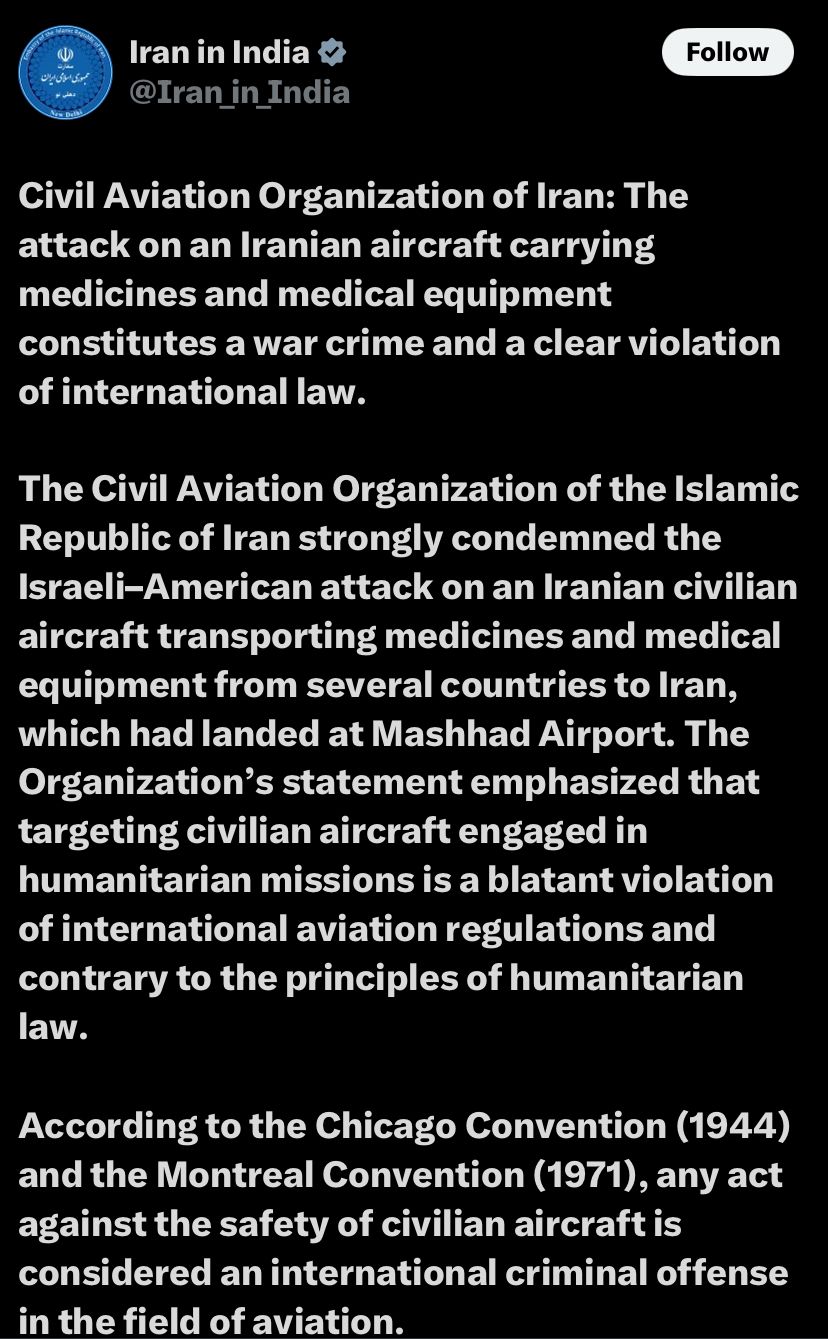
The specific incident involving a flight headed to Delhi often gets conflated with the Syrian intercept, but it points to a broader strategy. Tehran frequently utilizes Indian and Chinese destinations as "neutral" transit points. When a plane is flagged as carrying sensitive cargo, the Iranian government quickly pivots to a humanitarian narrative.
This is a brilliant, if cynical, defensive strategy. By claiming a mission is for medical supplies or aid, Iran forces the intercepting country to choose between allowing a potential weapons shipment or risking an international incident involving "humanitarian" goods. It is a game of chicken played at 35,000 feet.
In the case of the Delhi-bound flights, the diplomatic pressure on India is immense. New Delhi has a long-standing energy and strategic relationship with Iran, but it also shares deep security ties with the U.S. and Israel. When an Iranian plane enters Indian airspace under a cloud of suspicion, the Indian Air Force is often put in the uncomfortable position of having to shadow a "friendly" nation's civilian flight because of intelligence passed down from Five Eyes sources.
How Transponder Spoofing Changes the Game
One of the most overlooked factors in these aerial encounters is the use of transponder manipulation. Modern investigative journalism has utilized flight tracking data to show that some Mahan Air flights "disappear" from public radar over Iraq and "reappear" near the Syrian coast.
This isn't a technical glitch. It is a deliberate tactic known as "going dark" or using a "ghost" hex code. By turning off the ADS-B (Automatic Dependent Surveillance-Broadcast) transponder, an aircraft becomes much harder for civilian controllers to track, though it remains visible on primary military radar.
Why would a "humanitarian" flight need to hide its position? The answer is simple: to hide the stopovers. A flight cleared for Tehran-Beirut that makes an unrecorded two-hour stop at a military airbase in eastern Syria is not a passenger flight. It is a tactical delivery. The F-15s at Al-Tanf were there to disrupt this precise lack of transparency. They were providing a physical "ping" to a flight that was attempting to operate in the shadows.
The Cost of the Shadow War
The passengers on Flight 54 were collateral damage in a conflict they likely didn't understand. To them, the U.S. jets were aggressors. To the U.S. pilots, the Airbus was a Trojan Horse.
This incident highlights the total erosion of the "safe sky" concept in the Middle East. When civilian airlines become extensions of the state's military apparatus, every passenger becomes a human shield. The international community has failed to address this because the evidence is often classified, and the political stakes are too high.
Mahan Air continues to fly. The U.S. continues to watch. The next time a pilot has to dive to avoid a mid-air collision, the world will argue about the "humanitarian" nature of the cargo while ignoring the military markings on the crates underneath the floorboards. The sky is no longer a neutral space; it is a layered battlefield where the flight manifest is the first casualty.
Stop looking at the flight path and start looking at the tail number. The history of that specific airframe usually tells you everything you need to know about why a fighter jet is suddenly sitting off its wingtip.