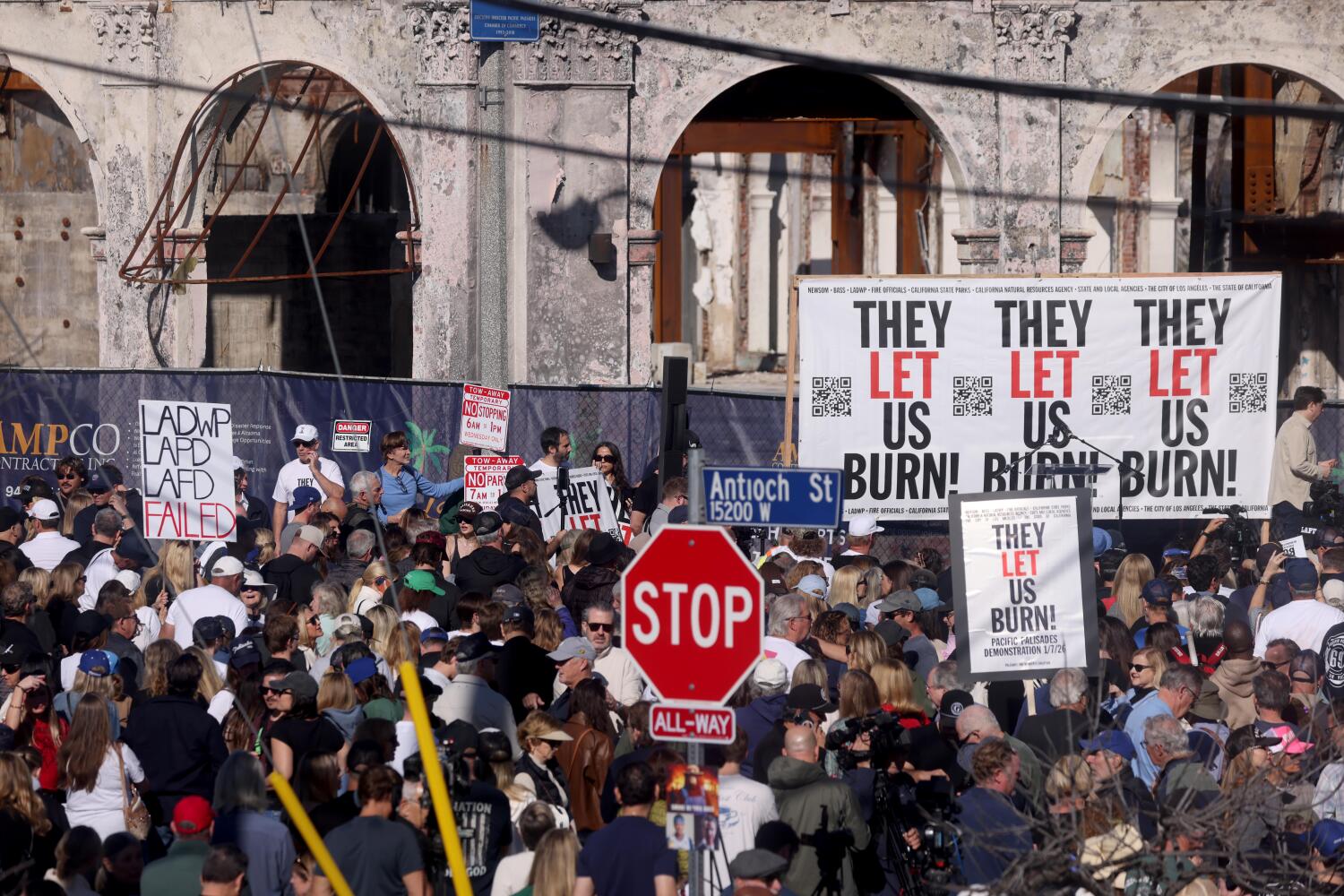
The air at Palisades Charter High School is fine. The parents are not.
Last week, a brush fire scorched the hillsides near one of Los Angeles’ most prestigious campuses. By Monday, the Los Angeles Unified School District (LAUSD) and environmental health experts gave the all-clear. The sensors showed "non-detectable" levels of particulates. The surfaces were wiped. The industrial HEPA filters were humming. Expanding on this topic, you can find more in: Why the Green Party Victory in Manchester is a Disaster for Keir Starmer.
Yet, the outcry was immediate. "It’s too soon," whispered the private Facebook groups. "What about the long-term effects of invisible toxins?" asked the self-appointed experts.
This isn't about science. It’s about the modern parental pathology of Zero-Risk Bias. We have become so obsessed with the microscopic possibility of harm that we’ve become blind to the macroscopic certainty of educational decay. While you’re squinting at an air quality index (AQI) reading of 12, your child is losing another day of instruction in a system that hasn't yet recovered from the 2020 lockdowns. Observers at USA Today have shared their thoughts on this matter.
The Toxicology of Common Sense
Let’s talk about "toxins." It’s the favorite word of the scientifically illiterate.
When a hillside burns, it produces wood smoke. Wood smoke contains particulate matter ($PM_{2.5}$). If you stand in the middle of the plume, it’s bad for your lungs. If you live in a house with a fireplace, you’re breathing it every winter. If you’ve ever sat around a campfire, you’ve inhaled more carcinogens in twenty minutes than a student at Pali High will inhale in a month of post-fire attendance.
The district didn't just "guess" it was safe. They deployed specialized teams to measure:
- Volatile Organic Compounds (VOCs)
- Particulate Matter ($PM_{10}$ and $PM_{2.5}$)
- Soot and Ash Resettlement
The results were boring. And boring is good. But for a certain breed of Westside parent, "boring" feels like a conspiracy. They want a guarantee of absolute purity—a biological impossible in a city that sits in a geographic basin designed by nature to trap smog.
I’ve spent fifteen years navigating the intersection of public policy and environmental safety. I’ve seen boards spend $500,000 on "remediation" for issues that posed less risk than a walk down Wilshire Boulevard at rush hour. We are lighting money on fire to soothe the anxieties of the comfortable.
The Invisible Cost of Precaution
Every day a school stays closed out of "an abundance of caution," we pay a tax. We pay it in learning loss, in the erosion of social structures, and in the sheer logistical nightmare for working parents who don't have the luxury of a home office and a Nespresso machine.
The "experts" quoted in the legacy media love to talk about "potential" risks. Of course they do. No scientist will ever say there is zero risk, because "zero" doesn't exist in nature. There is a "potential" risk that a meteor hits the school library. There is a "potential" risk that the school’s lunch meat contains microplastics.
By hyper-focusing on the air in the 90272 zip code, we ignore the real health crisis: the systematic fragility we are building into the next generation. When we tell students they cannot return to a clean building because a fire happened near it three days ago, we are teaching them that the world is a terrifying, fragile place where data matters less than feelings. We are raising kids who think "safety" is a static state provided by an institution, rather than a managed reality of life.
The Myth of the "Clean" Home
Here is the irony that no one wants to admit: The air inside your home is probably worse than the air inside Pali High right now.
Modern schools, especially those recently renovated or high-performing like Pali, have commercial-grade HVAC systems. They use MERV-13 filters or better. They have high air-exchange rates. Your home, with its gas stove, its "scented" candles (which are basically soot-delivery systems), and its lack of industrial-grade filtration, is a stagnant pool of indoor pollutants.
If you kept your kid home because you were worried about the school's air, but you cooked a steak on a gas range that night, you’ve failed the math.
"We are prioritizing the optics of safety over the mechanics of education."
Imagine a scenario where we applied this level of scrutiny to every daily activity. We would never let a child ride in a car (statistically the most dangerous thing they do). We would never let them play contact sports (concussions). We would never let them use a smartphone (neurological havoc).
But because fire is visceral and cinematic, it triggers a primal fear that overrides the spreadsheet.
Stop Asking the Wrong Question
The question shouldn't be "Is the air 100% free of every possible molecule of smoke?"
The question should be: "Is the marginal risk of being at school higher than the proven damage of being out of it?"
The answer is a resounding no.
The "concerned experts" mentioned in the news are often industrial hygienists who make their living by being "concerned." If they say everything is fine, their billable hours disappear. If they suggest "further testing" or "deep cleaning of the ductwork," they’ve just secured a contract. It is the ultimate conflict of interest masquerading as public service.
We’ve seen this movie before. We saw it during the pandemic when we kept schools closed long after the data showed that children were not the primary drivers of transmission. We are seeing it now with "climate anxiety" being used as a catch-all excuse for institutional paralysis.
The Professionalization of Panic
We have reached a point where "safety" is no longer a metric, but a performance. LAUSD is forced to perform for the loudest voices in the room—usually the ones with the most time to spend on Twitter or at board meetings.
The district actually did its job here. They followed the protocols. They used the sensors. They cleaned the surfaces. In a rare moment of bureaucratic competence, they made a decision based on evidence rather than optics.
And yet, the "insider" consensus is that they "rushed" it.
Rushed? It’s a building. The fire is out. The smoke cleared. The filters were changed. What exactly are we waiting for? For the ghosts of the burned brush to vacate the premises? For a shaman to bless the end zone?
If you are a parent at Pali High and you are still "concerned," do us all a favor: Read a peer-reviewed paper on $PM_{2.5}$ dissipation rates. Look at the actual AQI sensors in Pacific Palisades. Then, look at your child’s math scores.
One of these things is a genuine emergency. The other is just smoke.
Get the kids back in the classroom. Stop using "safety" as a weapon against the very education you claim to value. The building is open. The air is clear. The only thing lingering is the stench of manufactured hysteria.
Go to class.