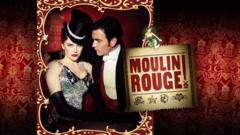
The year was 2001, and the world was shivering. Not from the cold, but from a sudden, jagged shift in the global psyche. We were looking for an exit. We needed a place where the colors were too bright to be real and the heartbeats were loud enough to drown out the news. Then, a man named Baz Luhrmann handed us a velvet-lined binoculars and told us to look at a windmill in Paris.
It has been twenty-five years since Moulin Rouge! exploded onto screens, and yet, the crimson dust hasn't settled. To understand why a story about a penniless writer and a dying courtesan still feels like a punch to the chest, you have to stop looking at the sequins. You have to look at the desperation.
The film didn't just celebrate love. It weaponized it.
The Fever of the Fin de Siècle
Imagine you are standing on a cobblestone street in 1899. The air smells of coal smoke, cheap gin, and the electric ozone of a century about to turn. There is a terrifying sense that everything is ending. This was the "Fin de Siècle"—the end of the cycle. People believed the world was decaying, but in that decay, there was a frantic, wild energy.
Luhrmann captured this not by filming a historical documentary, but by filming a hallucination. He knew that a literal 1899 Paris would feel gray and distant to a modern audience. So, he cheated. He used Nirvana. He used Madonna. He used the "spectacular, spectacular" language of MTV to translate the feeling of being young, broke, and dangerously in love in a city that didn't care if you lived or died.
The facts of the production are well-documented: the $50 million budget, the nine months of filming at Fox Studios in Sydney, the legendary "Satine" necklace featuring 1,308 diamonds. But these numbers are hollow. The real story lies in the "Bohemian Revolution"—the three pillars of Truth, Beauty, and Freedom. These aren't just script motifs. They were the survival kit for a generation of artists who realized that the Industrial Revolution had left them behind.
The Girl Who Sold the Moon
Satine is often described as a tragic heroine, but that is a sanitized version of her reality. She was a business asset. In the world of the Moulin Rouge, her body was the currency that kept the lights on and the absinthe flowing. When we meet her, she isn't looking for a soulmate; she is looking for a benefactor. She is looking for a way to survive the "consumption"—tuberculosis—that is slowly turning her lungs into lace.
Consider the stakes for a woman in her position. In the late 19th century, tuberculosis killed one out of every seven people living in Europe and North America. There was no cure. There was only the "flush"—the bright red cheeks that looked like health but were actually the sign of a body burning itself out. When Satine coughs into a white silk handkerchief and sees the red stain, she isn't just seeing blood. She is seeing her expiration date.
The Duke represents the crushing weight of reality. He is the bank. He is the contract. He is the man who believes that because he can buy the theater, he can buy the soul of the person inside it. Christian, the "penniless sit-on-the-floor writer," represents the impossible. He offers her the one thing she cannot afford: a reason to stay.
A Symphony of Anachronisms
The genius of the film’s soundtrack wasn't just in the remixes. It was in the recognition that emotions are timeless, even if the technology changes. When Ewan McGregor sings "Your Song," he isn't just a character in a movie; he is every person who ever felt too small for the world and used a melody to bridge the gap.
The "Elephant Love Medley" is a masterpiece of narrative efficiency. It takes twenty of the most famous love songs of the 20th century and weaves them into a debate. Satine argues for cynicism; Christian argues for poetry. By the time they hit the high note of "I Will Always Love You," the audience has been tricked into believing in the Bohemians again.
But why does it work? Why didn't it collapse under the weight of its own campiness?
It worked because the actors played it straight. Nicole Kidman and Ewan McGregor didn't wink at the camera. They didn't act like they were in a musical; they acted like they were in a war zone where the only weapon was a high C. The sweat was real. The frantic pacing was a reflection of a heart rate spike.
The Shadow of the Red Windmill
We often forget that the real Moulin Rouge was a place of radical social mixing. It was where the aristocrats rubbed elbows with the pickpockets. It was a pressure cooker of class tension. The film uses this tension to drive the plot toward its inevitable, crushing finale.
The tragedy isn't that Satine dies. We knew she would die from the opening monologue. The tragedy is that she dies at the exact moment she becomes a complete person. She achieves her dream—she becomes a "real actress"—and in the same breath, the curtain falls for the last time.
It is a cruel irony that mirrors the real-life fate of many Belle Époque stars. They were icons for a season, burned brightly, and vanished into the archives of history. The film forces us to sit with that loss. It refuses to give us a happy ending because a happy ending would be a lie. Life is fleeting. Art is the only thing that lingers.
Why We Still Return to the Heights of Montmartre
Twenty-five years later, we live in an era of polished, algorithm-driven content. We have plenty of "content," but very little "spectacle." Moulin Rouge! remains a vital piece of cinema because it is messy. It is loud. It is garish. It is unafraid to be "too much."
When we watch it today, we aren't just celebrating a movie. We are mourning a kind of filmmaking that dared to be operatic. We are remembering the feeling of 2001—that strange, brittle moment before the world changed forever—and finding comfort in the fact that, even in the dark, people are still writing songs about the light.
The red windmill still turns in our collective memory. It turns not because of the gears and the wood, but because of the wind generated by every person who ever believed that the greatest thing you'll ever learn is just to love and be loved in return. It’s a simple sentiment. It’s a cliché. But when the orchestra swells and the confetti falls, it feels like the only truth left in a world of shadows.
The ink on Christian’s typewriter has long since dried, but the story is never finished. Every time a new viewer sits down and hears the first blast of the "Labelle" intro, the revolution begins again. The tragedy isn't in the ending; it’s in the fact that we ever stop singing.
The curtain stays up as long as you keep watching.