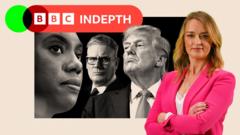
Rain slicked the black tarmac of the Downing Street garden, a dull, rhythmic drumming that seemed to mock the frantic whispers inside Number 10. Keir Starmer, a man whose entire political identity is built on the steady application of forensic logic, sat across from a whirlwind. Across the Atlantic, the gold-leafed reality of Mar-a-Lago was already recalibrating the world’s axis. Starmer had spent months carefully curating a relationship with Donald Trump, treating the former and future president like a volatile chemical compound that could either power a city or level a city block.
The strategy was simple: pragmatism over pride. While his own backbenchers threw verbal stones from the safety of the cheap seats, Starmer chose the path of the quiet dinner. He broke bread. He found common ground on security. He played the long game, hoping that a bit of early-season diplomacy would insulate the United Kingdom from the protectionist storms brewing in the Florida heat. For a different look, check out: this related article.
But the atmosphere has changed. The wind has shifted.
The problem with building a fence is that you eventually have to decide which side you are standing on when the fire starts. For the British Prime Minister, that fire is currently fueled by a binary choice that no amount of lawyerly nuance can resolve. On one side stands the "Special Relationship," a historical tether that remains the UK’s primary security blanket. On the other lies the European Union, a massive, regulatory behemoth that remains Britain’s largest trading partner and its most natural cultural ally. Similar coverage regarding this has been provided by NPR.
The High Cost of the Middle Ground
Imagine a small business owner in the Midlands. Let’s call him David. David manufactures specialized valves for aerospace engines. For David, "geopolitics" isn't a theory discussed over brandy; it is the price of stainless steel and the complexity of a customs form.
When Trump talks about a universal 10% or 20% tariff on all imports, David’s heart skips a beat. That tariff is the difference between a profitable quarter and laying off five engineers who have been with him since the 1990s. Starmer’s "stay on his good side" approach was supposed to be the shield that protected David. The hope was that a friendly relationship would earn the UK an exemption—a hall pass from the trade war.
However, the price of that hall pass is becoming clear. Trump doesn't give gifts; he makes trades. If the UK wants to be spared from the tariff wall, it will likely be asked to align its standards with Washington rather than Brussels. It will be asked to lower barriers for American agricultural products—chlorinated chicken, hormone-treated beef—and to distance itself from the EU’s stringent environmental and digital regulations.
This is the trap.
The moment Starmer leans toward the American regulatory orbit to appease Trump, he slams the door on any meaningful "re-set" with Europe. The EU has made it painfully clear: if you want easier trade across the English Channel, you must play by European rules. You cannot have a foot in both camps when the camps are moving in opposite directions.
The Ghost in the Room
Politics is often a theater of the ego, and Donald Trump is its most prolific director. Starmer, a man who treasures his reputation for being "the adult in the room," finds himself in a play where the script changes every five minutes.
The recent friction over the Chagos Islands and the vocal support from Trump’s inner circle for Nigel Farage has turned a diplomatic tightrope walk into a public gauntlet. It isn't just about trade anymore. It is about the perception of sovereignty. Every time Starmer makes a concession to keep the peace with the Trump administration, his critics at home smell blood. They see a leader who is being bullied, not a statesman who is being strategic.
Is it possible to be a bridge when the two sides don't want to meet?
The human element of this struggle is found in the exhaustion of the British civil service. These are the people tasked with writing two different versions of every trade proposal. They are the ones trying to find the "Goldilocks" zone—a magical middle path where the US stays happy and the EU stays open. But that zone is shrinking. It is a vanishingly thin line on a map that is being redrawn by populist fury on one side and bureaucratic rigidity on the other.
The Security Shield vs. The Economic Engine
There is a visceral fear that ripples through the Ministry of Defence when the topic of Trump and NATO arises. This is the invisible stake that haunts Starmer’s sleepless nights. If the US pulls back its umbrella, Britain is exposed in a way it hasn't been since the 1940s.
Starmer's decision to "keep Trump on side" was never really about a personal liking for the man. It was an act of national survival. If you believe the world is becoming a more dangerous place, you do whatever it takes to keep your strongest ally in the room. But what happens when that ally demands you sacrifice your economy to save your security?
Consider the dilemma of the tech sector in London. To appease a Trump administration focused on "America First" and aggressive stances against China, the UK may be forced to implement tech bans or investment restrictions that alienate Beijing—a move that could cost billions in capital. Simultaneously, if the UK mirrors US deregulation to stay in Trump’s favor, it loses the "equivalence" status required to provide financial services to the European market.
It is a pincer movement.
The Weight of the Handshake
Watching Starmer navigate this is like watching a grandmaster play chess while the board is vibrating. Every move intended to stabilize the relationship with the US causes a piece to fall over on the European side.
The irony is that Starmer’s greatest strength—his methodical, cautious nature—might be his greatest weakness in this specific arena. Trump values personal loyalty and grand, performative gestures. The EU values treaties, fine print, and collective consensus. Starmer is trying to offer both, and in doing so, he risks providing neither.
The human cost of this uncertainty is a paralysis in investment. Boards of directors don't like mysteries. They want to know if the UK is a satellite of the American economy or a distant moon of the European one. Until Starmer chooses, or until the choice is forced upon him by a sudden tariff or a collapsed treaty, the country remains in a state of suspended animation.
We often talk about "geopolitics" as if it’s a game of Risk played by giants. In reality, it is the sum of a thousand small anxieties. It is the researcher at a university wondering if their grant will vanish because of a change in international data-sharing rules. It is the farmer in Scotland wondering if they will be undercut by industrial American cattle farms. It is the voter in a "Red Wall" seat wondering if "Taking Back Control" meant handing the steering wheel to a billionaire in Palm Beach.
The Invisible Edge
There is a specific kind of silence that follows a gamble that hasn't paid off yet. Starmer has placed his chips on "Engagement." He has bet that he can be the one leader who manages to tame the storm through sheer, stubborn reasonableness.
But the storm doesn't care about reasonableness.
The pressure is mounting. The honeymoon period of the "Special Relationship 2.0" is over before the cake has even been cut. Every tweet from the Trump camp, every smirk from Nigel Farage, and every stern warning from Brussels chips away at the Prime Minister’s armor. He is learning, in real-time, that you cannot be a friend to everyone in a world that is rapidly dividing into "us" and "them."
The rain in London hasn't stopped. It just feels heavier.
Starmer stands at a window, looking out over a country that is tired of "interesting times." He knows that the next phone call from Washington could change everything. He knows that the next summit in Brussels could end the dream of a smooth Brexit repair.
The fence he has been sitting on is starting to splinter.
Eventually, the pain of staying still becomes greater than the fear of jumping. The only question left is which way he will fall, and who will be there to catch him when he does. The red tie he wears is a symbol of his party, but in the glaring neon light of the new American era, it looks less like a badge of office and more like a target.
The world is watching a man realize that in the high-stakes game of global power, sometimes the most dangerous thing you can be is "on side."