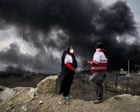
The security of global energy markets changed the moment explosions rattled the windows of Tehran and Jerusalem while a tanker burned off the coast of Dubai. This is not a localized skirmish but a fundamental breakdown in the maritime order that has governed the flow of oil and goods for decades. When a tanker is struck in the Strait of Hormuz, the immediate concern is the fire on deck, but the long-term damage is to the insurance premiums, shipping routes, and the very concept of "safe passage" in the Middle East. The simultaneous nature of these strikes across Iran, Israel, and the Persian Gulf indicates a level of coordination designed to test the limits of Western intervention and regional air defenses.
The Anatomy of a Multi Axis Strike
Modern warfare in the Middle East has moved past the era of conventional troop movements. What we are seeing now is a sophisticated application of asymmetric pressure. The attack on the tanker in Dubai serves as a clear signal to the global economy. By targeting a vessel in one of the world's most congested shipping lanes, the aggressors are effectively holding the world's energy supply hostage.
The explosions in Tehran and Jerusalem represent a different layer of this crisis. These are deep-territory strikes aimed at high-value infrastructure and psychological dominance. When air sirens go off in Jerusalem while Iranian capital defenses are being breached, the traditional deterrents have clearly failed. We are witnessing a cycle where every red line is crossed the moment it is drawn.
The Invisible Toll on Global Logistics
While the headlines focus on the flashes of fire, the real crisis is quietly unfolding in the boardrooms of shipping conglomerates and insurance firms. Every time a drone hits a hull, the cost of moving a barrel of oil increases. These aren't just incremental changes. These are seismic shifts in how trade is priced.
Ships are already beginning to divert. The detour around the Cape of Good Hope adds thousands of miles and weeks of travel time to voyages that used to take days through the Suez Canal. This delay ripples through the entire supply chain. It means higher prices at the pump in Europe and delayed manufacturing components in the United States. The logistics industry operates on razor-thin margins and precise timing. A single night of strikes in the Middle East can throw a year’s worth of planning into total disarray.
Hardware and Hubris
The technical reality of these strikes exposes a massive gap in current defense capabilities. For years, the narrative was that missile defense systems like the Iron Dome or the Aegis Combat System were impenetrable. Recent events suggest otherwise. Swarm tactics—using dozens of cheap, off-the-shelf drones to overwhelm expensive interceptors—have proven that cost-to-kill ratios are heavily skewed in favor of the attacker.
It costs a few thousand dollars to build a loitering munition. It costs millions to shoot one down. This math is unsustainable for any military, no matter how well-funded. In the strikes across Tehran and Jerusalem, the sheer volume of incoming projectiles meant that some were always going to get through. This isn't just a failure of technology; it’s a failure to adapt to the new reality of low-cost, high-impact warfare.
The Crude Reality of Energy Security
The Persian Gulf remains the world’s most sensitive nervous system. Even with the rise of American shale and the transition toward renewables, the world cannot function without the daily flow of 20 million barrels of oil through the Strait of Hormuz.
Investors are currently pricing in a "conflict premium," but that premium assumes the oil continues to flow eventually. If the strikes near Dubai lead to a sustained closure or even a "soft" blockade through prohibitive insurance rates, the price of crude will not just rise—it will break the back of the global recovery. We have seen this play out before during the "Tanker War" of the 1980s, but the technology today is far more lethal and the global economy far more integrated.
Intelligence Failures and the Fog of Proxy War
One of the most concerning aspects of this wave of strikes is the apparent blindness of regional intelligence agencies. Moving the hardware required for a coordinated attack across three different countries and a major body of water should, in theory, leave a significant digital and physical footprint.
The fact that these explosions occurred almost simultaneously suggests that the actors involved have mastered the art of "dark" communication. They are operating outside the traditional surveillance nets. This suggests a level of state-sponsored sophistication that goes beyond local militias. We are looking at a decentralized command structure where the orders are top-down but the execution is localized, making it nearly impossible to stop the next wave before it starts.
The End of the Status Quo
For the last decade, the Middle East has operated under a "shadow war" framework. There were unspoken rules. You could hit a warehouse, but not a capital. You could harass a ship, but not sink it. Those rules have been set on fire.
By striking the heart of Tehran and Jerusalem at the same time a tanker is burning, all parties have signaled that the era of restraint is over. This is a move toward total theater engagement. It forces every neighbor—Saudi Arabia, the UAE, Jordan—to pick a side or risk being caught in the crossfire. Neutrality is becoming an expensive luxury that few in the region can still afford.
Strategic Miscalculations and the Path Forward
The danger of this moment is the belief that these strikes can be "managed." There is a recurring delusion among political leaders that they can dial the tension up and down like a thermostat. History shows us that once the first missile is fired into a major city, the trajectory of the conflict is no longer in the hands of the politicians. It belongs to the commanders on the ground and the technical reliability of their equipment.
The burning tanker off Dubai is a physical manifestation of a broken international system. If the maritime lanes are no longer protected by international law, they will be governed by whoever has the most drones. This is the brutal truth of the current crisis. We are moving into a period where the stability of the global economy depends on the split-second decisions of a few radar operators and the erratic intentions of regional power players.
Companies must now plan for a world where the Middle East is not just a volatile region, but a persistent no-go zone for predictable trade. This means diversifying supply chains away from the Gulf and investing in localized energy production at a pace that was previously considered unnecessary. The explosions in Tehran and Jerusalem weren't just attacks; they were the starting gun for a new, much more dangerous era of global instability.
Direct intervention is the only remaining card for the West, but it is a card that comes with the risk of a regional conflagration that no one is prepared to fund or fight. Security is no longer a given. It is a commodity that just became significantly more expensive.