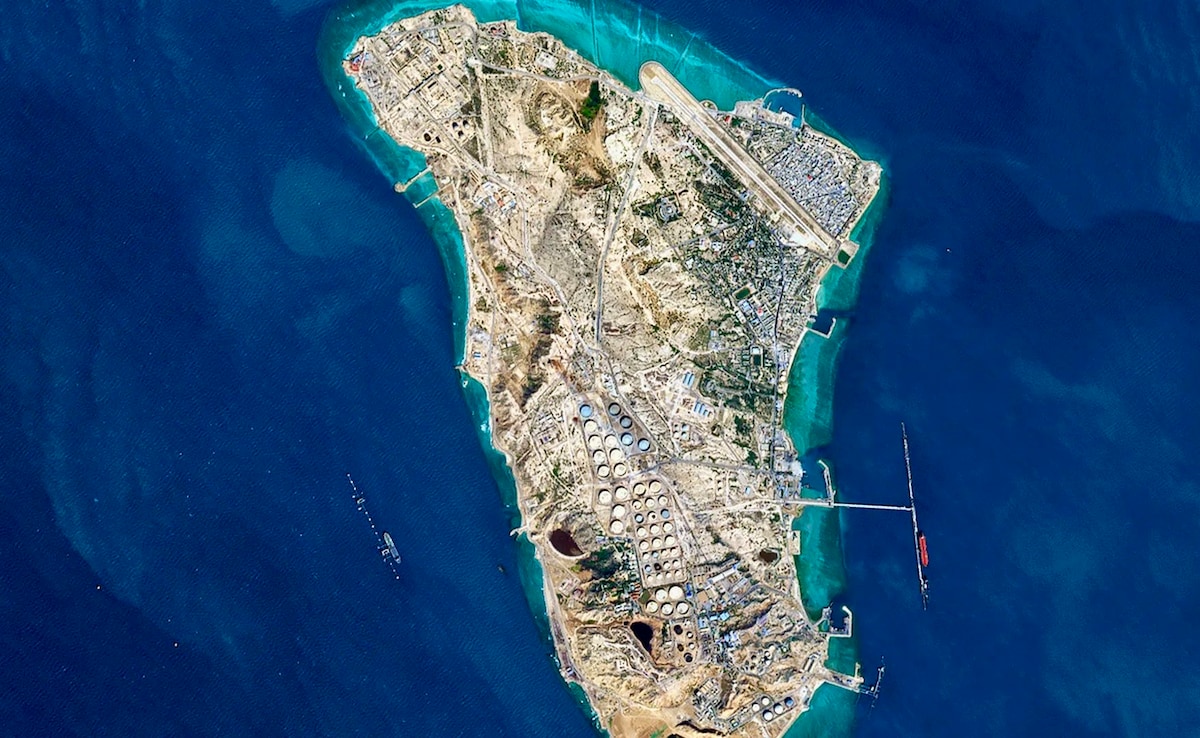
Imagine a rock. It is barely eight miles long. It sits in the turquoise expanse of the Persian Gulf, looking more like a sun-bleached bone than a fortress. This is Kharg Island. To the casual observer or the satellite lens, it is an industrial terminal, a maze of pipes and storage tanks that bleed the black wealth of a nation into the bellies of passing tankers. But for a young sailor on a U.S. destroyer, Kharg is not a point on a map. It is a ghost.
The conversation in Washington often treats Kharg Island as a strategic "target," a box to be checked in the event of an escalation. Policy papers speak of it in the clinical language of economic leverage and regional containment. They calculate the barrels of crude lost. They estimate the shock to global markets. What they often fail to mention is the specific, terrifying reality of the water between the mainland and that bone-white shore.
Steel meets salt. The humidity is a physical weight, slicking the skin and fogging the glass of high-tech optics. If the order ever came to move against this outcrop, the mission would not look like a clean, cinematic strike. It would be a slow, agonizing crawl through a graveyard that hasn't been filled yet.
The Invisible Swarm
Modern warfare has a way of making the expensive feel fragile. Consider a hypothetical scenario: a billion-dollar Arleigh Burke-class destroyer, a masterpiece of engineering, slicing through the Gulf. It is protected by the most sophisticated radar on the planet. Yet, the primary threat to this vessel wouldn't be a rival battleship or a screaming jet. It would be something that costs less than the destroyer’s daily fuel budget.
Iran has spent decades perfecting the art of the "mosquito fleet." These are small, fast, and often unmanned boats. Some are guided by remote operators tucked away in coastal bunkers; others are packed with high explosives and programmed to find a hull. In the narrow, congested waters surrounding Kharg Island, these drones don't need to be invisible. They just need to be many.
One drone is a nuisance. Ten is a problem. Fifty is a nightmare.
This is the "asymmetric" reality that military planners whisper about when the cameras are off. To take or neutralize Kharg Island, U.S. forces would have to operate in a literal "kill zone" of loitering munitions. These are essentially flying or floating grenades that wait. They hover. They watch. When they strike, they don't aim for the thickest armor; they aim for the sensors, the flight decks, and the human spaces.
The Floor of the Gulf
If the sky is full of buzzing threats, the water beneath is a silent, static terror. The Persian Gulf is shallow. In many places, it’s less than 100 feet deep. This isn't the open Atlantic where a submarine can hide in the depths. Here, the seafloor is close enough to touch, and it is littered with mines.
We often think of mines as relics of World War II—rusty spheres with spikes bobbing on the surface. That version is long gone. Today’s sea mines are "smart." They sit on the bottom, camouflaged by silt and time. They don't just explode when something hits them. They listen. They are programmed to recognize the specific acoustic signature of a specific type of engine. They wait for the heavy thrum of a transport ship or the unique vibration of a minesweeper.
For a Marine tasked with an amphibious approach to Kharg, the water is a minefield of "acoustic triggers" and "magnetic influence" sensors. You cannot see them. You cannot easily jam them. You simply have to hope that the path cleared by the lead ship was truly clear. It is a game of Russian Roulette played with a thousand chambers.
The psychological toll of this environment is immense. On a ship, there is nowhere to run. If a mine detonates beneath the hull, the ship doesn't just take damage; it becomes a trap. The steel flexes, the lights go out, and the sea rushes in.
The Human Cost of Oil and Iron
Behind every "strategic objective" is a person. There is a technician on Kharg Island who knows exactly which valve to turn to create an environmental catastrophe that would choke the Gulf for a generation. There is a drone pilot on the Iranian coast who grew up playing video games and now holds a joystick that could end a hundred lives. And there is the American sailor, perhaps twenty years old, standing watch in a heat so intense it feels like breathing through a wet towel.
To take Kharg Island is to engage with a cornered adversary in their own backyard. It is not just about the "drones and mines" mentioned in the briefings. It is about the geography of desperation.
The island itself is a fortress of industrial complexity. It isn't just a beach to be stormed; it is a sprawling chemical plant. One stray shell, one misplaced drone strike, and the mission turns from a tactical seizure into a humanitarian and ecological disaster. The black smoke from burning crude would blot out the sun for weeks. The "stakes" aren't just numbers on a screen at the New York Stock Exchange. They are the lungs of the people living downwind.
The Illusion of a Clean War
We have become accustomed to the idea of "surgical strikes" and "precision engagement." We like to believe that technology has moved us past the meat-grinder battles of the 20th century. But Kharg Island is a reminder that some places on earth defy precision.
The Persian Gulf is a crowded room. There are civilian tankers, fishing dhows, and commercial flights crossing overhead at all times. In the chaos of an operation against Kharg, the "fog of war" isn't a metaphor. It is a literal cloud of confusion where a drone might mistake a merchant vessel for a warship, or a defensive battery might lock onto a target that isn't a combatant.
The risk to U.S. troops isn't just the hardware of the enemy. It is the environment itself. The heat causes equipment to fail. The salt corrodes the very tech meant to keep the sailors safe. The narrow channels mean that a single sunken ship could block the entire "highway," turning a tactical retreat into a slaughter.
Military experts point to the "Strait of Hormuz" as the ultimate chokepoint, but Kharg is the plug in the center of the bottle. Taking it doesn't just require force; it requires a willingness to lose things that cannot be replaced. We talk about "projecting power," but in the waters around Kharg, power is projected at the tip of a very short, very sharp knife.
The Quiet Before the Surge
There is a specific kind of silence that happens at sea just before dawn. The wind drops, and the water becomes a sheet of dark glass. In that silence, if you are close enough to the coast, you might hear the faint hum of a distant engine—a small boat, perhaps, or a drone patrolling the perimeter.
It is a reminder that the "security" of the world's energy supply rests on a foundation of incredible fragility. We drive our cars and heat our homes, largely oblivious to the fact that the lifeblood of our economy passes within a stone's throw of these bone-white islands and their silent guardians.
If the day ever comes when the "ghost" of Kharg Island becomes a target, the world will watch the high-definition feeds of the first strikes. We will see the explosions and the maps. But we won't see the sweat on the brow of the sonar technician listening for the click of a mine. We won't feel the shudder of the hull as a swarm of drones closes the distance.
The true story of Kharg Island isn't written in the oil it produces or the missiles that threaten it. It is written in the heartbeat of those sent to hold the line in a place where the sea itself is a weapon. The bone-white rock remains, indifferent to the empires that eye it, waiting for the next ship to brave the red anchor of the Gulf.