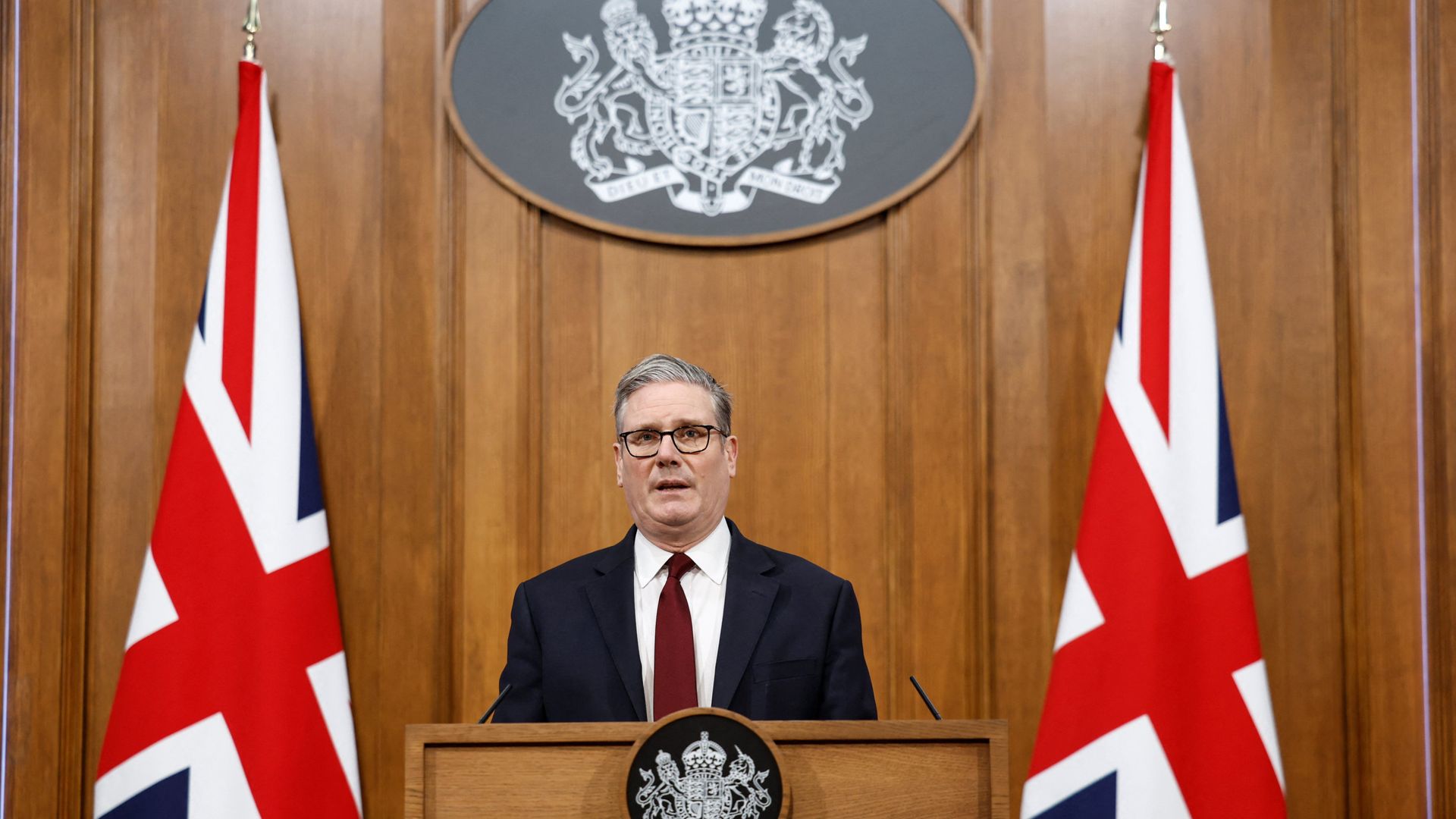
While the White House demands total loyalty and the Strait of Hormuz remains a graveyard for global shipping, Keir Starmer is playing a high-stakes game of strategic patience. The British public is sharply divided over his refusal to join the American offensive against Iran, but the Prime Minister's calculation goes beyond mere polling. He is attempting to decouple British foreign policy from a Washington administration that many in Whitehall fear has no exit strategy.
In the three weeks since the United States and Israel launched the first strikes on February 28, 2026, the Middle East has spiraled into a conflict that has already claimed tens of thousands of lives and sent oil prices into a vertical climb. Starmer’s refusal to allow the US to use British bases like Diego Garcia for offensive sorties was the first major fracture in the "Special Relationship" since the Iraq War. It was a move that earned him the public ire of Donald Trump, who famously remarked that Starmer is "not Winston Churchill." Recently making news in this space: The Kinetic Deficit Dynamics of Pakistan Afghanistan Cross Border Conflict.
The Strategic Schism
The disagreement is not about whether the Iranian regime is a threat. No one in 10 Downing Street disputes that Tehran’s nuclear aspirations and regional proxies are a menace to global stability. The friction lies in the execution. Starmer has grounded his position in a "calm, level-headed assessment of the British national interest," a phrase he has used repeatedly to distance himself from what he views as an impulsive American campaign.
Unlike the 2003 invasion of Iraq, where the UK followed the US into a "regime change" mission without a viable post-war plan, the current British government is demanding a legal framework and a clear diplomatic endgame before committing a single soldier to offensive operations. Additional insights regarding the matter are detailed by USA Today.
- Defensive Only: The UK has deployed three fighter jet squadrons and counter-drone teams to Cyprus, but their mission is strictly limited to intercepting Iranian missiles and drones targeting allies or British interests.
- The Hormuz Crisis: While Trump has demanded the Royal Navy help clear the Strait of Hormuz, the UK is instead floating the idea of aerial mine-hunting drones. This is a deliberate attempt to provide a technical solution to a military problem without escalating to a full naval engagement.
- The Ukraine Factor: Starmer is privately terrified that a prolonged war in the Middle East will drain Western resources away from Kyiv. He has explicitly warned that the conflict must not become a "windfall for Putin."
A Nation Split by Experience
Public opinion reflects a country haunted by the ghosts of the early 2000s. Recent data suggests that while 46% of voters support a "purely defensive" role for the UK military, only a tiny fraction—roughly 6%—support joining the US in offensive strikes. This is not a pacifist stance; it is a skeptical one.
The economic reality is hitting home faster than the military one. With oil costs surging, Starmer has had to announce emergency support for households reliant on heating oil. For many Britons, the "handling" of the war is measured not in tactical victories, but in the price of a tank of petrol or a monthly energy bill.
The Legal Tightrope
The Prime Minister's background as a human rights lawyer is more than just a biographical detail; it is the blueprint for his current strategy. He has insisted that any British involvement must have a "proper, thought-through plan" and a firm legal basis. This is a direct rebuke to the US approach, which London sees as operating outside the bounds of international consensus.
By refusing to join the offensive, Starmer is betting that the UK can act as a bridge between a volatile Washington and a cautious Europe. Germany and France have similarly balked at a NATO-led mission in the Gulf, preferring a "coalition of partners" that avoids the optics of a Western crusade against an Islamic power.
The Cost of Defiance
The risk for Starmer is isolation. If the US-led strikes succeed in rapidly toppling the regime in Tehran, the UK will find itself with zero leverage in the resulting power vacuum. Conversely, if the war drags into a multi-year quagmire, the British economy could be strangled by high energy costs regardless of whether its jets are dropping bombs or just patrolling the Mediterranean.
The "Special Relationship" is currently being tested in a way it hasn't been in decades. It is no longer a given that London will provide the diplomatic and military cover for American interventionism. Starmer is gambling that by saying "no" today, he is protecting Britain's ability to say "yes" to a more stable, negotiated future tomorrow.
There is no easy path out of this. The Strait remains closed, the missiles are still flying, and the British public remains unconvinced that their government has the power to change the outcome. Starmer has chosen his hill; now he has to survive the bombardment.
If you are a British national currently in the Middle East, the Foreign, Commonwealth & Development Office (FCDO) advises you to register your presence immediately to receive the latest security updates and support.