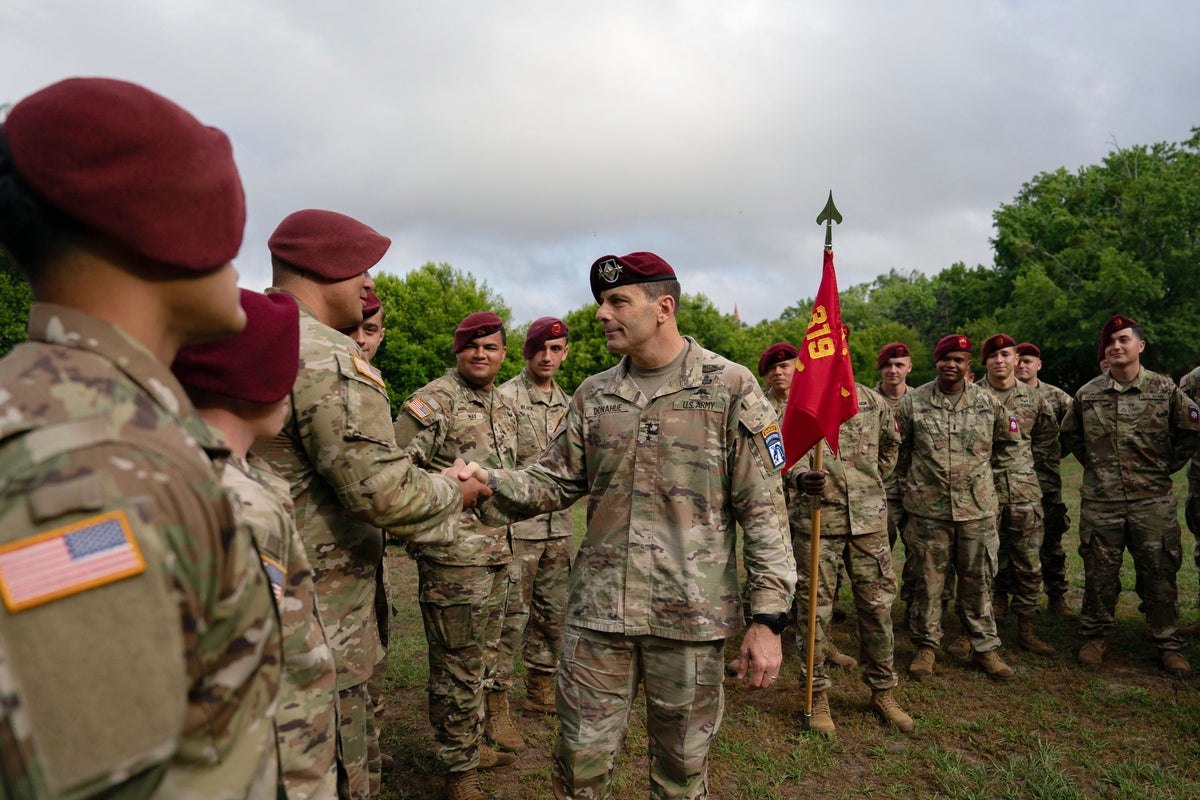
The Pentagon is currently drafting plans to deploy approximately 3,000 ground troops from the 82nd Airborne Division and elite Marine Expeditionary Units into the Iranian theater, a move that would shift the current conflict from a high-altitude bombing campaign to a messy, boots-on-the-ground occupation. At the center of this strategic pivot is Kharg Island, a scrub-covered rock in the Persian Gulf that functions as the literal cash register for the Iranian state. While President Trump has publicly oscillated between "winding down" the war and "doing whatever is necessary," the internal mechanics of Operation Epic Fury suggest the military is preparing for a "seize and hold" mission designed to break the stalemate over the Strait of Hormuz.
The objective is simple: by physically occupying the terminal that handles 90% of Iran’s crude exports, the U.S. gains a "by the balls" leverage point that three weeks of aerial bombardment has failed to provide.
The Kharg Island Gamble
For twenty-four days, the U.S.-Israeli coalition has dominated the skies. The Iranian Navy has been largely neutralized, and the Supreme Leader’s air defenses are in tatters. Yet, the Strait of Hormuz remains effectively closed, choked by mines and the threat of asymmetrical "swarm" attacks from the Iranian coastline. Global oil prices have breached $110 per barrel, and the political clock is ticking.
Military planners are no longer satisfied with "degrading" targets from 30,000 feet. The proposal to send in the 82nd Airborne’s Immediate Response Force—a brigade capable of landing within 18 hours—represents a fundamental shift in risk tolerance. The logic is that if you control the spigot at Kharg, you control the regime’s ability to survive the month.
However, the "why" goes deeper than just oil flow. Internal memos and discussions among defense officials indicate a desire to replicate the "Venezuela Model." Following the capture of Nicolás Maduro in 2024, the administration saw how physical control over energy assets could force a regime to cooperate without the need for a total, nationwide occupation. Kharg is the Iranian equivalent of a strategic jugular.
Logistics of an Island Invasion
Taking a fortified island is not a surgical strike; it is a meat-grinder operation. Despite the Pentagon’s confidence, Kharg is roughly 15 miles off the Iranian coast, well within range of mobile shore-to-ship missiles and drone batteries that have survived the initial waves of Epic Fury.
The current plan under review involves a two-stage assault:
- The Marine Vanguard: Roughly 2,500 troops from the 31st Marine Expeditionary Unit, currently diverted from the Pacific, would lead the initial amphibious assault. Their combat engineers are tasked with the immediate repair of the island’s damaged airfield to allow for heavy transport.
- The Airborne Reinforcement: Once the perimeter is established, the 82nd Airborne would drop in to provide the "mass" needed to hold the island against inevitable counter-attacks from the mainland.
There is a significant hurdle. If the U.S. seizes the island, it becomes a stationary target. Retired Rear Admiral Mark Montgomery and other analysts have pointed out that seizing the export terminal doesn't actually mean the U.S. can "restart" the oil flow. The pipelines start on the mainland. If Tehran turns off the pumps at the source, the U.S. is left holding a multi-billion dollar piece of infrastructure that exports nothing but American casualties.
The Disconnect in the Chain of Command
There is a glaring discrepancy between the White House’s rhetoric and the Pentagon’s movement. On March 19, President Trump told reporters, "I’m not putting troops anywhere." Less than 48 hours later, the USS Boxer and the USS Tripoli groups were confirmed to be steaming toward the Gulf with thousands of Marines aboard.
This suggests one of two things: either the President is engaged in a massive disinformation campaign to keep Tehran off-balance, or the Defense Department is moving pieces into place for a contingency the Commander-in-Chief hasn't fully signed off on yet. Secretary of Defense Pete Hegseth has remained tight-lipped, focusing on the "annihilation" of Iranian naval assets, but the preparation of the 82nd Airborne’s headquarters staff for deployment tells a different story. You don’t move a division headquarters just to supervise more airstrikes.
Risks of Horizontal Escalation
The Iranian response to a ground seizure would likely be "horizontal," meaning they will look for soft targets elsewhere to balance the scales. We have already seen this pattern. Since the war began on February 28, Iranian-aligned groups have targeted U.S. interests in Qatar, Bahrain, and the UAE.
A ground invasion of Kharg Island would be viewed by Tehran as an existential threat, likely triggering the "scorched earth" protocols they have threatened for decades. This includes the destruction of Saudi and Emirati desalination plants or further mining of the Bab al-Mandab strait.
The U.S. is betting that the Iranian regime is too fractured following the death of Ali Khamenei to mount a coordinated response. With Mojtaba Khamenei struggling to consolidate power amidst internal protests, the Pentagon sees a window of opportunity. It is a gamble that assumes the "cash register" is more important to the IRGC than their ideology.
The Brutal Reality of the Off-Ramp
Trump has recently mentioned looking for an "off-ramp," but in military terms, an off-ramp usually requires a position of overwhelming strength. Seizing Kharg Island is intended to be that position. The goal isn't to start a ten-year occupation of Iran, but to hold the country’s economy hostage until a new, "cooperative" leadership emerges in Tehran.
The problem with "limited" ground operations is that they rarely stay limited. Once American soldiers are on Iranian soil—even an island 15 miles offshore—the political cost of withdrawal without a "total victory" becomes an impossible pill for any administration to swallow.
The 3,000 troops currently being weighed for this mission are not just security guards for oil piers. They are the potential tripwire for a much larger, much longer ground war that the American public was told would never happen. As the ships get closer to the Gulf, the distinction between "protecting shipping" and "invading a sovereign nation" is disappearing.
Would you like me to analyze the projected impact of a Kharg Island seizure on global Brent Crude prices over the next quarter?