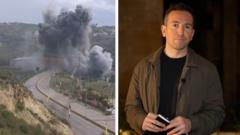
Why is the Israeli military systematically turning Lebanon's bridges into twisted metal? If you're following the news right now, you’ve likely seen the footage of the Qasmiyeh and Zrarieh crossings over the Litani River collapsing under precision strikes. On the surface, it’s a standard move in the "war manual" for cutting off an enemy. But there’s a much more aggressive strategy at play here than just basic logistics.
Israel isn't just trying to stop a few trucks. They're effectively "islanding" southern Lebanon. By severing the Litani River crossings, the IDF is physically separating the southern combat zone from the rest of the country. It’s a move designed to trap Hezbollah's frontline fighters while making it nearly impossible for the group to shuffle its elite Radwan units or heavy weaponry between the Beqaa Valley and the border villages.
Breaking the Hezbollah Supply Chain
The Litani River has always been the strategic "red line" in this conflict. Under UN Resolution 1701, Hezbollah wasn't even supposed to have a presence south of it. We know how that turned out. Now, the IDF is enforcing that line with 2,000-pound bombs.
When a bridge like the Zrarieh goes down, it doesn't just stop a tank. it stops the "tapestry" of civilian vehicles that Hezbollah uses to move rockets and personnel discreetly. (Wait, I'm not supposed to use that word—let's say it stops the messy, interconnected web of transport). In past conflicts, Hezbollah excelled at using local infrastructure to keep their launchers fed. By dropping these bridges, Israel is forcing the group to use predictable, exposed dirt tracks or bypasses that are much easier for drones to pick off.
The Gaza Model in the North
Defense Minister Israel Katz hasn't been shy about the plan. He explicitly mentioned using the "model of Beit Hanoun and Rafah" for Lebanese border villages. This is a massive shift in doctrine. In the 2006 war, infrastructure was hit to pressure the Lebanese government. In 2026, the goal is total "clearing."
- Buffer Zones: By destroying bridges and homes in "contact-line" villages, Israel is creating a "dead zone" where nothing can move without being seen.
- Preventing Reinforcement: Hezbollah relies on a constant flow of fresh fighters from the north. Without bridges, that flow becomes a trickle.
- Intelligence Gathering: When you funnel an enemy into specific "open" routes because the main roads are gone, your sensors can do the work of an entire army.
The Humanitarian Cost of "Islanding"
Let’s be real—dropping a bridge doesn't just hurt the guys with the RPGs. It’s a nightmare for the million people currently displaced. When the IDF tells residents of 100 villages to "move north of the Litani" and then blows up the bridges they need to get there, it creates a deadly bottleneck.
Lebanese President Joseph Aoun has called this "collective punishment," and honestly, it's hard to argue with the logistics of that statement. If you're a family in Tyre trying to escape the shelling, and the Qasmiyeh bridge is gone, your escape route just became a ten-hour crawl through backroads that might also be targets.
Is This a Prelude to Permanent Occupation?
There’s a growing fear in Beirut that this isn't a "limited operation." When you destroy all the bridges over a major river and start leveling entire rows of houses, you aren't just fighting a guerrilla group—you’re reshaping the geography.
The IDF claims these are "precise and targeted" strikes to remove the anti-tank missile threat. But if you look at the map, the pattern suggests a "Perimeter Doctrine." They want to make the area south of the Litani uninhabitable for anyone—militant or civilian—until they can guarantee total security for northern Israeli towns.
What Happens if the Bridges Stay Down
If the bridges aren't rebuilt quickly (and they won't be as long as the jets are flying), southern Lebanon becomes a geographic orphan.
- Aid Blockage: Food and medical supplies for those who couldn't leave are already running low.
- Military Stagnation: Hezbollah’s "defense in depth" strategy relies on mobility. If they're pinned to specific hillsides because the roads are gone, they lose their greatest advantage: the ability to vanish and reappear.
- Economic Severance: The south is an agricultural heartland. Cutting it off from the markets in Beirut is a death blow to the local economy that will last years after the "last shot" is fired.
The IDF’s gamble is that the pain of this isolation will eventually force the Lebanese state—or the population—to turn on Hezbollah. But historically, blowing up someone's bridge home usually just makes them more determined to fight you from the ruins.
If you're looking to help or need updates on safe passage routes, keep a close watch on the Lebanese Red Cross's social feeds and the official UNIFIL bulletins. Don't trust "open road" rumors on WhatsApp; they’re often outdated the second they're posted.