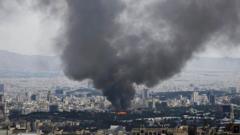
The smoke rising over Tehran and the centrifuge halls of Natanz is the final, predictable answer to a diplomatic charade that was never designed to succeed. On February 28, 2026, the United States and Israel launched coordinated military strikes—dubbed Operations Epic Fury and Roaring Lion—effectively ending months of shadow-boxing in Geneva and Muscat. While the world watched negotiators like Steve Witkoff and Abbas Araghchi trade optimistic soundbites about "significant progress," the reality on the ground was a massive American military buildup that made conflict an inevitability.
This was not a failure of diplomacy. It was a calculated transition from "maximum pressure" to "strategic submission." For the Trump administration, the talks were a tactical delay, a way to exhaust the clock while Iran’s internal stability crumbled under the weight of nationwide protests and a brutal security crackdown that has reportedly claimed over 30,000 lives. Washington didn't want a deal; it wanted a surrender. When Tehran refused to ship its enriched uranium to the U.S. and dismantle its hardened underground facilities at Fordow and Esfahan, the missiles were already programmed.
The Illusion of the Geneva Breakthrough
Just forty-eight hours before the strikes, Omani mediators were still briefing the press on a "technical breakthrough" scheduled for Vienna. This was a ghost. The gap between the two sides was never a matter of percentages or inspection protocols; it was an existential divide.
The U.S. demand was total: zero enrichment, the destruction of all nuclear infrastructure, and a permanent ban on ballistic missile development. Iran’s counter-offer—a "token enrichment" at one percent for medical purposes—was dead on arrival in a White House that views any Iranian centrifuge as a ticking clock.
The strategy was clear. By engaging in talks, the Trump administration provided a veneer of diplomatic effort that satisfied regional allies like Qatar and Oman, while simultaneously positioning two carrier strike groups, including the USS Gerald R. Ford, within striking distance. It was the ultimate "peace through strength" gambit, where the "peace" was merely the silence before the first wave of B-2 bombers.
A Regime Under Siege from Within
What the competitor headlines missed was the crucial link between the streets of Iran and the bunkers of the IRGC. The 2026 crisis is unique because it is the first time Washington has explicitly tied a nuclear ultimatum to domestic repression.
Since the protests ignited in late 2025, the Iranian government has faced a "fragile state" scenario. The economy is in a state of total collapse, and the communications blackouts have failed to stop the flow of information to the West. President Trump’s rhetoric shifted from nuclear technicalities to a direct call for the Iranian people to "take over your government."
This wasn't just about uranium. The strikes targeted not only nuclear sites but also the command-and-control infrastructure used to suppress the uprising. By hitting the regime’s "internal security" assets, the U.S. and Israel are betting that the military operation will serve as a catalyst for a domestic rupture.
The Technological Toll of Epic Fury
The sheer scale of the February 28 operation suggests a level of intelligence penetration that goes far beyond traditional satellite imagery. Reports indicate that "high-value regime targets" were struck with surgical precision, including a reported hit on a location where Supreme Leader Ali Khamenei was believed to be sheltered.
The military reality is stark.
- Targeting Logic: The U.S. didn't just hit the "roofs" of nuclear sites; they used advanced bunker-busters to reach the deep-earth facilities that were thought to be invulnerable after the 2025 skirmishes.
- Cyber Integration: Sources suggest that Iran’s air defense systems were blinded by a massive, preemptive cyber strike, allowing Israeli and U.S. jets to operate with near-impunity over sensitive airspace.
- Regional Fallout: In a desperate bid for deterrence, Iran launched ballistic missiles at U.S. bases and partner states, including Kuwait, the UAE, and Jordan. This escalation has effectively neutralized the "neutral" status of Gulf mediators, forcing a regional alignment against Tehran.
The High Cost of the "Big Win"
Critics argue that by striking during active negotiations, the U.S. has burned the bridge of diplomacy for a generation. If the goal was to prevent a nuclear-armed Iran, the physical destruction of the facilities may buy time, but it also provides the ultimate justification for the regime—or whatever succeeds it—to go clandestine.
Furthermore, the U.S. military itself has warned of the "depletion" of weapons stocks. A sustained, weeks-long operation against a country of 85 million people is not a "surgical strike." It is a war of attrition. The administration's gamble rests on the hope that the Iranian military will crack from within before the American public loses patience with another Middle Eastern entanglement.
The talks in Geneva were the final act of a play where the ending was written months ago. The transition from the negotiating table to "major combat operations" was not a pivot; it was the plan. As the 7-day national holiday in Iran begins—not for celebration, but for mourning—the region faces a vacuum that no amount of precision-guided munitions can fill.
The era of "managing" the Iranian threat is over. The era of forced transformation has begun.
Would you like me to analyze the specific economic impact of the new 25% tariffs Trump has proposed for any country still trading with the post-strike Iranian entities?